What up, kiddos! Got a really cool notification the other day – AT Reviewed has surpassed 500K overall views! That’s really astounding to me – this started as a small project that I wasn’t even sure I’d get that far on, and snowballed into something that people seem to dig. So a few new updates – for one, it’s about time I got rid of those pesky, tiresome dermatologist ads that pop up after every paragraph, so no more intrusions in your reading experience! I also bought the domain, which should hopefully make it a lot easier to access the site.
Since there’s probably some lag time between seasons, I wanted to start a new little project. The new season brought a lot of new faces to the table, and while these fresh new voices helped to breathe new life into the AT world, it did make me miss the original team and how much I had become invested in their unique styles. That’s not to say that the new team doesn’t have their own voice, but it became much easier to detect the style of AT‘s alumni primarily because they had so many opportunities to showcase it in the course of nearly 300 episodes. And personally, part of the reason I wanted to start this blog was to highlight those individuals touches.
It remains very, very cool to me how Adventure Time brought together indie artists that mostly didn’t have a ton of professional experience or a style that seemed to mesh with the current landscape of children’s entertainment and unified those sensibilities to make way for something completely unique. So I wanted to pay tribute to that crew by doing this little Artist Spotlight series. As always, I have no idea how many of these I’ll realistically tackle over a period of time, and if there’s new AT content, those reviews will take priority. And as much as I’m inclined to talk, I’ll try to keep commentary relatively light. I want this to be more about celebrating the work of each artist (in a, by no means, comprehensive way) rather than to analyze writing or art style. But there’ll be a little bit of that too. First up is my personal favorite board artist, Tom Herpich!
Art Style
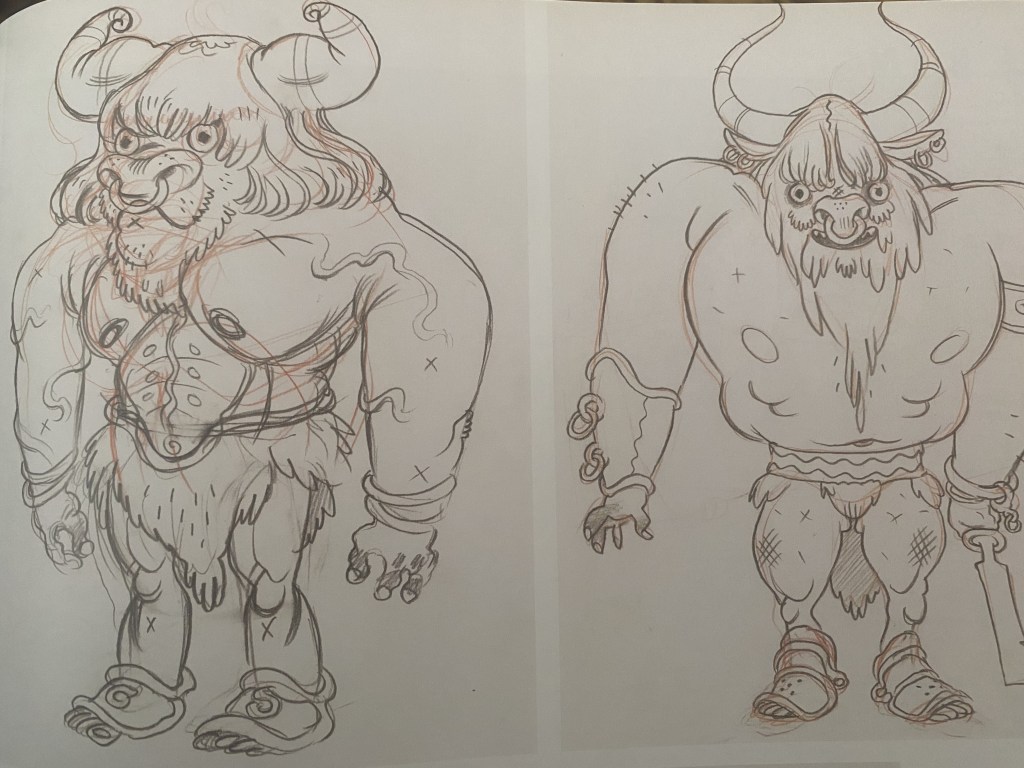
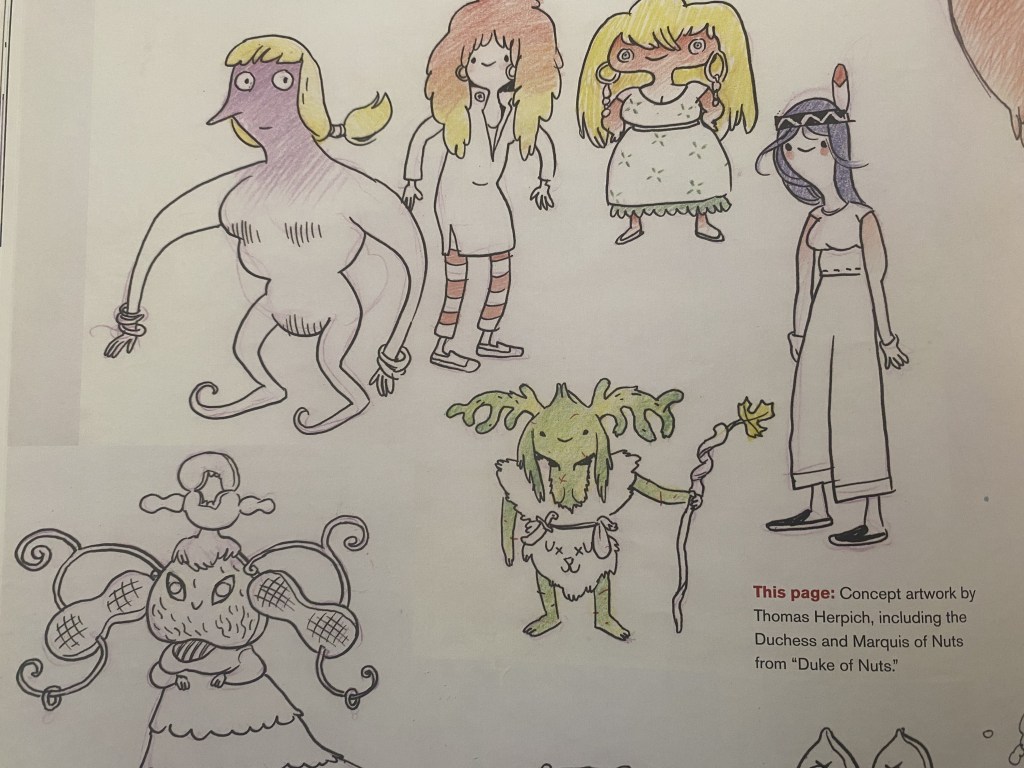
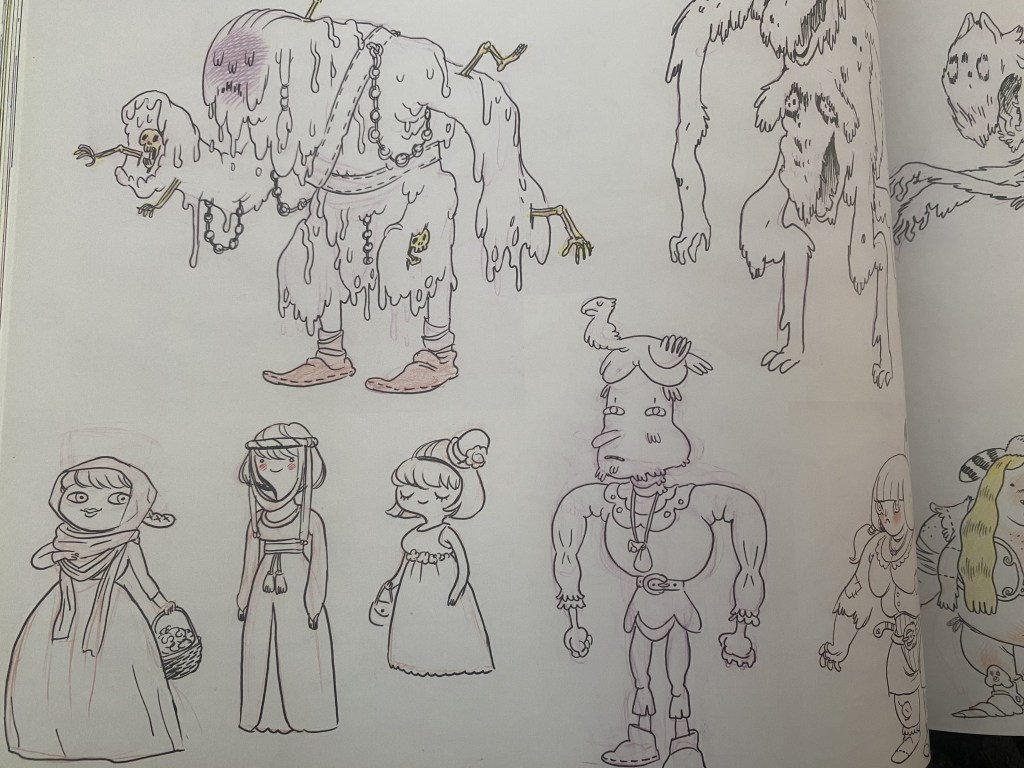
Herpich is one of the more detail-oriented artists working on the series. He often draws humanoids and beasts with various complex pieces of armor, clothing, accessories, etc. He also has a really solid combination of contrasting styles: body proportions are very detailed and close to human anatomy, while other features, like the eyes, nose, mouth are exaggerated and cartoonish. His style of writing is very much in the same vein – overly goofy humor wise but with a realistic sense of darkness in dramatic moments. Like most of the other artists, it becomes very apparent in seeing his own sensibilities bleed through from both a visual and tonal perspective.
Character Design
That love for detail really comes out in his character design work. Herpich started out as a character designer and would originally make designs overly complex in a way that didn’t really translate to the mostly simplistic style of the series. In an interview from the Art of Ooo book, in reference to Mannish Man’s initial designs, Herpich states, “I didn’t realize at the time that all this stuff was impossibly complicated, plus strayed so far from the original storyboard drawings that it would’ve all had to be reboarded to use these designs.” It’s interesting to see how the series shaped Herpich’s artwork while also seeing how his style has influenced the designs of monsters and magical entities.
Finn & Friends
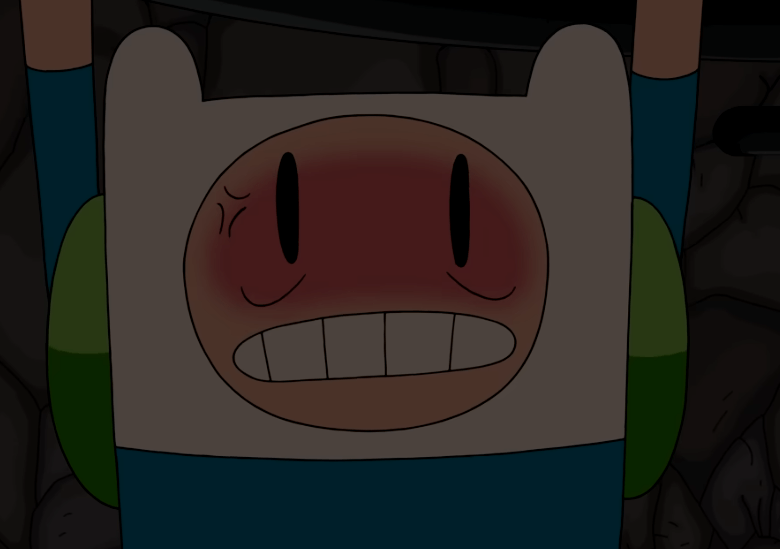
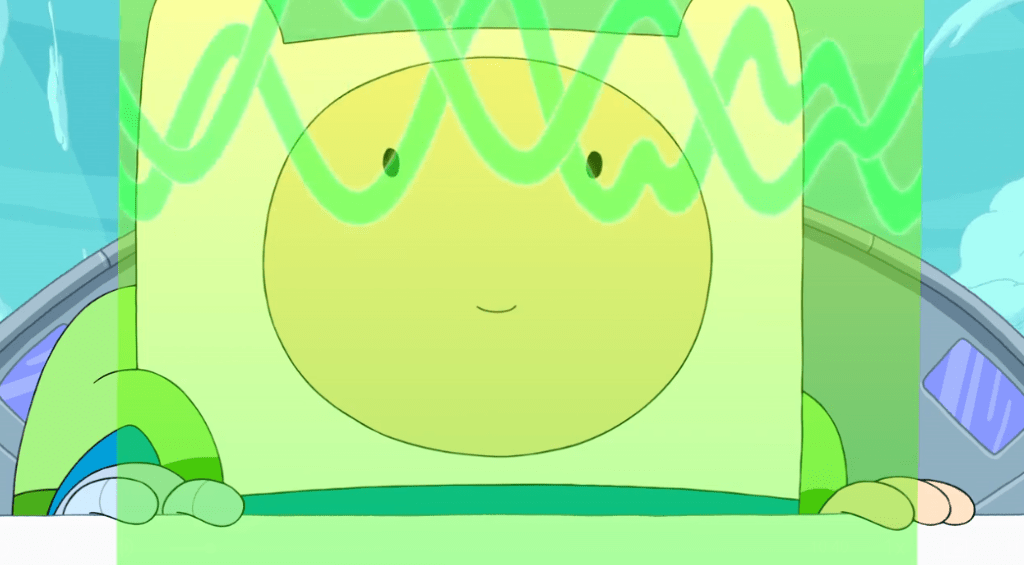
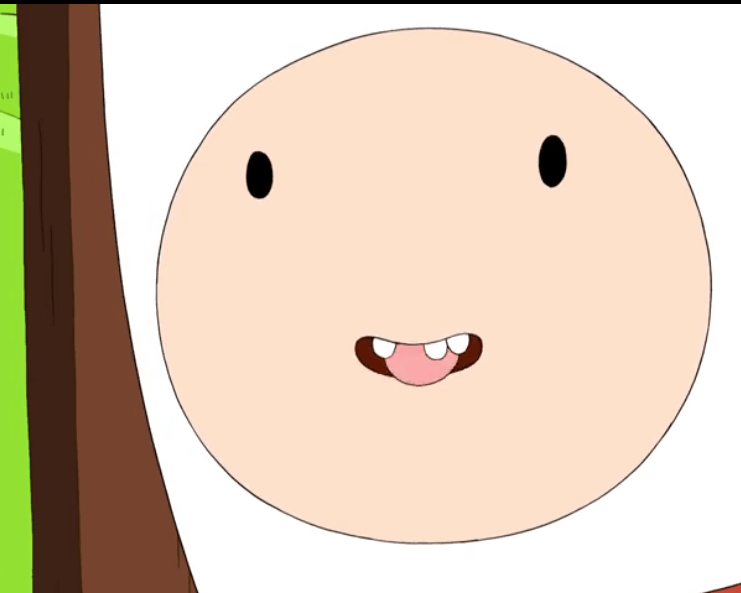
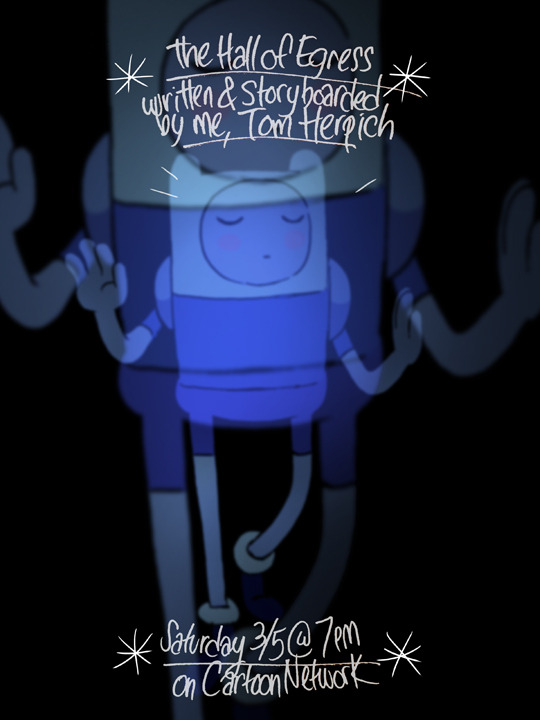
Herpich’s Finn is most distinctive in his more oval-than-round eyes and the far distance apart from the mouth, as well is very round and large teeth. Sometimes Finn has a full top row of teeth with Herpich! He loves to draw exaggerated expressions with Finn’s teeth and mouth, seen in the top two rows (this type of grimace is Herpich’s specialty). It’s easier to notice his style in full force from season five onwards, but the oval eyes are always a dead giveaway, as seen in the bottom left still from Go With Me. Similar to the tone I was discussing above, Herpich has a very dualistic approach to Finn’s character. He’s often at his dumbest and goofiest from Herpich’s perspective, but also prone to his inquisitive, as seen in episodes like The Visitor, Hallf of Egress, and The Tower.
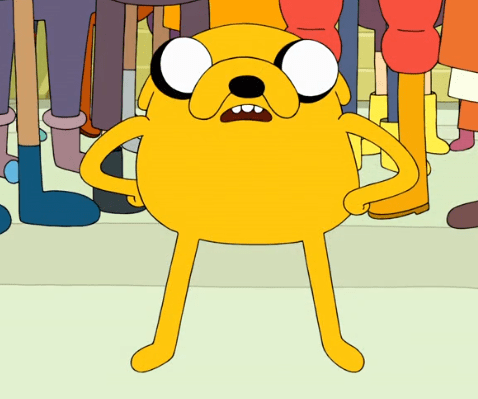
The oval eyes occasionally find their way into Jake’s design, though more recognizably are peaking over the top of his head. Herpich is also one of the few board artists that consistently draws Jake with two ears present, even within the standard 3/4 perspective. Herpich’s characterization of Jake is a bit less pronounced than his partner Steve Wolfhard’s is, with Herpich seeming to excel more within Finn solo journeys.
Some other examples of scenes and characters that were boarded by Herpich. A lot of his hallmarks can be seen across multiple characters: oval eyes, large, rounded teeth, mouths that are very distant from the eyes, eye blushing, and the oval-shaped grimace I mentioned above. Herpich will also sneak his desires for more detailed human anatomy in, as seen in the top left screenshot of Martin.
Promo Art
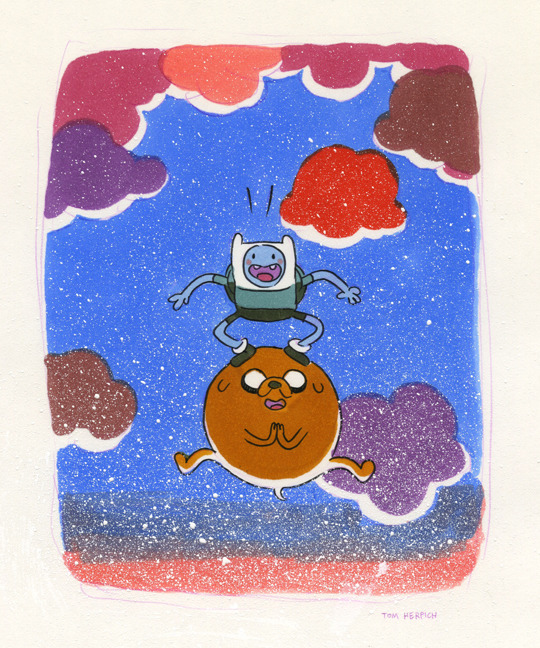
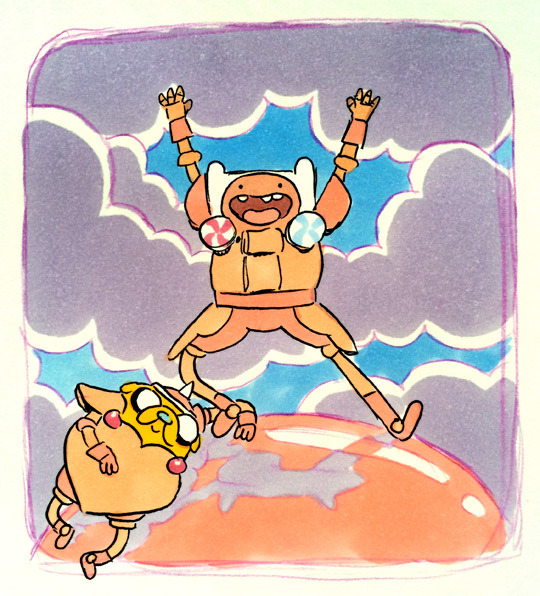
Examples of promo art that Herpich whipped up.
Herpich’s solo Finn episodes are some of my favorites, and that goes for the promo art as well. I really love the bold color choices on all of these, with these three in particular feeling almost like an interconnected series.
Miscellaneous promo art, with the second and third promoting season seven and the series finale respectively. The first image was to promote the series returning from a long hiatus between Daddy-Daughter Card Wars and Preboot. It’s one of my favorite AT images produced outside the series – has so much simplistic charm and love instilled into it.
Storyboards
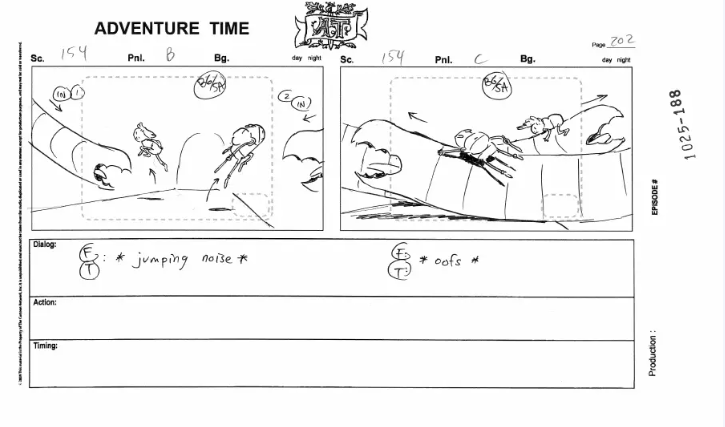
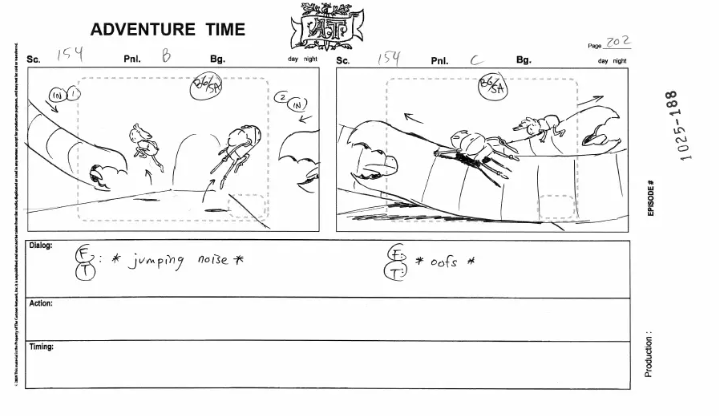
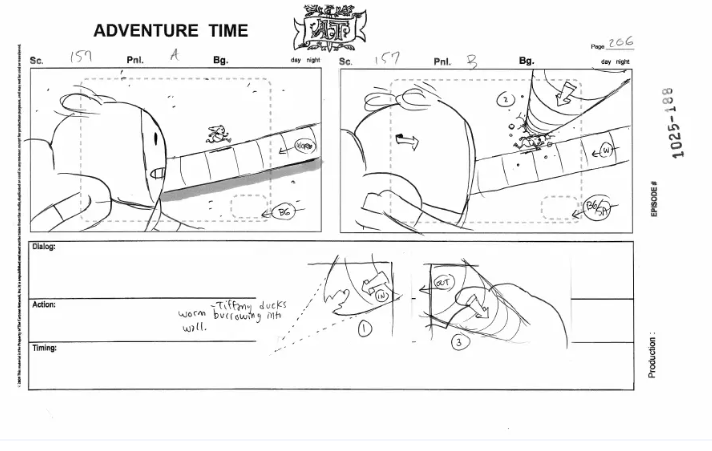
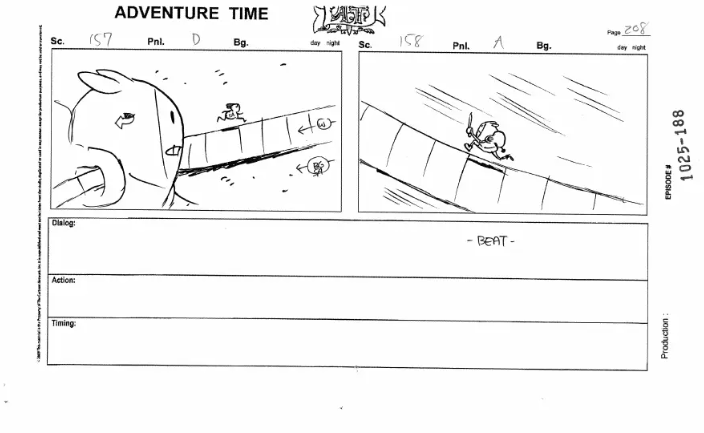
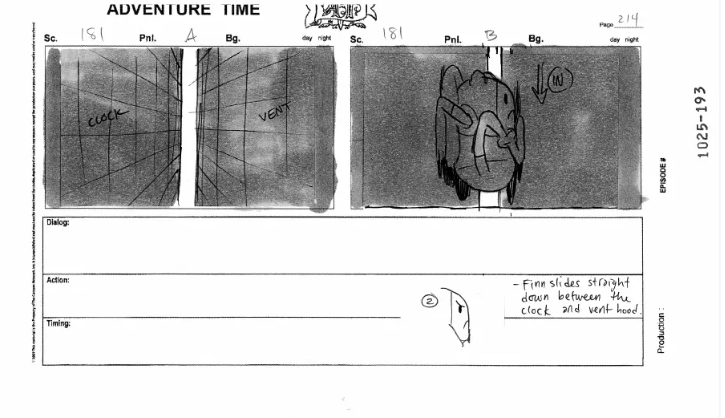
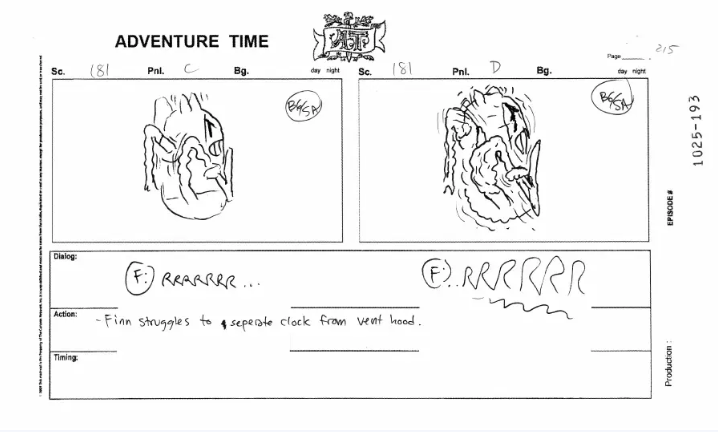
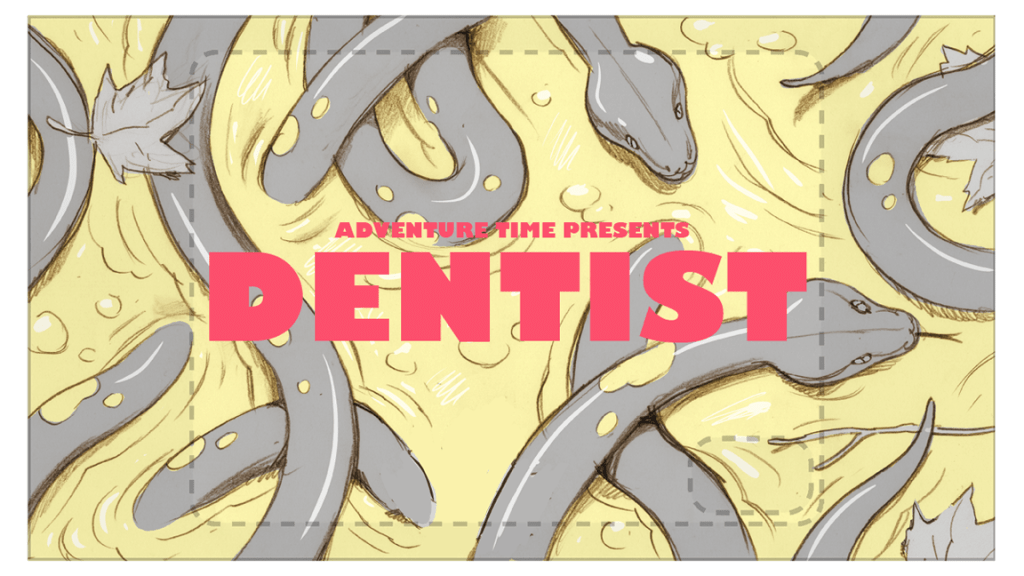
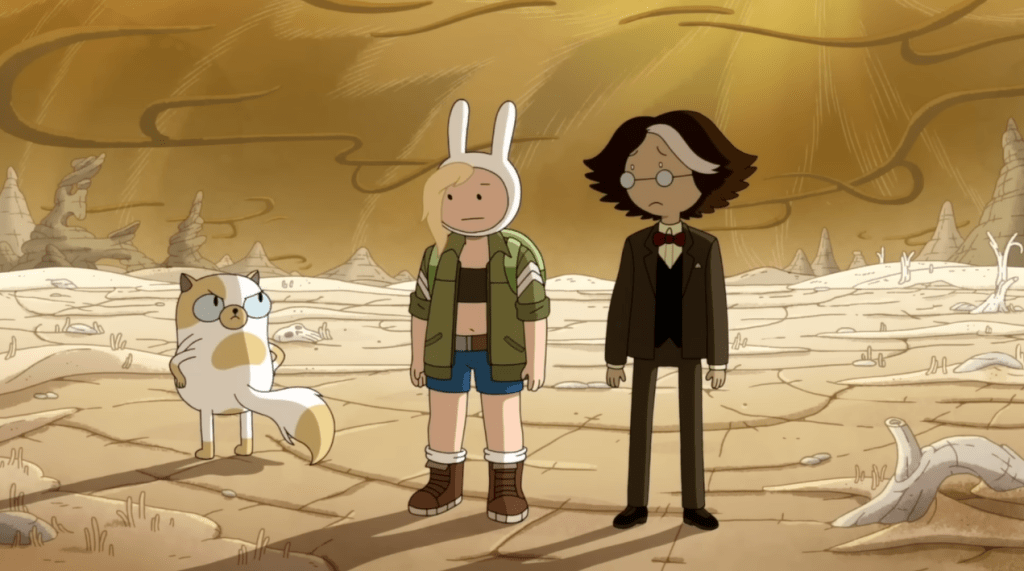
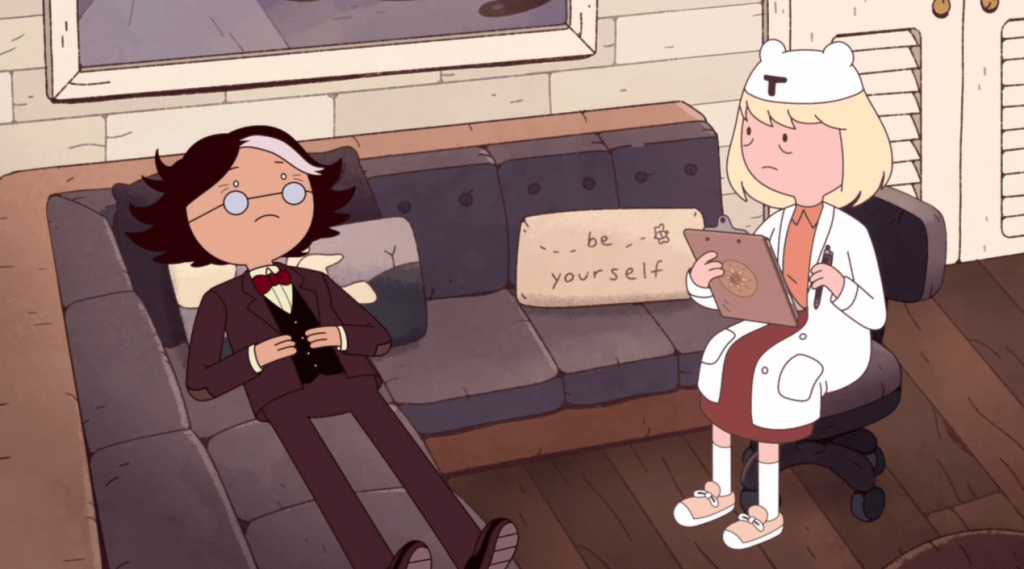
Herpich attention to detail really permeates through his boards, and he’s conjured up some of the most fluid action sequences in the series. The above is from Dentist – a lot of malleability with the characters as well. I love the realistic physics of Finn’s hat moving – something mostly unique to Herpich.
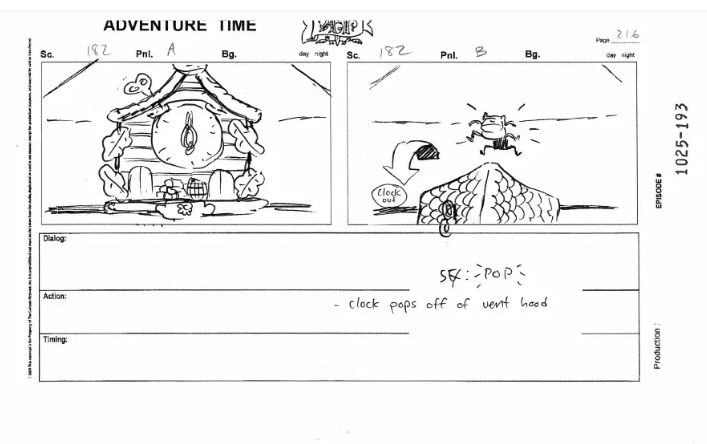
Another high-stakes sequence from Walnuts & Rain. Really elaborate shots and camera movements for a storyboard as well – AT really utilized storyboarding as an effective method of directing more so than most animated shows in the industry.
Title Cards
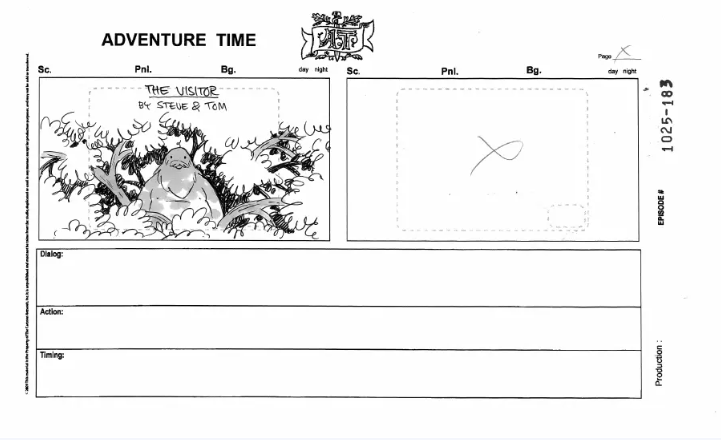
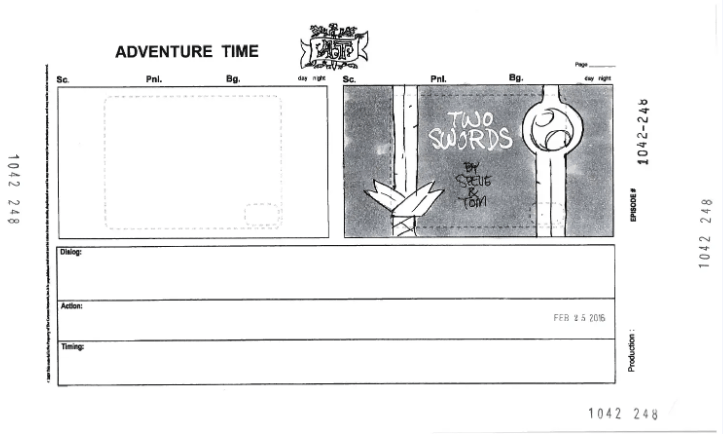
Herpich is also unique in that he’ll create rough sketches for title cards within the storyboards, something that is not required of him, but he’ll add anyway. Most of these don’t end up being used for the final designs; they all commonly feature characters facing toward the screen.
The actual title cards that Herpich has designed are day-and-night from his rough sketches. Most of them don’t feature characters at all, but shots that build environment for the episode itself. It’s a rare opportunity that allows Herpich to work on background design versus his usual responsibilities.
And that’s it for this one! I hope that this was an enjoyable expedition, as I mentioned, I plan to do more of these in the future. If there’s any aspects that are lacking or could be improved, I’m happy to hear your suggestions! Will keep with the board partner model and tackle Steve Wolfhard’s contributions next.
I’ve said it before on this blog, but man, I was not looking forward to Fionna & Cake. I was really bummed out that a franchise with so much potential for exploration would resort to such a gimmicky concept that hasn’t even been beloved by the fanbase for over 8 years. But I was very pleasantly surprised to see that the series (or the “season” now) was actually very clever in not playing into the lowest common denominator of its source material and utilized it to tell a very engaging story about accepting your own ordinariness. In a way, this has always been what Adventure Time has excelled at – playing into the sensibilities of what a general audience would want to see/what sells with a big studio and then pretty much doing whatever they want after its greenlit. Granted, Fionna & Cake doesn’t have the same kind of freedom that its predecessor did. They only had 10 episodes to tell a concise story, so there’s not really a ton of room to experiment with ideas and styles and tone. But for what they were actually able to fit in to those 10 episodes went above and beyond my expectations, making for pretty great first season. Mostly.
The stuff I’ve gushed the most about throughout the season is anything involving Simon, which was equally surprising to see just how invested I was in his role. Despite how outlandish his circumstances are, having been controlled for thousands of years by a magical crown and suddenly becoming conscious once more in the midst of a colorful post-apocalyptic landscape, his portrayal is strangely relatable. I think there’s a lot you can draw from his experience thematically: feeling like you don’t belong, being deprived of the highs and lows of life, dealing with the day-to-day following addiction recovery, not knowing how to exist without your partner. With all successful AT allegories, there’s no singular one connection, and Simon’s journey allows you to connect with him in whatever way you see fit. His arc is probably the most successfully executed on; it helps that it closely relates to the cosmic stuff that I love so much, but also because I think it caps off in a relatively nuanced manner. You have Simon realize that he has his own part to play in the world, but I don’t think it’s as neatly tied up as some of the other plot points in the season. He still has a lot of soul searching to do, but at least has a good foundation based on his own journey. I additionally really love the exploration of his relationship with Betty, learning to take the past off a pedestal and accept its imperfections while still cherishing the experience. It’s a far cry off from that awful Marcy and Simon comic series, which has Simon rescue Betty from the clutches of GOLB, with nothing learned or gained from the process itself. This version doesn’t negate the tragedy set up by Come Along With Me, but instead plays off it in a way that allows for quiet, somber closure and ambiguity when it comes to what it means for these characters.
Fionna and Cake’s arcs are a bit more spelled out. Again, I have to give kudos where its due for making me care even a little bit about these characters who were essentially props in the OG series. And Fionna’s journey of learning to put the wants of others before her own is decently well-executed, with the additional relatability of being 20-something and incredibly self-indulgent. But I think there remains little to gather from this whole expedition outside of a surface level. Pretty much every episode beyond that first one, Fionna and Cake’s bits are overshadowed by characters and story beats that I find much more interesting. Fionna’s connection to Simon is probably the strongest thing going for her character – I find their relationship genuinely very endearing and crucial to each other’s growth. As I discussed in my Cheers review, it’s neat how their arcs overlap while being driven by two drastically different mindsets: Fionna is unable to look outside of herself because of her own self-cherishment, while Simon is unable to because of his own self-hatred. It’s two sides of the same coin and explored in a way that I think is less obvious than Fionna’s individual storyline, boosting both in execution. I do worry about the future of the series where Simon is potentially not as involved, because I really wonder how Fionna can stand alone without that intriguing connection. Her dynamic with Cake is fun, and unique from their Ooo counterparts, but not nearly as lovable as Finn and Jake’s, which is to be expected. The one time they tried to establish conflict between the two in Jerry brought out some of the lamest character moments in Cake, who otherwise was very enjoyable. Cake was always the strongest part of each of the original Fionna & Cake entries in the series, and she remains very funny in this iteration. I could see her role potentially getting annoying in future seasons, as she’s really just there to be quippy and add comedic relief when scenes get a little too heavy, but it really didn’t bother me much this time around. As I also mentioned in my review of Jerry, however, I don’t think her having an arc of her own was super compelling. Necessary, maybe, as it does tie into Fionna’s desires to look outside herself and the debacle around wanting a more magical world, but I don’t think it added much for me personally. I really wouldn’t have been mad if Cake was purely there to just add some goofs in and support Fionna in her own journey, as any of the more tension-heavy moments from her were a bit of a wet blanket.
We get lots more Prismo here, which is always delightful for a character who really only got to shine once or twice a season, if that. I do miss Kumail Nanjiani’s portrayal, but Sean Rohani did a fine job at taking over. Prismo is mostly out of commission outside his titular episode, but his appearance does make way for lots of fun bits of exploration in the cosmic realm. Also, Scarab is here! I think Scarab is ultimately this season’s biggest failure. Granted, he doesn’t steal too much screentime, but as the primary antagonist, he’s around way too much and contributes so little. I’ve probably said it before but villains, outside of the Lich, have never really been the show’s strength. A lot of the conflict in Adventure Time is more internalized, with actual foes and bosses kind of just coming across as pretty normal or insecure dudes and dudettes. Most adversaries are comedic in nature and don’t pose an actual threat, but Scarab is kind of neither. He’s not funny or threatening enough to really justify his existence outside of being an opposition to the main crew, which I do understand to an extent. With telling such a tight story that seemed pretty sure of what it wanted along with well-defined internal struggling, there also needed to be some sense of conflict that helps those two individual stories unravel. I just wish it made for a more interesting adversary, but this is something AT has really been struggling with in recent years. Hugo, New Death, Dr. Caledonius (had to look her name up because holy shit, who even remembers her?) are all villains that suffered from being tacked on for external drama while never feeling fun or intense enough to really leave any lasting emotions. I somewhat wish the next season would just try to have no outward antagonist and just let the characters and stories pan out without coming up with a new big bad every iteration.
I do think the structure of this season was generally quite sound otherwise. Adam Muto talked about how working on the miniseries kind of prepped the team with a better understanding of how to tackle ongoing stories in a successful way, and it shows here. I never want AT to become so story focused that it loses the charm of having each episode possess its own identity, and I think Adam probably felt the same. Every episode in this season cleverly has its own unique feel and landscape, never feeling like any truly blend together (with the exception of maybe the last two episodes). Additionally, I think the longer runtime is mostly used very well. Again, the team obviously had some experience with this in Distant Lands and mostly succeeded in their efforts, and that remains pretty consistent here. Granted, a few episodes like Fionna Campbell and Cake the Cat do feel a bit aimless in their spare time, but every other episode is so loaded with ideas and concepts that can’t even be handled entirely within their runtime that it does replicate that traditional jam-packed feeling of the 11 minute chunks. As I’ve said, I’ll always prefer Adventure Time for what it was during its run: a mainly structureless series with a million episodes that could focus on story elements, interesting ideas, or just something fun. But I do think a lot of the spirit still remains within this season, even if it does have to be a lot tighter and still try to prove itself so that it can move on to tell more stories.
The multiverse definitely complements the individuality of each episode. It’s the element I was most concerned about, because I’m so fatigued with the current landscape of multiverse stories that seem to only be interested in doing really gimmicky concepts with it. However, as the whole series has proved, Adventure Time likes to take gimmicky ideas and explore them in their own unique way. The multiverse here, outside of boasting fun and new, yet familiar environments also explores the nature of characters that we know within an entirely different light. It’s cool to see that the soul-shape of each of these characters seems to remain in each world – Finn is dedicated to doing good, PB desperately needs control over her environment, and Marcy retains a level of playfulness no matter where her moral code lies. These characteristics remain in spite of their surroundings, but even then, we watch them act in drastically different ways. It’s cool to see an exploration like Farmworld Finn’s display that the characters we know and love aren’t necessarily static or even largely identifiable in other parts of the cosmos. Despite there being some consistencies in general nature, Finn, PB, and Marceline do not have consistent senses of self that expand beyond their own worlds. Their nurturing is subject to change and can mold their nature into pretty much anything that serves their environment. Finn’s sense to do good could involve slaying monsters to protect a Kingdom of candy or it could mean protecting his family at all costs. PB’s need for control could involve creating her own Kingdom or it could lead to her becoming a rebel in the face of oppression. Marceline’s playfulness can be quite childish, if not also a bit selfish at times, but can be managed in the right company, or lead her to destructiveness in the wrong company. It’s really cool to see this concept applied to characters we already know and love, and to do so in a way that doesn’t aim to just display alternate versions of them. There’s a level of exploration that is quite interesting and really challenges what is consistent about these characters no matter where they’re found across the stars.
It was pretty surprisingly to see announced that Fionna & Cake would be intended for young adults as opposed to its initial tween audience. I think this is generally something that was naturally built into, as the original series gradually grew into something pretty exclusively for older kids and teens, Distant Lands had a bit more of an edge to it that pushed it into a primarily teenage territory,and F&C takes that one step further. I think it’s smart that the season doesn’t try to push this in a particularly egregious way, with really only supplementing blood and minor swears throughout. I even thought they could’ve pushed it a little more! There’s some thematically darker stuff, like all of Jerry and Simon’s entire plight, though it’s difficult to say if those are elements that wouldn’t also be included in the original series. Overall though, I think I’m glad they went in a bit of a safer direction right off the bat so it’s not too jarring of a jump forward. Hoping they can continue to push these boundaries, especially moving forward. From early previews, it looks like Huntress Wizard is going to be more prominently featured next season, so I’m hoping this means that we can finally have a scene where her and Finn do ayahuasca and get saucy. This is what a TV-14 rating is all about!
This is usually the part of the season reviews where I talk about the board teams, but lord, I am not really equipped to do so anymore. With so many new staff members and so little time to explore individual tones and styles, I can’t really eloquently talk about each writer beyond an art style perspective. Big shoutout to my friend Digamma-F-Wau in the comments, who has been shedding light on who worked on each portion of F&C episodes where I have failed to determine. There’s a few dead giveaways I’ve been able to pick up on; Lucyola Langi draws the characters with such massive pupils that it’s hard not to pick up on her style when you see it. Anna Syvertsson, who is the only staff member that has the bragging rights to say she joined for the Minecraft special, draws those pupils really close together, often accented by eyebrows that peek off of the forehead. Graham Falk still boasts his more cartoony style with a slight tilt to each character. Iggy Craig is one of the better board artists when it comes to character acting, constructing one of my favorite scenes in the entire season (I.E. Simon having a breakdown in DBG’s tavern). But otherwise, it was pretty difficult for me to determine style, let alone tone. Things feel a bit cleaner this time around, even with individual artist identity occasionally bleeding through. I mentioned Graham Falk’s style, but besides the intro to Simon Petrikov and the silent cartoon world in Prismo the Wishmaster, it was really hard to pick out his scenes even considering that he’s one of the most standout artists of the original series. The season still looks quite nice visually, with occasional bumps in animation, usually courtesy of Nick Cross’s contributions. This is may be the best the series has looked color wise, with each episode presenting a really unique palette. Carolyn Ramirez worked on the color script for each episode this season, and her work really shines. Additionally, plenty of alumni of the original series contributed to the show’s visual design, with Tom Herpich, Derek Ballard, Charmaine Verhagen, and many others pitching in.
In terms of writing, as mentioned, it’s pretty hard to determine who excelled and who didn’t. There’s only so many episodes to work with, so you don’t have a good chance to understand the sensibilities of each writer. You don’t have 2oo episodes and counting to pick up on Jesse Moynihan’s desires to explore emotional ambiguity or Somvilay Xayaphone’s opposition to telling any jokes that have a direct punchline. And, with four or five boarders each episode and no complete consistency on individual teams, it kind of makes it impossible to analyze the group efforts in the way that Tom Herpich and Steve Wolfhard collaboration could be observed. Granted, I’ll say that I generally liked the even numbered episodes more. Generally, any episode with Graham Falk, Iggy Craig, Lucyola Langi, and Jim Campbell seemed to resonate more with me than the odd numbered episodes, with the exception of Jerry that only featured Campbell as a writer. Would love more of an approach in future seasons if the episodes could be broken up similar to the original series, with two board artists at the helm. No idea if that’s really ethical in terms to how the seasons are produced, but I’m definitely yearning for a bit more artist individuality in each entry.
AT has really leaned into its musical sensibilities in recent years, with F&C churning out an original tune pretty much once or twice per episode. Generally speaking, most of these are jams. I love the very 90’s poppy opening in Fionna Campbell, the grand Rankin/Bass style numbers in The Winter King, and especially adored Rebecca Sugar’s contribution in Simon Petrikov. Also dug the Half Shy song in Jerry, with it additionally boasting interesting thematic elements. There are times in recent years when I’ve felt that AT seems a little obligated to do musical numbers because of Sugar’s contributions, and that was really felt during Cake’s song in Cake the Cat. I might just be saying that because I didn’t particularly like that song, but it did feel like it was a bit shoehorned for the sake of incorporating more tunes in. I was mean enough to the ending song in my review of Cheers, so I’ll let that one go. One thing I’ll mention once more and then let go of is that I’m still bummed with how much I feel the score weighs down the series. Amanda Jones is a fine composer but I really don’t think her sensibilities mesh with Adventure Time. One thing I dug about Tim Kiefer and Casey James Basichis (whose contributions I often fail to properly address on this blog) is that they were constantly experimenting with weird sounds and instruments in a way that the series in its current iteration just doesn’t really play around with. Most scenes are accented with relatively generic adventurous or dramatic stings, and the better cues seem to just be trying to replicate that original magic. The series as a whole is not nearly as weird as it once was, so maybe it’s more fitting that the score that goes along with it additionally isn’t as experimental. Still, I think score is a pretty major part of any animated series, and the lack of Kiefer is definitely noted and slightly hurts my immersion at times.
Season One Episodes Best to Worst
Simon Petrikov
The Winter King
Jerry
Prismo the Wishmaster
Destiny
The Star
Casper & Nova
Cheers
Fionna Campbell
Cake the Cat
Final Consensus
Overall, I was super impressed with Fionna & Cake. After feeling a bit fatigued by the relatively lackluster Distant Lands, F&C really reinvigorated my love for the series with its strong storytelling and dedication to evolving the franchise further. Did I love the season as a whole? Not completely, there’s elements I really dug, but other that I didn’t get totally into, which you can read into above. Granted, it was way better than I expected and clearly had a lot of love put into it, which I think is pretty unique for such a long-running series. Adventure Time really appears to be something special for everyone who has the pleasure of working on it, and it seems like everyone is careful to preserve its legacy. That being said, I do worry that more of the wild days of the series are over. As much shit as Season Six got, I do thoroughly love how willing it was to push away from what fans really wanted to see and just played around with ideas and themes that the artists working on it found interesting. I do feel like in a way that initial charm of the series is lost, but I’ve also come to terms with that. I’m happy to be getting more of the show in any capacity, and as long as there’s still a lot of love put into it, I’ll remain a loyal viewer.
Well, it seems like every FUCKIN’ time I start getting comfortable with the show quietly moseying along, some big change hits and I’m stuck with the question, “how much longer can I keep doing this??” We got a whopping THREE new AT projects announced recently – a BMO pre-school show, a show seemingly in the spirit of the first season, and an AT movie, with Rebecca Sugar, Pat McHale, and Adam Muto at the helm.
I’ll give my brief thoughts on each – Adventure Time: Side Quests, which is supposed to be a lighter and more comedic take akin to the early seasons, is probably the one that sounds the least promising to me. I don’t really like the idea of a “strictly comedic” AT series because, well, what’s the point? The whole franchise is supposed to be this blend of weird nonsensical stuff contrasted by really heavy and emotional themes, so I wouldn’t want to see any adaptation of the series lean too far in one direction. The one thing in its favor is that, if it is trying to emulate those very early seasons, I think it has potential to keep their spirit alive where, with only so many episodes to work with for the mainline series, there’s not a whole lotta room to fuck around. But, Adventure Time itself has kind of struggled to replicate this earlier tone effectively, so I don’t know if it’s even something that could be pulled off. That first season is really a time capsule in how much it embellished the energy of early 2010s internet culture and I’m not sure you can really bring that back – but I’ll be prepared to eat my words if necessary. The BMO preschool show is obviously not for me, but I think it looks harmless enough. Very cute that it’s going to be a claymation based series, and I think it’s sweet that older AT fans who have kids will be able to introduce the series to their young ones. I don’t really have any desire to watch it or talk about it, but maybe I’ll get really high one day and then do a write-up about it.
The movie is intriguing, and I love that Sugar and McHale are coming back for it. Based on that, I’d love for it to be a smaller, quieter story about Finn and Jake in their youthful days. Could even make it about them dealing with the grief of losing their parents. I don’t think they would do anything super wild or out-of-the-box for a movie, so I’m hoping the emotional core of it is strong enough to carry it through. But again, if they did something insane that is not easily accessible by people who aren’t already super fans, that’d be rad too! And there’s F&C season 2 on the way. WOOF. Can’t make any promises, but I’m thinking that I’ll probably continue with full episode write-ups for F&C, do a write-up for the movie, and then share my brief thoughts about Side Quests and MAYBE Hey Yo, BMO! I love this series so I’ll probably eat up every morsel of content that I can get, but I can barely keep up with this gig as is! We’ll just have to see where I am when they eventually come out. In the meantime, I’ll be wrapping up with Fionna & Cake season 1 write-ups shortly – Casper & Nova is in the works now. Thanks as always to y’all who keep reading – plenty more on the way! Hopefully!
Before we start, I wanted to make a brief announcement. By next summer, this blog will be wrapping up, as I move into the final few seasons. I should have a schedule out at some point for the remaining 50-or-so episodes and when their respective reviews will be posted. Not sure about post-blog content yet, but I am starting up a podcast reviewing animated programs in general that I’m particularly psyched about! I’m sharing this because I have an open application for anyone who might be interested in co-hosting with myself. If you’re interested in applying, feel free to do so and you might have the chance to work with a huge dork like myself! The application will be open until the first week in December, so I’ll keep advertising on the blog until then. On with the review!
It’s easy to see why Lady Rainicorn is the virtually the most ignored main character in the series. Like so many other unintelligible or foreign characters from other miscellaneous TV programs (Kenny from South Park, Coco from Foster’s Home for Imaginary Friends, Boomhauer from King of the Hill, etc.), Lady is difficult to incorporate into main stories because a majority of AT’s audience, including the characters themselves, do not understand Lady’s Korean (or whatever language she speaks in dubbed versions) dialect. Lady’s native tongue is primarily what makes her interesting and unique, but while the other prominent characters begin to develop and change throughout the series, Lady and the other unintelligible characters I mentioned tend to generally lose focus, as the initial charm of their character cannot compete with the changes surrounding them. That being said, I do love Lady as a character. As unique as her voice is on its own, I actually think that she possesses a more intriguing trait that ties into my fondness for her: she’s perhaps the most normal and mature character in the series. It’s odd to say that when referring to a sentient rainbow unicorn, but it’s the truth; while the main cast is either enjoyably goofy (Jake, LSP, BMO) or filled to the brim with baggage (Princess Bubblegum, Marceline) or somewhere in between (Finn, Ice King), Lady proves to be the most laid back in her behavior and the most stable when it comes to her emotions. Now, that doesn’t mean she has no problems, as seen in this episode, but she’s matured to the point where she’s confident enough to tackle her issues head on and dismiss them accordingly. And we see her do just that in this episode, where she not only confronts her hateful past boyfriend, but her past in general.
It’s important to note that this is the first episode in the series to use subtitles to translate Lady’s dialogue (among others) to the audience. I’m kind of half and half about this decision; on the one hand, I feel like part of the charm regarding Lady also contributed to the fact that the audience was never spoon-fed when it came to trying to decipher exactly what Lady is saying, whether it be theorized guesses, or just working off of body language and tone. On the other hand, I’m… not entirely sure this episode would work without them? It’s hard to say, because I want to claim that I’d be able to get through this one fine without subtitles, but I’ll never truly know because I’ll never have the option to do so. So, ultimately I feel as though it was a fully necessary decision, but one that I will always feel a bit iffy about just because I generally feel like it takes away part of the fun about Lady’s character. The only other issue I have with the subtitles actually doesn’t apply anymore; when this episode first aired, the giant fucking Cartoon Network logo took up half of the screen and covered parts of the dialogue, which was hella distracting. Luckily, DVD and digital releases mean I no longer have to complain about this minor inconvenience anymore! On the whole, it is really cool that a majority of the dialogue in this episode is spoken in Korean. I don’t know how well the younger kiddos are into reading written dialogue, but I still think it’s cool for the sensibilities of non-Korean speaking lads to be challenged by watching an entire 11 minute block of Korean speech. That’s also implying that any younger kids actually watched this episode, what with the fact that CN completely gave up on advertising by this point in time, which led to record-low ratings for this episode, but I digress.
While this episode is somewhat intended to be a Lady-focused episode, T.V. takes just as much spotlight when he essentially lures Lee in, LR’s former boyfriend, and instigates the main conflict of the episode. While I do enjoy this one overall, I think this is the episode that made T.V. go from a pup that I just didn’t care much for, to my least favorite of his siblings. He really has no motivation in the entire episode, and merely is there to, as I mentioned, drive the conflict forward and to be as selfish and lazy as possible. A lot of people would argue that Kim Kil Whan is more unlikable because of his actions in Ocarina, but I think that Kim Kil Whan is at least a less hollow character. KKW is certainly harsh in his actions, though he’s driven by his desires to ensure that his father leads a worthwhile life (in his eyes, at least), while T.V. is simply driven by his desire to do whatever he wants and to mooch off of the people who treat him better than he deserves to be treated, and he still gets rewarded by the end of the episode. It really reminds me of all the Lumpy Space Princess episodes where she acts like an absolute asshole to others and suffers no repercussions. Just leaves me with a bad taste in my mouth.
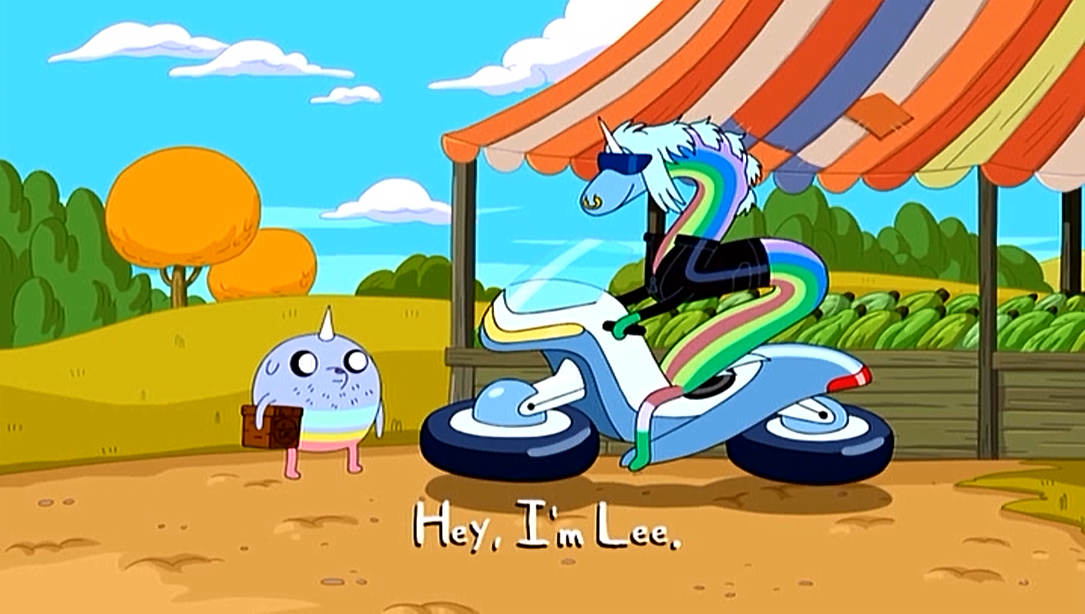
Thankfully, the other two main characters of this episode are much more enjoyable. I think Lee is a particularly interesting villain with a unique voice (he’s actually portrayed by former storyboard artist Bert Youn, awesome!). I like how Lee isn’t necessarily one-dimensional in his bigotry, as he’s more so seeking socio-economic security, rather than being racist for the sake of being racist. Lee wants to root for whoever’s on top, whether that means demeaning those different from him, or going against his own species as a result. But he isn’t just a straightforward villain, and he’s actually quite charming, for the most part. This especially factors into how Lady and Lee ended up together to begin with. While Lee is obviously rebellious and close-minded, it seems like he actually treated Lady well, for the most part. He was seemingly kind, loving, and even intended on keeping her away from his more elaborate plans to harm dog-kind. Of course, he’s clearly shown to be manipulative when Lady does find out, and likely cares more about his rank within the Crystal Dimension more than he actually cares for her. It really does ring true to me that toxic people are typically the most charming individuals you come across: they’re funny, down to have a good time, and bring with them loads of energy and immediate social gratification. It isn’t until later that the charm begins to fade and the true ugliness of these beings begins to show, in which Lady gradually picks up on as she spends time with Lee. That’s the other factor regarding toxic people: those who surround them are sometimes the nicest souls out there, but easily impressionable and ignorant to seeing the cons of humanity. Their entire backstory is told successfully through the use Lady’s easily seen progression and the clear implication that prejudice following the Rainicorn-Dog Wars still exists in the mainstream.
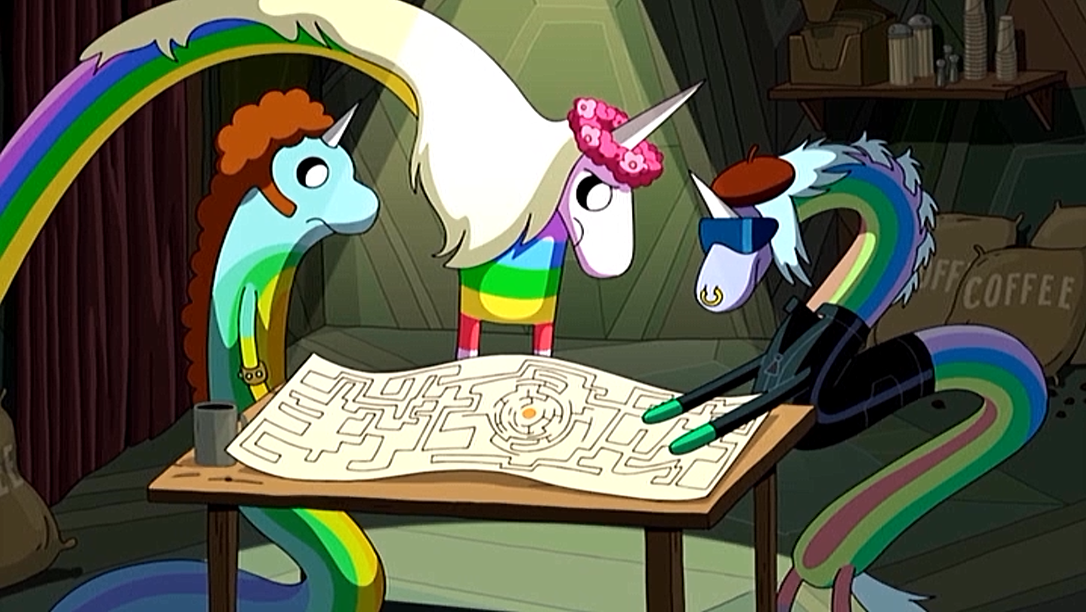
There’s a lot of really neat subtext regarding the post-Rainicorn-Dog Wars world. It’s very clear that, while prejudice is still rampant, there are means of progression in terms of some citizens. It’s clear that the native language of rainicorns is Korean, while dogs primarily speak English. Bob and Ethel (who make their triumphant return!) use translators, likely because they want to adapt to the changing society and to communicate with other dogs around them. While other characters like Roy speak in English entirely… which is strange, because he seems to be on board with Lee’s whole plan, but it could also mean that he too is tired of conforming to the standards that society has pushed onto him. I’m just glad that Fred Stoller got to provide his talents for the show. And I just noticed that their names are Lee and Roy. Leroy. Hm.
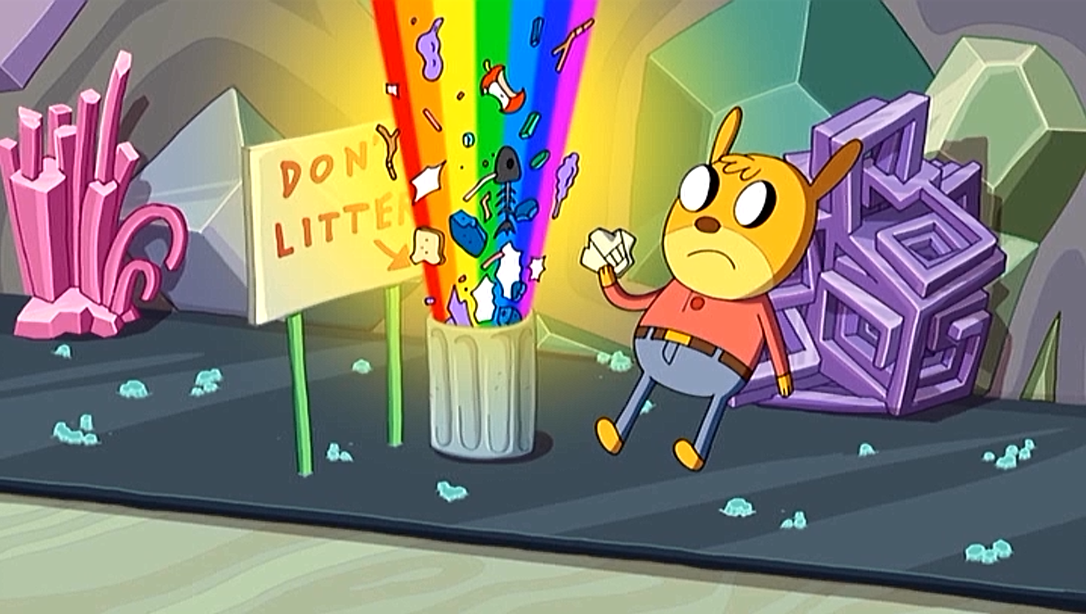
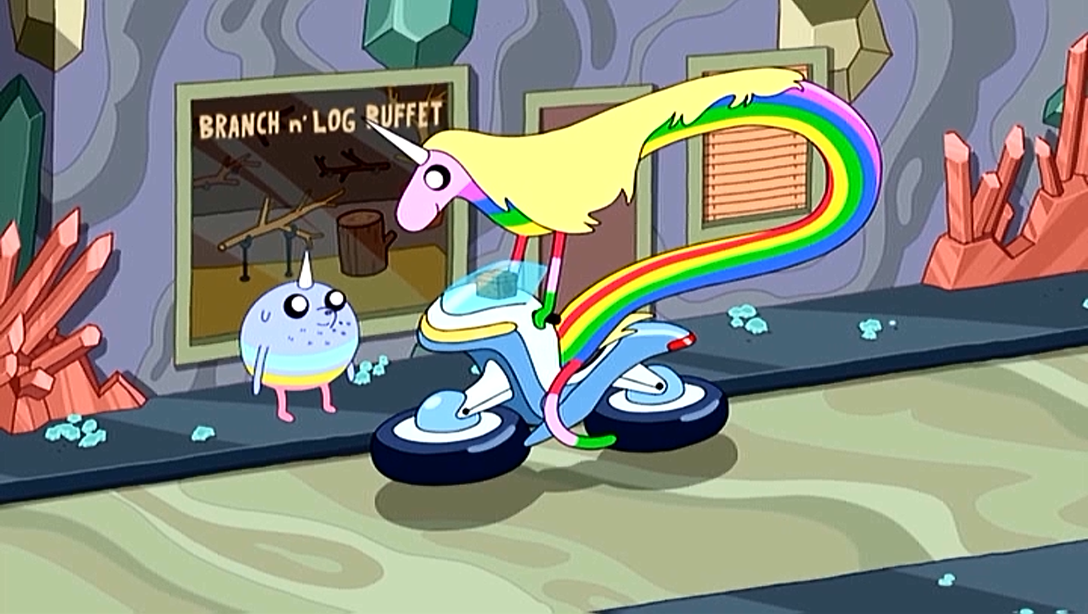
Keeping in tradition with the rest of this episode, this one just looks awesome. Crystals Have Power previously introduced us to a considerably less interesting Crystal Dimension, but this one is awesome. I love the combination of bleak, subdued backgrounds, coupled with the bright and colorful crystals that surround them. There’s so many locations and backdrops that were specially made for this episode; background designers Andy Ristaino and Chris Tsirgiotis really put in all of their effort to ensure that the Crystal Dimension feels big and expansive, and they truly made something beautiful in the process. Not to mention, it allowed for them to have as much fun with making everything as crystallized as possible. Even the clouds are crystals! Aside from backgrounds, this episode has a keen sense of character design to it as well. It is so clearly Graham Falk’s work, and that fact really shines through when looking at all of the different dog designs that he drew up. I too love that he made a valiant effort to divert from making all of the dogs look too similar to Jake, but also made it apparent that he didn’t want to make them too different either. Falk’s zany sense of humor is also apparent as always, but most prominent when Lady merely uses a newspaper to wade off the opposition of Lee’s dog guards. That had me in stitches.
One main criticism I have about this one is that I don’t really like how it ends. Aside from the T.V. aspect I mentioned earlier, I feel like the crystallized sandwich has no real payoff. I guess it is somewhat of a humorous tie-in to Jake’s love of sandwiches, and that dogs in general have some special kind affection for the food item in general, but I just don’t really get how it works and why it consumed Lee, but not T.V. And the way T.V. saves the day by simply placing the sandwich back in the box is really lame. I feel like Graham Falk wrote in this aspect to merely drive the conflict of the episode, but didn’t really have anywhere to go with it from there. It really feels like a rushed and barely thought out conclusion.
But, in general, I think Lady Rainicorn of the Crystal Dimension is nice. I don’t think it’s particularly great, but after seven seasons, it’s entirely necessary for Lady to have this type of star role for an episode. It’s an interesting exploration of her backstory, and the backstory of the Crystal Dimension in general, with silly gags and animation scattered throughout. It has its issues story and character-wise, but it’s one that provides for a strong exploration of one of AT’s most mysterious characters.
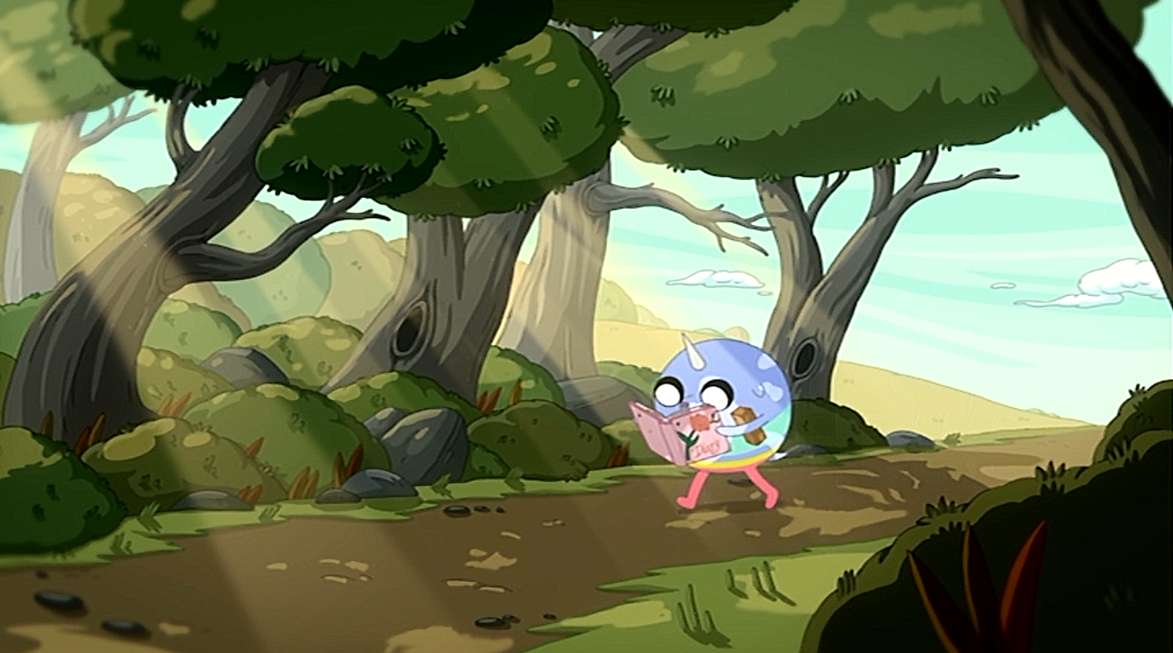
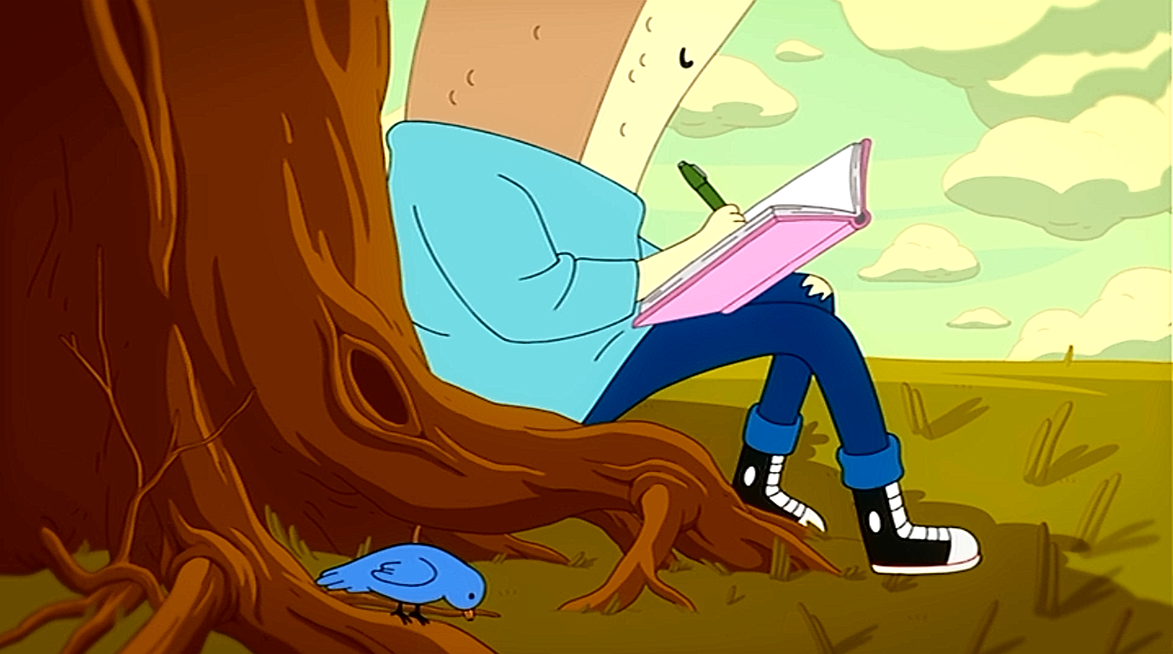
T.V. is likely my personal least favorite of the pups. I don’t have any personal gripes against him, I just think he’s the least interesting out of his four siblings. Even Kim Kil Whan, who was a bit of an asshole in his debut episode, at least has a thoroughly compelling connection to his father. T.V. has neither that nor a very diverse personality; he’s a lazy homebody, and even when done right, these characters are never truly fun to be around in my opinion. Jake is partially lazy, though his character isn’t limited to his laziness: he’s caring, compassionate, and funny. T.V., on the other hand, is mostly limited to his lack of enthusiasm about practically everything and his ultimate desire to be unproductive, which makes his character feel quite hollow and dull in comparison to all of these other well-fleshed out characters in the Land of Ooo. Now, that rant aside, I actually think that The Diary is a really good way to make use of his character. It uses his desire to get invested in whatever escapist fantasy is most convenient to him quite nicely, and makes for a decent character study on how much one should invest their time into the lives and drama of others. Also, this is one that’s straight up beautiful. It was solo-boarded by Jillian Tamaki, who assisted Jesse Moynihan with Astral Plane, and her emphasis on cinematic moments and serene artistry help to really make this episode shine on a visual perspective.
My feelings in the first paragraph mostly represent how T.V. goes through little development following subsequent appearances after this episode, but I think his character, at least in this episode, is expanded on in somewhat interesting ways. The beginning sequence that features him playing video game clearly elaborates on his feelings and overall insecurities; his choice to “run away” from the dragon, rather than fighting it, could represent his own “fight or flight” response to dealing with his own anxieties and fears. It’s nice to see that Lady, despite being a caring and fair mother, knows her limitations when allowing T.V. to go about his adult life in an unconventional ways. It’s also crazy to think that this is Lady’s ONLY major appearance in season six, and it’s limited down to only a few scenes and lines of dialogue. Lady’s practically an afterthought by this point in time, but it at least makes sense since she is the only character the audience can’t directly understand. Quite a shame though, because I do like her character a lot, but her nature and being limits herself to only a few brief appearances per season. But I digress; Jake’s attitude towards his son is also quite fitting, seeing as how T.V. does embody a part of Jake’s self. And even though Jake’s view of his son isn’t necessarily responsible and he probably shouldn’t encourage such behavior, it is sweet to see him approve of his son regardless of his lack of productivity. I’m sure many people could jump on the fact that this support probably makes Jake an even worse father, but he does begin to recognize when things in T.V.’s life go awry later on, and does at least assist him along the way. It’s a good bonding experience for the two.
T.V. anti-social behavior is presented well in brief instances, such as his quick transportation away from the kind old man who merely wanted to say hello. T.V. doesn’t seek excitement or satisfaction in reality, as he would rather be consumed by his own intriguing fantasy worlds and realms that can help him to escape from his failure to connect to the real world. It isn’t until T.V. comes across the journal of “B.P.” (of whom I swore was going to be Breakfast Princess when this episode first aired) that he begins to get invested in the real-life struggles of an anonymous teenage, which eventually become twisted into more fantastical opportunities to place himself into and project imaginary realities. It’s cool to see just how enthralled T.V. is by the life of this one random Candy Person, and also how it likely strikes him as unique from any type of fantastical experience he has had in the past. This story is tied to real life people, relationships, and situations. It’s no wonder that T.V. does eventually get sucked in to the point where he begins to confuse his own reality with that of B.P.’s life. T.V. is all about playing different characters and taking on new identities, to the point where he doesn’t even have his own life experiences and characteristics to even know himself. His experience as B.P. is his way of living vicariously through others, as well as giving him a sense of purpose in life.
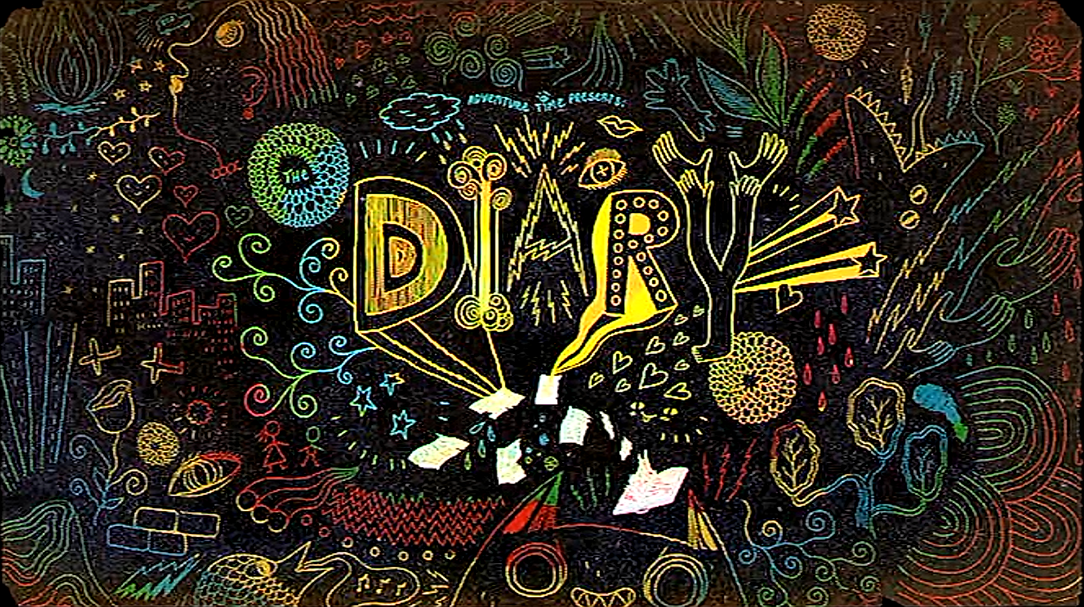
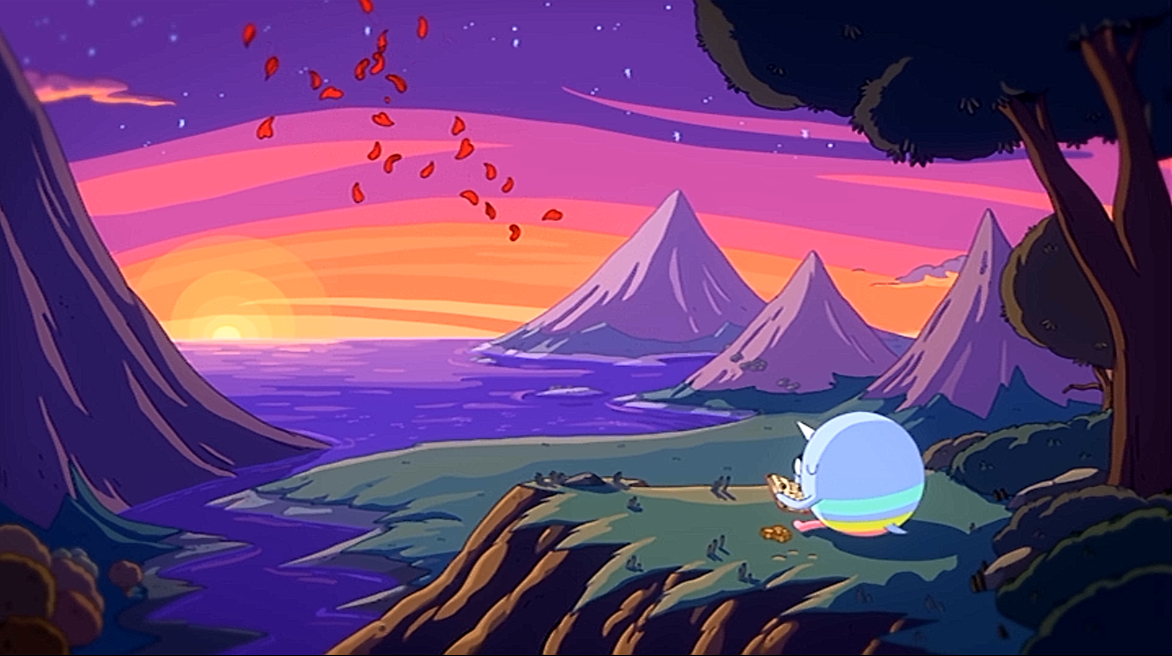
As I mentioned, probably the strongest aspect of this episode is its use of visual storytelling. Not only is it chock full of different backgrounds, per usual, but it also utilizes great attention to detail that helps it to truly shine. I love those scenes right after T.V. finds the journal and begins to roam around in the changing environment. As the day goes from afternoon, to evening, to night, the shadings and colors the reflect T.V. are really quite beautiful. There’s also some terrific shots that feature nature just being nature as B.P.’s voice is heard reading the journal in a very poetic way, like the squirrel who attempts to get T.V.’s attention and the heart shaped rose petals that land on top of T.V. That’s Alia Shawkat voicing B.P., who later would go on to voice Jake’s daughter Charlie, and Shawkat does a great job of carrying out B.P.’s writings with complete sincerity and in a compelling, tense way. Also, the way her writings and drawings begin to materialize on screen as T.V. continues reading is also a visual treat, and helps to add energy to the actual backgrounds even when nothing particularly eye-catching is going on. Along with Evergreen and Jake the Brick, The Diary is yet another season six episode that makes use of its artistry in the best possible way. After all, if you’re gonna pull off these really deep, poetic themes and messages, why not make the episode look as great as possible to go along with said beauty? Aside from beauty, the episode does touch on surrealism in its visuals as well. T.V.’s roleplaying journey into B.P.’s life is the perfect visual representation of the literal existential rollercoaster that T.V. has gotten himself into, and his line “you don’t know me, nobody knows me!” could be his attempt to get into character, or he may be touching on his own real life issues as well. It’s tense, entertaining, and captivating.
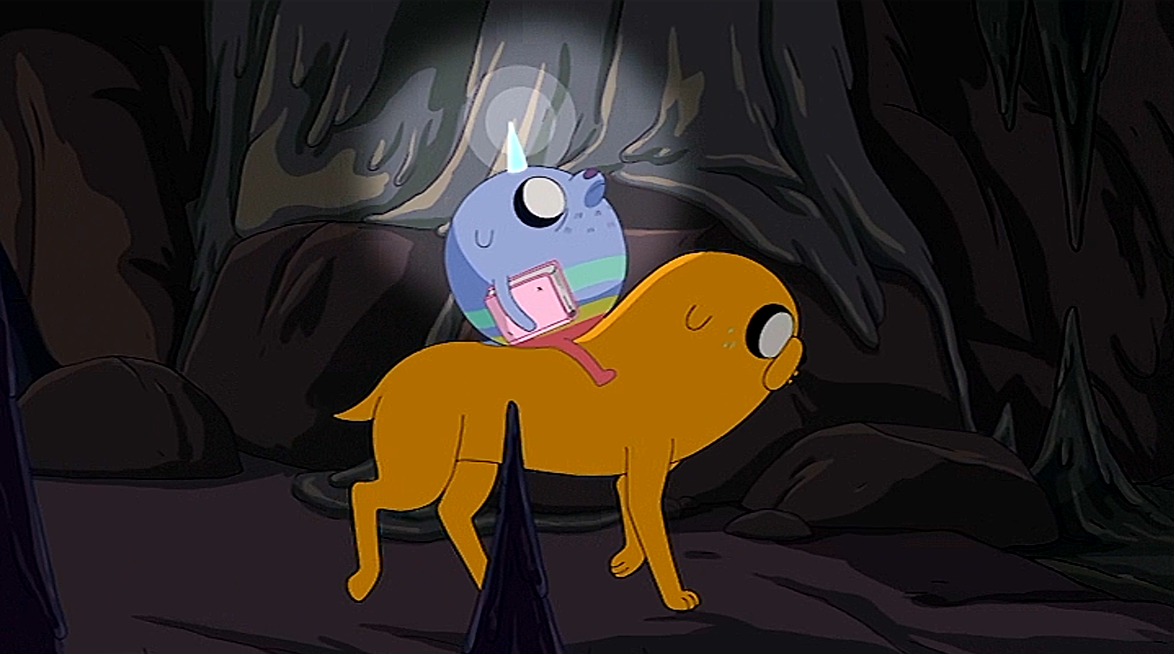
While I think the scenery and the atmosphere are certainly the strongest aspects of this one, the episode does have a decent mystery that certainly kept my attention on the first viewing, and still has me generally intrigued even after knowing the ending. It kind of reminds me of the bunny plot from Jake the Brick; the identity and mystery behind B.P. isn’t really inherently interesting, but it’s made to feel like something that’s genuinely worth finding out because of how much the characters care about it. And it isn’t till Jake finds his son in utter deterioration that he begins to get behind the mystery as well. I thought it was quite sweet to actually see Jake try to help his son see the mystery through, though again, not sure how great of a parent this actually makes him. I think on a parental level, it’s summed up quite nicely by how Lady rolls her eyes and simply chooses to ignore the situation, rather than to invest her time in their dilemma. It’s both hilarious, and kind of paints a picture on their views of responsibilities. Though the show never fails at making Jake likable and caring, even when his role as a good dad is in question.
The writing itself doesn’t provide for many jokes or funny gags, but like most episodes from this season, it seems like it’s more interested in telling an enticing story, rather than trying to completely amuse the audience. There’s subtle moments, like the grass guy from the flea market who narrates the backstory of his music box. It comes off as both kind of poignant and even quite funny, as he begins to recall literally everything about who bought the actual box.
It probably goes without saying that I think the character of B.P. herself is quite enjoyable and kind of cute. I like how she’s written to embody the life of a teenage girl, but without being completely stuck up and egotistical. Her quirks are emphasized more than anything, and she parallels T.V.’s obsessions quite nicely. She too begins to center her life around the entire identity of a single person, that being Justin, and shuts herself off from society because of him (also, I like the fact that T.V. and B.P. both share names based on acronyms). It’s a simple, but neat little tale about teenage infatuation, and leads to her final monologue, which is once again presented with great visual flare and some solid voice work.
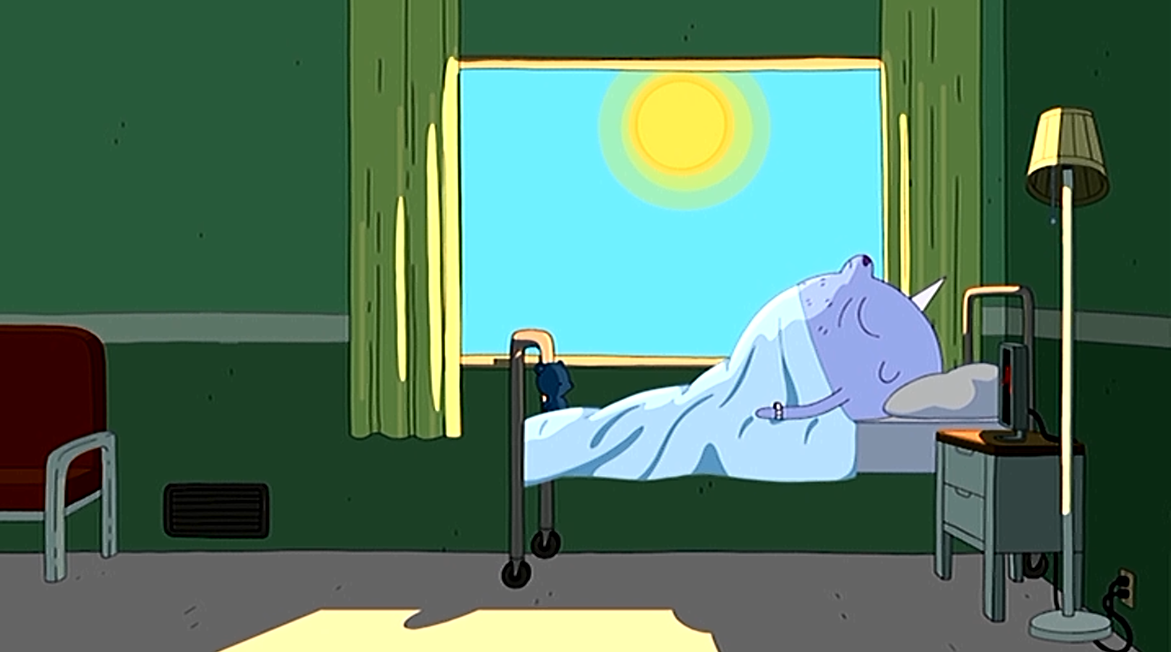
“You know when you’re little and the future feels really far away? You don’t know what it looks like, you just hope you’ll have stuff figured out by then. You’ll know exactly how to act, and feel. You’ll have conquered all your fears, and you’ll never feel dumb or uncomfortable. You don’t think about how you’ll actually get there. The middle parts, between now and then, the middle parts suck. Which is why I split, I guess. Okay, so riding out your teen years in a cave is pretty dramatic, but do you know how much reading you get done in a cave? I even figured out a cure for my crab hand! Oh Justin, I hope you’re not too upset. And I hope you didn’t spend too much money on that birthday present. It wouldn’t have worked out between us anyway. You’re kind of clingy.”
The ending of her speech is a hilarious subversion of what we already know about B.P.’s character, but the rest of it comes off as some insightful stuff. And it comes as a notion that nobody is really prepared for the issues that face them in the real world. Growing into those teen and early adult years pose as the most confusing, because nobody wants to accept exactly how difficult life truly is. That’s why T.V. refuses to live his own life at least, and finds joy and solace through masking his struggles with the power of fantasy. Facing the real world means facing issues that often times don’t have solutions, and some that truly do suck, but T.V., like B.P., has his own unique way of struggling through said problems. Whether or not these methods are actually orthodox and reasonable is certainly in question, and the episode doesn’t stray away from such queries. Though B.P. proves to move on to live a successful life, powering through those sucky middle parts the only way she knew how to.
And I never in a million years thought we would’ve gotten an episode dedicated to the backstory of Nurse Poundcake, but here we are! It’s amazing how resilient Adventure Time is in adding depth to some of the most unimportant and obscure characters in the Land of Ooo, and how it actually kind of works. Nurse Poundcake’s story is one of success and triumph after long periods of fear and doubt, proving that all those struggles as a young adult are generally meaningless, as life continues to progress forward. T.V. may not be able to live his life through B.P.’s eyes anymore, though he’s hopefully left with the idea that even through his sucky young adult life, there’s still an opportunity for him to progress forward and have an impact on the world. Or maybe he’ll just continue to mooch off of his mom forever, as he’s later seen doing. Ah well!
The Diary makes for a decent story and character study, but I think it’s really just another great example of Adventure Time using the art form of animation to its strongest extent. It doesn’t skip a single beat in trying to create spectacular visuals to surround an overtly poetic story. Granted, I think there’s a lot of other season six episodes with better stories, but this one is really solid based on its atmosphere and tone alone. That’s not to say the plot isn’t good, as it still stands as relatively intriguing from beginning to end. I think the mystery element is a bit squandered in subsequent viewings, considering that it can’t really surprise me anymore, but it isn’t really supposed to be the big draw of the episode to begin with. The Diary is a somewhat stressful tale about the act of living through others, but one that is carried out with an enlightening message on life and supported through sheer eye-candy. No pun intended.




































 Adventure Time Reviewed