Adventure Time, Animation, Lifestyles

“Jermaine” Review

J1.png

Original Airdate: April 23, 2015

Written & Storyboarded by: Brandon Graham & Jesse Moynihan

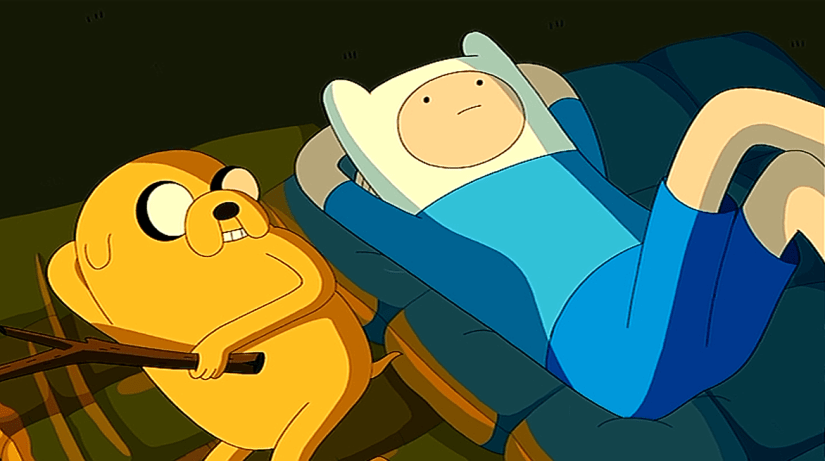
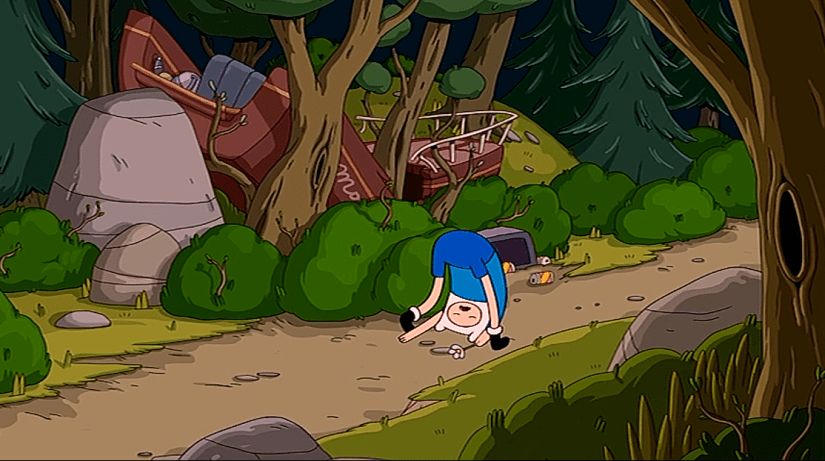
Connecting the dots to every tiny piece of established information in the Adventure Time world was probably the most difficult aspect for the writing team in the long haul. What I mean by this is that the series initially started out as a crazy and silly fantasy world with little restrictions as to what could be done in said world. Years later, those restrictions have mostly stayed the same, though to make the Land of Ooo feel more real and authentic, the series has taken a stance to be strong in its continuity so that those wackier early seasons could essentially be retconned as worldbuilding. Finn and Jake’s estranged brother Jermaine was included in the episode Crystals Have Power as a mere gag character; even Jesse Moynihan, who established Jermaine’s existence in this world, didn’t really think twice about what that creation meant and how it would affect the story down the line. And it didn’t for a while, as Crystals Have Power aired five whole seasons ago, and outside a brief mention in The Pit and cameos in Memory of a Memory, Jake the Dad, and Joshua & Margaret Investigations, the character has never had a proper chance to shine, and the writing staff, up until this point, had failed to find a rational way to include him in the story. Jermaine finally brings its title character to centerstage, and is a turmoil-fueled expedition that capitalizes on an interesting relationship between siblings that we really haven’t seen in the series thus far.

J2.png

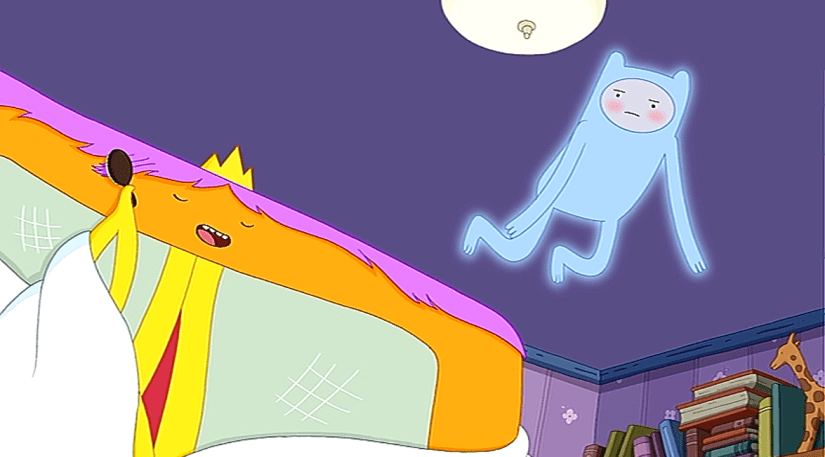
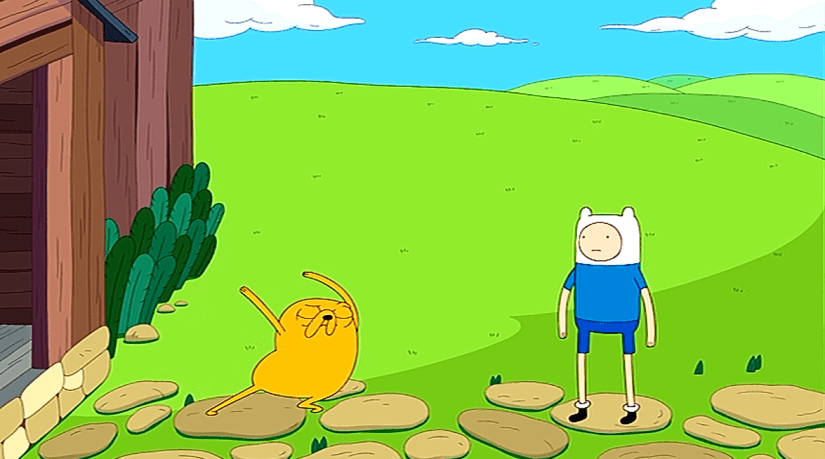
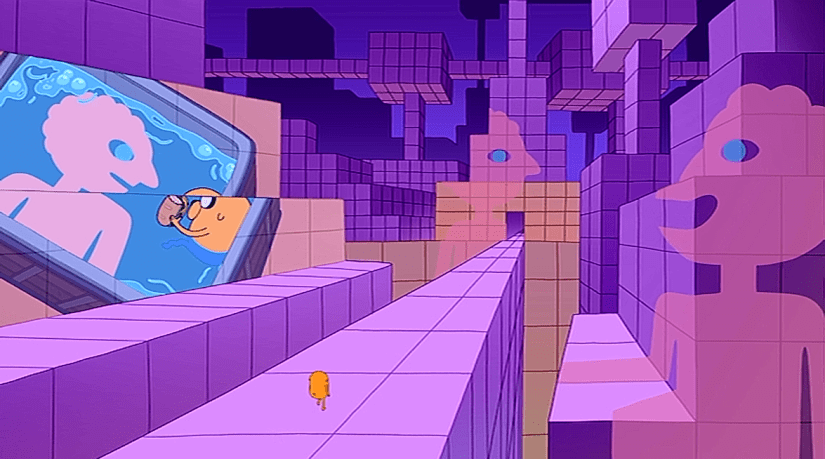
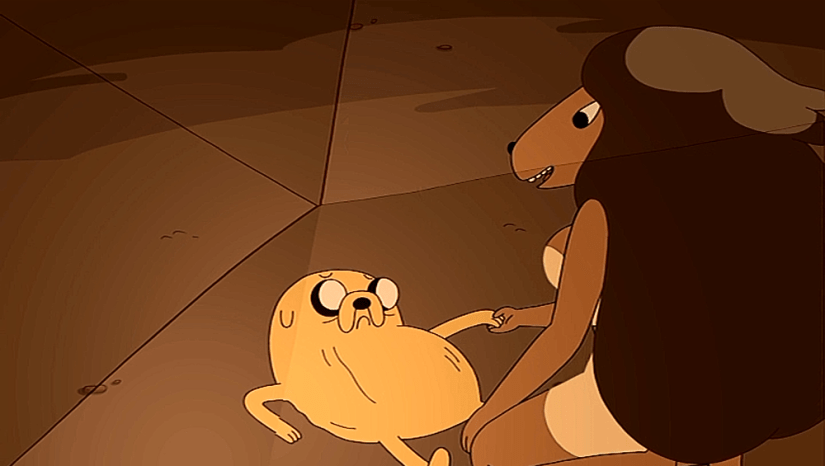
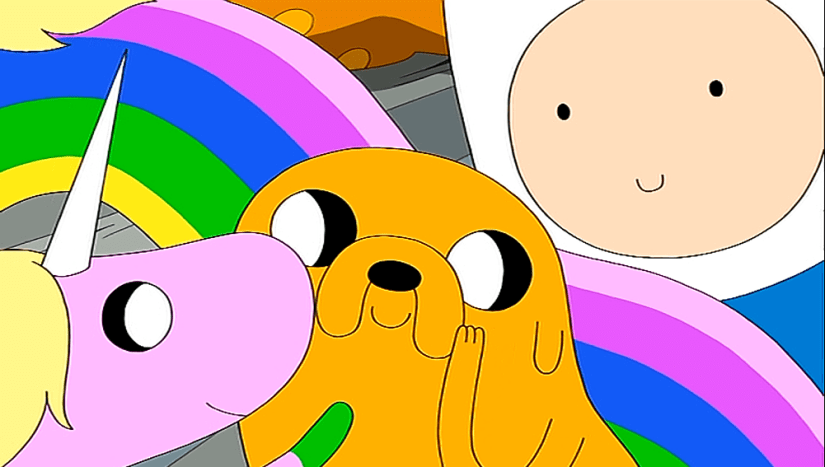
The beginning starts off fantastically, courtesy of some great visual gags from guest storyboard artist Brandon Graham. This is Graham’s only episode in the series, but man, do his drawings stick out in a really fun way. The dream bit where Jake slides on Lady Rainicorn’s body is such a fun, bouncy sequence that features some stellar animation as well. The reveal sequence with Jermaine is plenty foreboding, and gives us a good idea of who Jermaine is as a character. The series ditched the Jermaine we saw back in Crystals Have Power: he no longer has missing teeth, prominent lips, and a deepened John DiMaggio voice. He keeps the unibrow, but is voiced instead by Tom Scharpling, who is quite obviously the voice of Greg Universe from Steven Universe. I can’t help but feel this bit of discontinuity is slightly distracting… I guess you could maybe argue that the dream sequence distorted Jermaine’s appearance like the nightmares in King Worm did, but I like this version of Jermaine better so I can’t really complain about the change on an entertainment level. His anxious state is well-defined by his almost compulsive recitation of “epsilon, eucrates…” that helps him stay calm, as well as concentrated. I also like that Jake and Jermaine are somehow always connected by their dreams, for completely unexplained reasons. It’s a bit of subtle character lore that has no role in the grand scheme of things, but is an interesting way to bring the two brothers together, considering their distant behavior elsewhere. Also, I think Graham may be the only storyboard artist who loves drawing Jake with toes more than Ako Castuera.

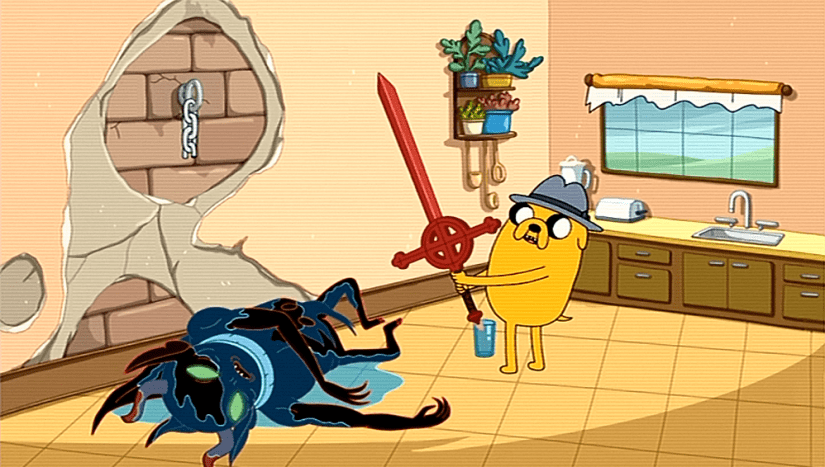
Jake’s stress and worry regarding his brother is also well-explored. One of the key components of Jake’s development throughout the series is that he’s aging at an unknown and incomprehensible pace, and that often leads to concerns on whether he’s being a good father, brother, caregiver and so on. Not only does Jake have kids of his own now that he wants to stay together as a close knit group, but he likely worries about Jermaine’s mental and physical health, and if something were to happen to Jermaine, Jake would probably feel responsible for not attempting to reach out sooner. This beginning scene is loaded with details as well: there’s that awesome coffee cup with a face, a living head within F&J’s cooler, BMO’s little karate practice, and Finn tinkering with who knows what. There’s so much going on in one brief scene, but it’s all jam-packed in a way that there’s always something really unique to look at. Guest storyboard artists oftentimes can be the most creative on a visual level, because it’s their one opportunity to get to work with such a creative and unique property, and Graham takes every opportunity he can get. My all-time favorite moment of his from this episode is the scene where Finn and Jake leave for Jermaine’s, as Jake’s stretchy legs propel the two forward, and we see a slow pan of Ooo’s descent from daytime into night. It’s only a couple of seconds and isn’t really significant to the story in any way, but it’s big on energy, beautiful, and competently drawn/animated. Always pretty awesome how successful Adventure Time can be in its simpler moments.

J3.png

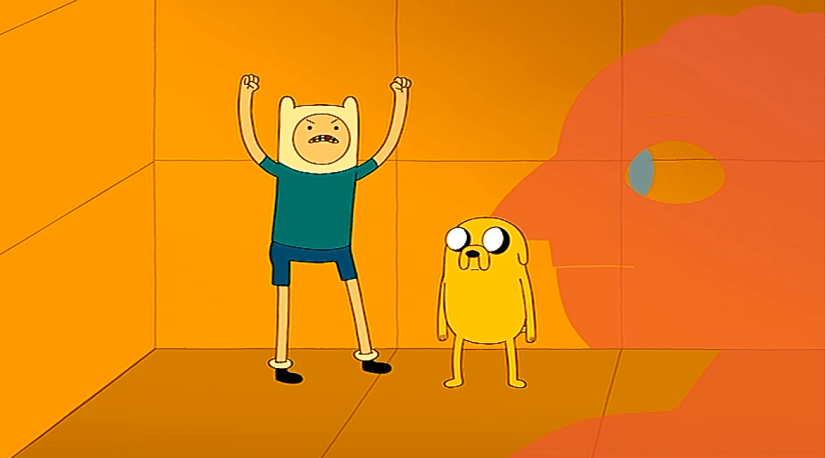
The demons all have relatively neat and creative designs despite the fact that they’re mostly limited to be translucent silhouettes. It is a bit weird to have demons like Kee-Oth and Bryce who are very detailed and unique in their designs, and then to have a bunch of nameless demons that seem to all seem to share similar attributes exist as the same species. I mean, maybe there are different types of demons based on origin or landscape? Or maybe it was because said demons were surrounded by darkness? I dunno, it didn’t really bother me because I did like the designs of these background demons and the way they moved, so it was pretty easy to glance over the possible inconsistency.

Jermaine proves to be a really sympathetic and likable character in a very short amount of time, and I think his anxieties and stressors are elaborated on in all of the right ways. He isn’t just a stick in the mud for the sake of being a stick in the mud, he was practically forced to be responsible against his own will for the sake of his father, and isn’t able to enjoy the pleasures of life because this responsibility demands his full attention 24/7. Jermaine could simply give up his job whenever he likes, but the one thing keeping him there is likely the burdening guilt that he would feel for his dad. It could be implied that Joshua’s dying wish for Jermaine was to protect all of his belongings, and so choosing a life of splendor and enjoyment would surely feel like a betrayal to Jermaine, who simply wants to obey his father’s desires. This also paints more of a grim picture about the kind of person Joshua was. Again, I’m still in the stance that Joshua was a solid father, but I think his moral ethics and treatment of others certainly come into question. Once again, the demons seem to be somewhat of victims here, as Joshua likely stole from them either for sport or for kicks, even though a majority of these items seem to be of little value or importance, at least from an audience perspective. Second, I think Joshua’s decision to ask Jermaine to watch over the house doesn’t come from the direct reason that Joshua favored Jake, (though, I think that’s an entirely plausible thought; Joshua did give birth to Jake, after all) but rather that Joshua saw him as the most responsible member of the family that would reasonably be able to carry on his legacy with little issues. It was still entirely selfish for Joshua to ask Jermaine to practically give up his life over material possessions, though as much as we’ve seen of this awesome crib throughout the past few seasons, it kind of makes sense. Joshua and Margaret’s house is AWESOME, and filled with many different treasures aside from just demon cups and posters. Their loot collection nearly doubles as a museum of different artifacts and delights, and shows just how much Joshua was able to achieve in terms of loot throughout his lifespan. Of course, this is Joshua’s legacy, though. Joshua was not considering the thoughts and values of his son when he asked him to take on said responsibility, and it’s not fair for Jermaine to sacrifice his own wellbeing for Joshua’s belongings.
J4.png

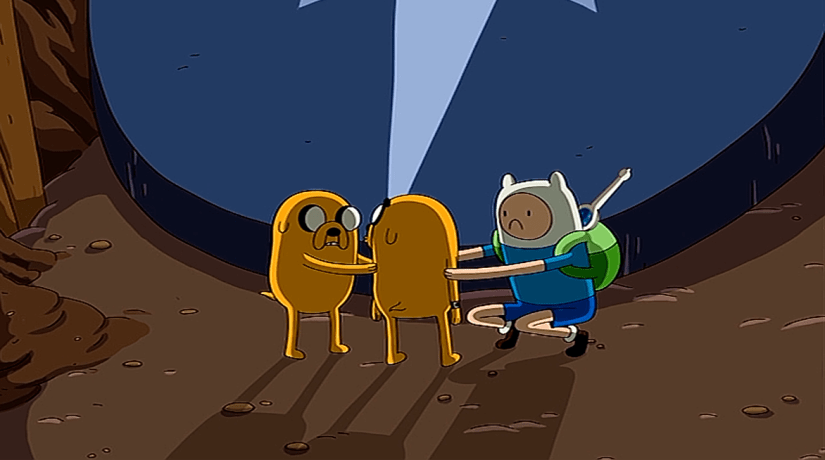
The episode nearly excels at making Jermaine too likable to possibly the fault of its own, as Finn and Jake can come off as almost distractingly pesky. I wouldn’t say the brothers are completely flanderized or anything like that, but it is frustrating to see F&J cause consistent problems in Jermaine’s state of being when he just simply wants to be left alone. Granted, Jermaine needed that extra boost of frustration and anger to help him realize the true issue at hand, but I wish the brothers were a little more conscientious in regard to his well being. I mean, how did Jake NOT know that the salt trail outside was protecting the house from demons? Granted, the two bros still get their moments of likability. Finn going absolutely berserk after being in his house for the first time in years was just delightful, and I do like how the bros are completely on Jermaine’s side throughout the entirety of the episode, even when it means going against their dad’s wishes.

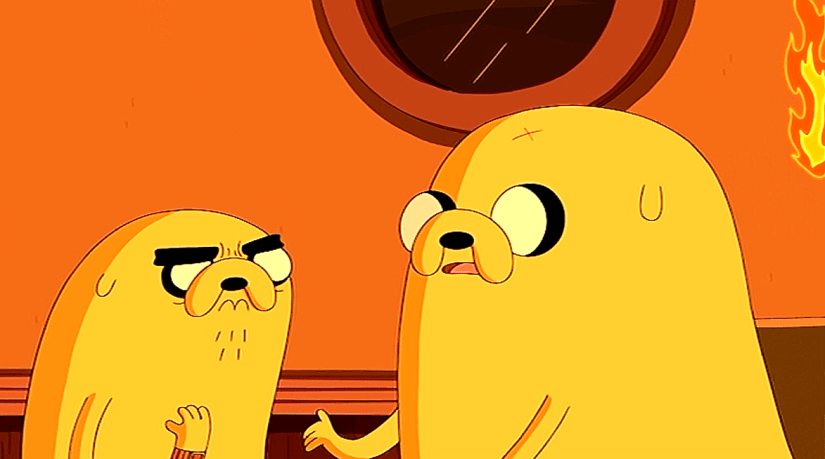
Their support is futile, however, as Jermaine finally blows up and lashes out at his two brothers, but with most of his anger aimed towards Jake. And this built up anger is completely understandable as Jermaine’s absolute jealousy towards Finn and Jake’s way of life. How could he not be filled with envy? Jermaine is stuck in a position that he mentally has no way out of, where he has absolutely no way of growing personally or enjoying life as it was intended, while Finn and Jake get to live in utter luxury for doing what they love and never have to worry about money, responsibility, or fulfilling their own desires. While I thought Kim Kil Whan was too harsh in his approach to showing Finn and Jake that they’re privileged beings, I think Jermaine’s blow up is completely sympathetic and rational, and his level of inferiority is certainly felt. Joshua likely enjoyed hanging out with Jake more, because of Jake’s desires to be adventurous and to fight bad guys, while Jermaine was always the smart and rational one. Joshua presumably loved Jermaine as much as he loved his other children, but saw different things in him that required attention to different responsibilities, while Jake was the one that Joshua could have fun with and relate to the most. However, Jermaine’s argument is based on his surface level understanding of Finn and Jake’s style of life. I don’t know if anyone else caught this, but that brief shot of Finn’s distressed face as Jermaine utters, “you can go off and find your own fancy ways!” kind of made me think that Jermaine has no idea that his brother went through severe depression and emotional issues in the past few months. Finn and Jake may have luxury at their fingertips, but they’re certainly not immune to the struggles and trials that life has to offer regardless, though Jermaine fails to see that because of how long they’ve been apart for.
J5.png

The fight is certainly entertaining, with more fun little details, like the flying shoe and the “jazz-bazz” dragon, and the words exchanged between Jermaine and Jake are certainly dramatic. I think it might be executed a little too silly in hindsight… I mean, it’s essentially ended by Jake repeatedly passing gas. But, I think it’s well-timed, as Jermaine begins to realize towards the end of their brawl that fighting Jake isn’t going to accomplish anything. As Jake reminds him, “you could’ve left at any time,” leaving Jermaine to recognize that his grief is likely with his father, and his own decision to not move on from said guilt. I even kind of think that Jake’s goofy response may have tied into his youthful fart jokes that he was describing, and the fake fart he released as Jermaine hit him may have been a method Jake used as a child to cheer Jermaine up. I do wish Jake was a tad more serious during this scene, as he responds a little too casually to the whole ordeal, but it also reinforces how Jake deals with these types of situations to begin with. He isn’t a fighter, and would much rather solve his issues with jokes and joy rather than with fists. And, after Jermaine does release all of his negative energy, he’s able to tearfully let his parents’ house burn down, knowing that a whole new life exists for him beyond the materialistic nature of Joshua’s possessions. He’s off to a great start, as he and his newly-found demon buddy Bryce walk into the horizon. Bryce is cleverly voiced by Jon Wurster, who is Tom Scharpling’s co-host in their podcast series The Best Show. Steven Universe beat this team-up by only two weeks in Story for Steven!

So yeah, I think Jermaine is another really great family drama based episode for the series. F&J can get a bit bothersome at moments, and the episode can also be a little too goofy when it isn’t warranted, but I think everything else is shed in really great light. I never imagined Jermaine would end up being this interesting of a character, but Graham and Moynihan worked with his personality really well. Jermaine works off of jealousy, inferiority, depression, and guilt in an exceedingly impressive way, and is supported by great animation, characters, and a really neat setting. While I’m writing this, I’m gonna put this theory to bed right now while I have the chance: I don’t think Martin was supposed to be in that picture on Joshua and Margaret’s wall. The storyboard clearly suggests that it was just intended to be two random sticks figures within a picture, and while it may have been implied at the time that this would be a picture of Martin and Finn’s mother, how would Joshua and Margaret even acquire this? Wouldn’t Finn pass by the picture and think, “hey, why are there two humans in a portrait on our wall? Are they my real family, or something?” It just doesn’t make much sense, and I think it was merely either an animation misinterpretation, or it was included to be up for debate, but I’m willing to say that there’s nothing of substance to come out of this little detail, and I think it’s better left ignoring.

Jermaine also has a special outro, with the Booboo Sousa song replacing The Island Song. The Booboo Sousa song was co-written by Jesse and his brother Justin.
J6.png

Favorite line: “Give me my cup, or I’ll skull-cup you!”

Adventure Time, Animation, Lifestyles

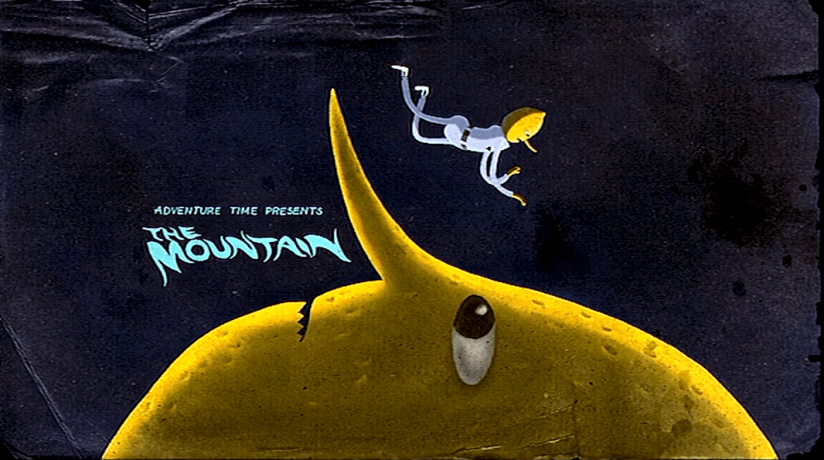
“The Mountain” Review

TM 1.png

Original Airdate: February 12, 2015

Written & Storyboarded by: Sam Alden & Jesse Moynihan

The Mountain is possibly Adventure Time’s most ambiguous episode to date, and it’s definitely difficult to understand. I wasn’t really excited for more Lemongrab when the premise for this one was released; I had kind of thought Lemongrab’s arc was finished by the time Lemonhope aired, and didn’t really want the character to be milked any further if there wasn’t a legitimate new direction to take him in. And apparently, Jesse Moynihan thought so too. On his blog, he detailed how he thought of the story for this one right as he was falling asleep, and he actually have a great sum-up on emotionally ambiguity in television in general. I’ll leave some of it below for reference:
“In my mind, the thing I really wanted to get away from, was the complete narrative handholding that embodies not only kids television, but almost all television: The ideology that demands we understand at all times what the character feels, what the conflict is, how exactly the audience should feel, and maybe the moral message. Even on shows I really dig like Game of Thrones, or True Detective, there’s very little ambiguity when it comes to how the audience is being manipulated to feel. Often times, in lesser TV shows, the writing acts as a rote, step by step instructional guide for how we should emotionally proceed as an audience. What’s funny is how well it works, despite its fake hackiness. Someone on screen yelling “I am mad at you! You killed my father! But I need your help!” or “I feel X because of Y, so you should Z” in the dumbest way possible can still have an impact on me. If I give in to the scenario, I guess part of me gives up an aspect of emotional control or something. It’s passive engagement with archetypes and familiar emotional cues. I’m willing to participate in passive engagement, but I greatly prefer the idea that entertainment may reflect the poetry and ambiguity of life.”

It’s a pretty neat mindset, and kind of addresses the experimental nature of season six, and the anxieties that went along with its production. During this season, Adventure Time has churned out some of the most different and unique eleven minute stories that television has ever seen, but again, as Moynihan touched on in his post, it’s hard to say that this is actually what people want to see. In fact, it isn’t! So many people left the AT bandwagon for Steven Universe at this point in time, and not to say that this is a bad thing, but SU is much, much more open about the issues each character is facing and how it affects themselves, while Adventure Time, or at least Moynihan, was trying to get away from that method of writing all together. Thus, The Mountain aims at tackling the complexities of both Finn and Lemongrab’s own insecurities, without making anything apparent. While it’s chock full of Moynihanisms, it’s also the storyboarding debut of Sam Alden, who is one of my favorite storyboard artists and writers on the show.
TM 2.png

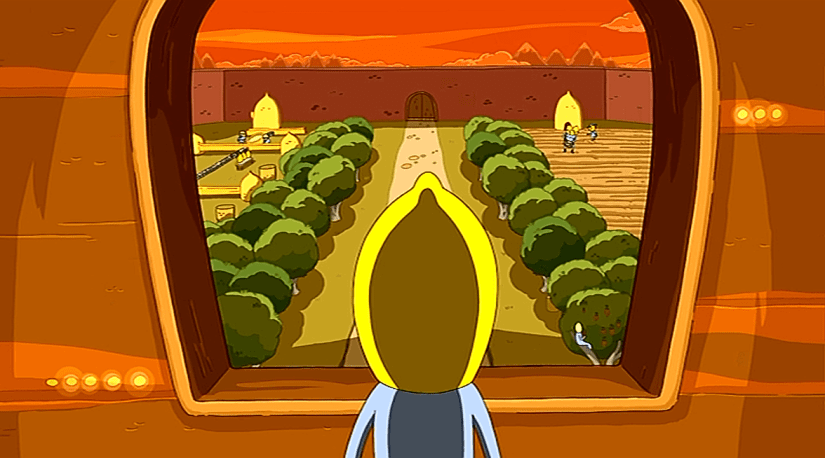
The opening provides some nice insight into what Castle Lemongrab has been up to recently, and it seems like all of the Lemon People are being treated relatively well. Granted, Lemongrab still receives the “royal treatment” and keeps everyone on a strict schedule, though nobody in the kingdom seems opposed to it, as they seem to be at utter peace. That is, except for Lemongrab of course, whose failure to be content in his own skin is represented by the crack in the mural on his ceiling. We saw those who struggle with their own disappointing lives back in Astral Plane, but here, Lemongrab is outright refusing his own being. It’s an existential crisis that has him searching for more than just self-satisfaction, but a search for something deeper and greater for his own being.

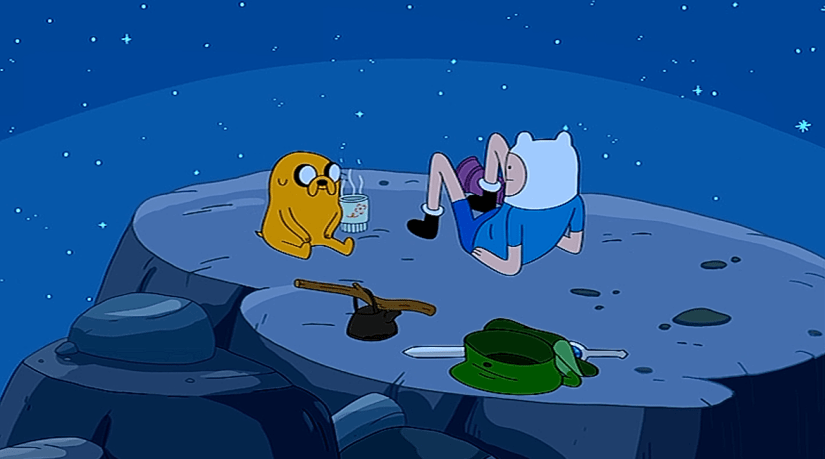
On the other side of things, Finn and Jake enjoy yet another campfire bonding session together, as they prepare to watch the “Dap of the Heavens,” which just feels like Adventure Time in its most classic form. Those fun times end when Finn discovers Flame Princess and Cinnamon Bun working out nearby, which once more reinforces that Finn isn’t really over her entirely. I absolutely love the show’s commitment to Finn’s inability to completely move on from his ex-girlfriend. A lot of break-ups in television are glanced over after the course of a couple of episodes, but here, even an entire season later, Finn is still struggling. It’s painted refreshingly in a different way here, however, as Finn seems more anxious than anything. After a period of growth, Finn likely realizes just how embarrassing his actions were towards FP in the past, and is haunted by his own mistakes. This is why I really like his statement of, “I need to distract myself with work.” After a period of depression, Finn realizes that he can’t accomplish anything by merely allowing himself to feel bad, and that he must shift his focus onto something more productive. It’s really sweet to see how proactive he’s become.

TM 3.png

Though not above all issues, it seems, as the guardian of the Mountain of Matthew acknowledges that Finn is filled with “way cray beeswax.” This likely is addressing the onset of problems that Finn began to experience following his break-up with Flame Princess, and how all of those negative, raw feelings are being brought back at the sight of her.

The inside of the Mountain of Matthew is pretty nicely designed, though nothing I would call especially remarkable. I actually felt its interior was a bit too reminiscent of the tree domain in Little Brother, though they aren’t entirely identical. It’s here where Lemongrab experiences the door trial which propels him forward. Since he and Finn both share a similar experience, I’ll quickly jot down what I think each door represents and then elaborate on it:

  1. Desire.
  2. Fear.
  3. Empathy.

Through the first gateway, Lemongrab sees PB with a catcher’s mitt, and asks Lemongrab to play with her. The use of a catcher’s mitt to represent Lemongrab’s loneliness is first utilized in You Made and is referenced again at the beginning of the episode. What Lemongrab wants most of all is to bond with his mother unconditionally in the strongest way possible, which is, in his lemon-y mind, playing a game of catch. The second door features Lemonhope in a successful place as the ruler of Castle Lemongrab, which shows Lemongrab’s absolute inadequate feelings towards his own status. Aside from having a relationship with Princess Bubblegum, Lemongrab has always wanted to feel successful in his own skin, and successful as a ruler of his own kingdom. Watching someone who strayed away from his sour ways be able to actually run the earldom better than his own self is deeply stressful for Lemongrab, and interferes with his own view of his place in the universe. The empathy card with the last one is definitely the most questionable, but Lemongrab’s caring feelings for his china doll, and the possible remaining feelings he may share for his brother, propel him to act unselfishly and do something for the greater good, which allows him to move forward.

TM 4.png

As for Finn’s experience with the doors, things go quite comparably. Through the first door, Finn has the opportunity to take Cinnamon Bun’s place, both physically and metaphorically, to “be with” Flame Princess. The second door has Jake and BMO about to feast on Finn cakes, without the company of Finn, which could simply represent Finn’s simplistic desire to possess his special cupcakes, or it could picture Finn feeling like he is ultimately left out of something. Finn can be a bit clingy and possessive, so it would make sense that his fear is something that reflects his underlying need of support and love. The last door doesn’t show much, aside from a giant butterfly (Finn’s spirit animal), though the screams of Lemongrab can be heard in the background. Finn, like Lemongrab, chooses the path to empathy, rather than something that will directly benefit himself.

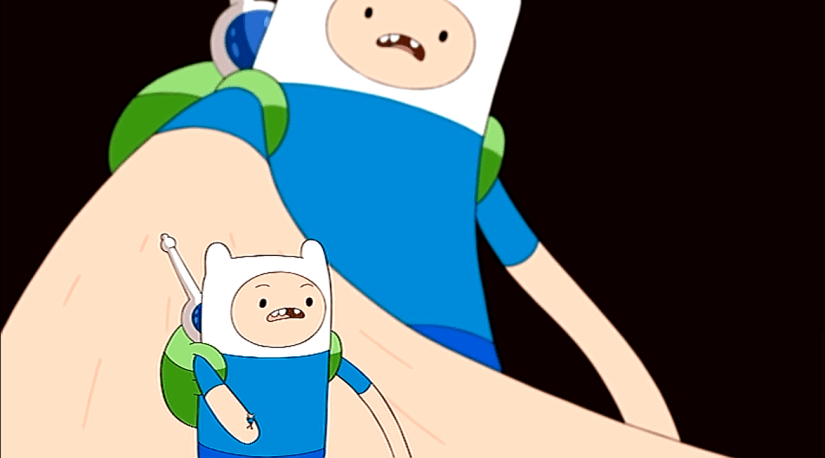
During a retrospective trial where both Finn and Lemongrab are met with massive versions of themselves, things start to get really trippy. Lemongrab’s experience while walking on his own body has him come to terms with the fact that he is coated in grease, and that to be a lemon is inherently to be “greasy.” Lemongrab was referred to as “Lemongrease” by the Pup Gang in You Made Me, though he strictly denied being such an entity. Here, after spending time on his own body, Lemongrab finally realizes that he is “grease.” Whether this means he’s a buzzkill, a dickhead, or a real out loud flim flammer, Lemongrab verbally acknowledges that he himself is a troubled being, though he also rejects this aspect of his life. As he chooses to progress forward to meet Matthew, Lemongrab bids farewell to his current self, in the hopes that he’ll find serenity and peace once he leaves behind all of his flaws and imperfections.

TM 6.png

While Finn’s experience through this portal isn’t nearly as reflective, there are some cool thing to point out. Finn continuously runs on his arm, which is missing in the vision. I believe this is in reference to the reinforced message that, even though a part of Finn’s self returned when his arm did, he still is not fully “whole.” This is shown in Is That You? with Finn’s thorn, and is displayed here as a means of showing that, while Finn’s arm is back, it isn’t fully there. Finn’s childlike happiness has returned to him, but it will never be the way it used to be entirely.

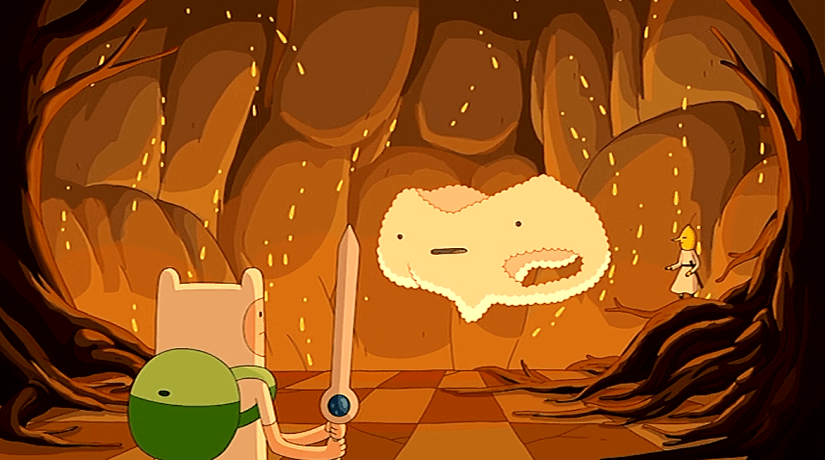
All of this boils down to the climax, with Finn and Lemongrab meeting up with Matthew. It’s both the coolest part of the episode, and the most confusing. But I’ve pieced it together as much as one can, and after years of reading what others have said, and as well as what I myself interpreted, it seems more apparent. Matthew states:

“The meat-bodies who have journeyed to this mountain have distilled themselves to their original source materials, and now exist in oneness.”

Matthew is essentially a cult leader or a false prophet of some sort, offering peace and restoration when the second end of the world comes, and for anyone who can no longer find peace and meaning in their own lives. Essentially, Matthew boils people down into being thoughtless, desireless beings who merely follow in the path of one ultimate sense of power that gives them meaning. It is cool how Matthew isn’t necessarily presented as a villain; like everything else in this episode, his state of being is ambiguous. There’s nothing that suggests he’s downright malicious, though his ultimate downfall is the fact that he destroys the free will and identities of other beings, but only at the expense of their original choice to sacrifice themselves to become something greater. This is why Lemongrab came; Finn states, “I know ya got issues,” and that’s exactly what propelled Lemongrab to choose a new path of being: to surrender his worldly and inner problems, and to become part of something bigger than himself, as many do with any kind of religion. Though, Lemongrab’s ultimate ego is what leaves him unable to surrender himself to Matthew. As he pulls out the remaining Lemonjons (or lemon candies) he gathered from his dinner, he realizes that the Lemonjons, being greasy and “flawed” could break Matthew. Lemongrab exclaims, “if you are the head that floats atop the ziggurat, then the stairs that lead to you must be infinite. Infinite stairs are UNACCEPTABLE!” Lemongrab knows that, to actually be something or someone as great as Matthew, the path to become undoubtedly perfect offers an impossible destination. Lemongrab came to the Mountain of Matthew to find peace in his state of being, but as it has been enforced time and time again, in Lemongrab’s mind it’s “his way or the highway.” Lemongrab fails to understand why he should give himself up to be like everyone else, because even though he isn’t fully happy with his life, he knows that he doesn’t want to lose his lemon-y essence in the end. The imperfect nature and utter “grease” of the Lemonjons causes Matthew “perfect” nature to erupt, and to show the true face of his followers, who are all identical and unremarkable, showing that his followers truly did sacrifice every sense of their being. It’s complicated to know if what Lemongrab did was right; these people are clearly upset with his actions, and while I don’t think the nature of Matthew was truly authentic, some people would much rather be apart of something that helps them feel more special and unique, even if it does stifle their own individuality and characteristics.

TM 5.png

But, the important part story-wise is that Lemongrab did successfully achieve solace through his experience in the cave. As he returns home, he spits the remaining gunk of the Lemonjon he was chewing into the cracked mural, and utters, “yo, yo, it’s grease!” It shows that even grease, something that Lemongrab once revolted against, could be something that’s filling and purposeful. Lemongrab is “grease,” but his overall acceptance of himself and his way of life is exactly what he needed to feel more comfortable in his own skin. Lemongrab does as he will, and his acceptance of how he does things, and the reassurance that they do embody something meaningful, gives him a reason to chill out and let things be.

Woof. This one is a doozy, y’all. And honestly, it’s hard to put into words exactly how I feel about it. It’s certainly interesting, and there’s no denying that. The themes and metaphors it presents are often difficult to read into, but provide this episode with a ton to work with when it comes to those deeper, analytical expeditions, as this review was. So it’s definitely intriguing, but does it work on a surface level? Well… I think it depends on the person. This is one that took several viewings for me to get fully invested in; there’s so much going on that it takes a lot of reading into to fully understand what’s going on in the story, which can certainly be frustrating. There’s other things holding it up: the environment, atmosphere, and trippy visuals are certainly a treat. Some of the trials that Finn and Lemongrab go through aren’t entirely difficult to understand, and Lemongrab himself is, as always, hilarious. My favorite bit is the running gag in which he simply utters “bye” before abruptly doing something extreme. Also, the scene where he kills the guardian, as Finn responds, “dude, I was gonna ask him to move,” had me in stitches. Granted, I still think the ability to get behind the actual themes and story of the episode is a big aspect, and I can totally understand if people weren’t able to enjoy this one as it is. It almost leaves too much up to the viewer where it feels like you HAVE to look deeper in order to have a pleasurable experience with it. But, as for myself, I do quite enjoy it, though that’s a personal preference and I don’t know how much of a gem it is on its own and how much I could truly recommend this to someone is. It’s an acquired taste, and one I get behind, but it surely isn’t for everyone.

TM 7.png

Favorite line: “You will be served in a pitcher by a little child!”

Adventure Time, Animation, Lifestyles

“Astral Plane” Review

AP  1.png

Original Airdate: January 22, 2015

Written & Storyboarded by: Jesse Moynihan & Jillian Tamaki

Finn no longer suffers from the major depression that he experienced at the beginning of the season, but that hasn’t stopped him from his search for meaning and self-examining behavior. Finn is at the age (likely 16 by now) where he’s beginning to question his own purpose in the world, as well as the purpose of the world itself. And often, when looking at life and its results as a whole, disappointment is certainly one of the most common feelings that we as human beings experience, and the Land of Ooo isn’t a stranger to that either. Finn gets a firsthand experience of how loneliness impacts the people of Ooo, and begins to wonder if living life is actually really worth it. This one is written and storyboarded by Jesse Moynihan and Jillian Tamaki, who joined the AT crew for this episode, as well as The Diary later on. While Astral Plane includes some of those typical Moynihanisms that seem more as though they’d be coming from his mouth than the mouth of our main character, the episode does manage to come off in a pretty natural and interesting way, and does genuinely exude some though-provoking material.

AP  2.png

Not only is Finn beginning to act older and more mature, but the way he’s drawn in this one actually makes him look taller as well. It’s a nice touch, though I wouldn’t really call it a permanent change for his character design. Every storyboard artist has their own take on Finn, so his appearance is never really entirely consistent to begin with. But still, the effort is felt, and it’s really nice to just see how much he’s grown both physically and mentally. His camping experience with Jake is also super cute; I love any moments that showcase the two brothers just hanging out and enjoying each other’s company, and Finn’s ponderous concern about owning pets is just the kind of goofy conversation I would expect them to share, which also ties into Finn’s behavior in the episode.

It’s notable that Finn entering his astral form in this episode is kept mostly ambiguous. While he did so by sheer concentration back in Still, this one has him summoned against his will, which could be contributed to the nature of the comet. But of course, as we learn, the comet is actually Martin’s star ship, so I’m quite curious as to why exactly Finn entered this plane of existence. Was it because of his search for answers that sent him hurdling toward Martin, or possibly just to Mars? Was his ascension inadvertently caused by Martin? It’s tough to know, and I myself don’t have a definitive answer. But regardless, the ride is more noteworthy than the actual destination.

AP  3.png

As Finn laments later in the episode:

“If just being born is the greatest act of creation. Then what are you suppose to do after that? Isn’t everything that comes next just sort of a disappointment? Slowly entropying until we deflate into a pile of mush?”

This is reflected through his experiences in the astral plane, and just how much he realizes by observing other people. Using this quote for reference, I’ll be diving into each character’s story individually.

The first person Finn comes across is Mr. Fox – er, Mr. Fox’s subconscious, more like it. Leaving right where he left off in Another Five More Short Graybles, Mr. Fox lives completely alone in his log cabin, and has essentially only himself to chat with. Thus, Mr. Fox experiences a life of solitude and isolation, but one that’s completely by choice. Mr. Fox is lonely, as Finn notes, but it’s never addressed that Mr. Fox is actually depressed. In fact, his astral self is even somewhat sociable with Finn as he enters in. Yet, Mr. Fox would rather live a life of comfort and peace, rather than one following his dreams or achieving any types of life goals. Finn notes that, while this lifestyle does seem awfully lonely and unfulfilling, it has some perks. People who are lonely often have more time to focus on work and their own personal projects, as Mr. Fox showcases. Though, it argues the question: is it more fulfilling to spend your time alone to work, than to experience life and the outside world? Should one attempt to fill their life with as much as they possibly can, or focus on developing their own skills in absolute seclusion from the outside world? There’s a happy medium for both, but I don’t think there’s a solid solution either way: The former has you sacrificing part of yourself, while the latter leaves you with nobody to share your life with. It’s a dicey path for people who especially love their own work.

AP  4.png

Bounce House Princess, the most obscure featured character in this episode, (seriously, this is her second, and also last, appearance in the series. Kinda weird to see her here, but also welcomed) is the next person Finn experiences on his travels. Bounce House Princess is also an introvert, though one that suffers from a pretty bad case of agoraphobia, and who can blame her? The world is pretty dangerous for a little bounce house, especially when there’s porcupines roaming about Ooo. Bounce House Princess’s dilemma is a sad one; she wants to be able to put herself out there and connect with other people, but she’s too afraid of (literally) getting hurt and/or ruining her life. It shows how dreadful anxiety can be: BHP loathes herself and is angry that she can’t just get out there and socialize with others, though anxiety can be consuming and is something that is somewhat out of her control. And her worst fears actually do come true when she deflates, proving that allowing herself to interact with the world may just be a bad life choice. Poor gal.

Ice King brings to the table his usual awkwardness, though it’s viewed somewhat in a complex light. Here, he’s actually pretty social. He’s talking to ladies at a party, and keeping everyone happy with supplies of ice. Yet, he’s overshadowed by his talent of producing ice, and nobody really wants to get the chance to know him otherwise. He is insane, after all, and everyone in the Cloud Kingdom likely recognizes this. While he’s not outright rejected, it becomes pretty clear that Lauren, the cloud chick, is more interested in Finn than she is by the IK. Thus, Ice King feels lonely, and only contributes to his own loneliness by pushing away the people around him. He freezes all of the Cloud People, thus eliminating a way for himself to be rejected. As Finn notes “it’s like part of him wants to be a sad wong-lord.” While Ice King likely doesn’t want to be sad, he eliminates all opportunities for himself to be happy because of his self-destructive and unorthodox behavior. He wants to be happy, but doesn’t rationally understand people and social cues enough to achieve such bliss. He’s simply stuck in his own awkward ways, unable to move forward because of society’s perception of him, and the fact that he’s never able to make choices to shift this perception. This leads Finn to question, “why would anyone want to be sad?”

AP  5.png

This transitions into Marceline’s tune (it had been months between Princess Day and Astral Plane by this point, I almost forgot that Marceline was even a character) “Yeah Girl, It Stinks,” which is brief, but awfully depressing and sheds light on Marceline’s emotional state as a whole. Practically in response to Finn’s question, Marceline sings about how she pushes away everything and has taught herself to not care simply because everyone she’s ever cared about has either died off or forgotten about her. Marceline also wonders what the point of everything is, because after a thousand years of putting her care and love into the world, everything is fleeting and nothing lasts, and she’ll continue to end up being alone. Marcy realizes that and channels that negative energy into her own creative outlet: music. This causes Finn to question whether sadness spawns creativity, which isn’t completely far from the truth. Oftentimes, sadness and loneliness can be channeled into something exceptionally beautiful through artistic mediums, but like Mr. Fox, is it worth it to feel sad and lonely if it means that you’ll possibly be more creative?

Finn has all of these conclusions about the meaning of sadness and loneliness, but no true answers. It isn’t until he experiences the convergence of space lards, and the birth of a baby lard, that he discovers the true amazing nature of creation and just how spectacular it is. Birth is a nearly unexplainable gift of nature that can ultimately not be conquered by any other event in life as more significant. In general, the scene is pretty gnarly. I love the simplistic design of the lards being used for something so epic, and the continuation of the ever-growing lard species never ceases to amaze me. There’s also the notion that they can see and even know Finn by name, further exemplifying their mystical nature.

AP  6.png

Though, the episode hits its climax as Finn hovers over to Mars, which is awesome to see once more. It’s even cooler to see the CG-animated introduction shot of Mars, which looks like something straight out of Futurama. All of Finn’s lingering questions arise when he’s met with the “G-Man” himself, Grob Gob Glob Grod. It’s cool to see the Glob gang back again, and even cooler to see that Finn essentially turns to answers from “God.” Of course, we have the background story of the “comet” heading straight for Mars, which is a direct continuation of the previous episode. Adventure Time is getting much better at picking up more quickly on story arcs and plot points, and that really only continues to improve with the next few seasons. But back to Finn and Glob’s conversation, this is where Finn begins to drop his knowledge on what he’s learned about the world around him, which is where Glob mentions that, “it’s not enough to have created something amazing, right? What if I just let my Martian super society go to butt?” meaning that anything one creates is deserving of protection and care. Creating is one thing, but managing and allowing that creation to thrive and develop is another. Of course, Finn retorts with the obvious, “what’s the point if we’re all gonna die in the end?” which is inherently nihilistic, but a thought process that’s easy to get wrapped up in. Ultimately, life is short and fleeting, and everything we do and everything we are will eventually come to end, so is there really any point in trying to impact the world, one might ask. This is counteracted by Glob’s decision to fly head first into the comet, ultimately deciding to potentially give up his own life for the sake of his own creation. Thus saving Mars and allowing everyone to continue living their own lives. Glob proves that, even through the disappointment of life, there’s something worth fighting for. Whether it be the lives of others, yourself, or the greater good, there’s always something tying purpose and meaning into the gift of life, and that’s defined through actions and personal impressions of yourself. Of course, not everyone in this episode is able to combat their own lives filled with disappointment: Ice King, Marceline, Mr. Fox, and BHP don’t have any well-defined resolutions, but they’re living regardless, knowing to trust their own intuitions and to keep moving forward.

As Finn states upon landing, “Glob is dead,” which is both literal, and humorously ties into Friedrich Nietzsche statement of “God is dead,” which references that fact that the rise of modern philosophy practically disproves the existence and effect of God. Finn realizes that, with all of the enlightening things he’s experienced, there are more complex ways of experiencing life and its meaning than just by one, solely-defined answer. There are many ways to live life, and many other opportunities, both disappointing and successful, in the future. One opportunity that fits under the category of both is the fact that Martin’s spacecraft is actually the comet hurdling toward Earth, and that his next meeting with Finn is inevitable. Though this really kind of bothers me: a space craft is what killed Glob? Really? Considering that he’s practically God in this universe, I have trouble believing that a machine would be his ultimate downfall. Granted, it makes sense that it wouldn’t actually be the catalyst comet, but it still feels like somewhat of a letdown that Glob was killed by a mere spaceship, and that he didn’t even destroy it in the slightest.

AP  7.png

Regardless, Finn, back in his own body, mentions to Jake that Bounce House Princess needs their help. Following in Glob’s own footsteps, Finn realizes that there’s something in life worth protecting. Adventuring has provided a gateway for the boys to preserve life and to help others in the past, and it truly helps to propel Finn forward into a more rounded and meaningful lifestyle.

I really dig the motifs going on in this one; the whole thing kind of feels like a Graybles episode specifically dedicated to sadness. I maybe would have chosen some different characters for representation… like, it’s cool to see obscure characters like Mr. Fox and Bounce House Princess, but I ultimately think it’s easier to connect with the characters we know better. I think Princess Bubblegum would have been able to fill in the shoes for isolation quite nicely, and maybe even Lumpy Space Princess could have fit in Bounce House Princess’s place. But that’s not a complaint by any means, I still do enjoy M.F. and BHP’s individual roles. As always, Moynihan creates a trippy and psychedelic environment that is pretty unforgiving with how philosophical it gets, and it’s always pretty sweet to see something this unique and different on a mainstream children’s network. Of course, to some it’s pretentious, and I understand where those people are coming from, but man, is it interesting regardless. Moynihan and Tamaki successfully create an interesting concept and environment based on the overarching theme of sadness and loneliness, and leave you with no defining answers, but rather even more questions than you had before. In typical Adventure Time fashion, Astral Plane aims to make the viewer think, rather than to be spoon-fed answers. And in a world with goofy Candy People with noodley arms, it’s always nice to see a little touch of sadness and existentialism.

AP  8.png

Favorite line: “Hey, do you ever say ‘Oh my Glob?'” “No, but sometimes Gob does.”

Adventure Time, Animation, Lifestyles

“Is That You?” Review

ITY 1.png

Original Airdate: November 25, 2014

Written & Storyboarded by: Jesse Moynihan

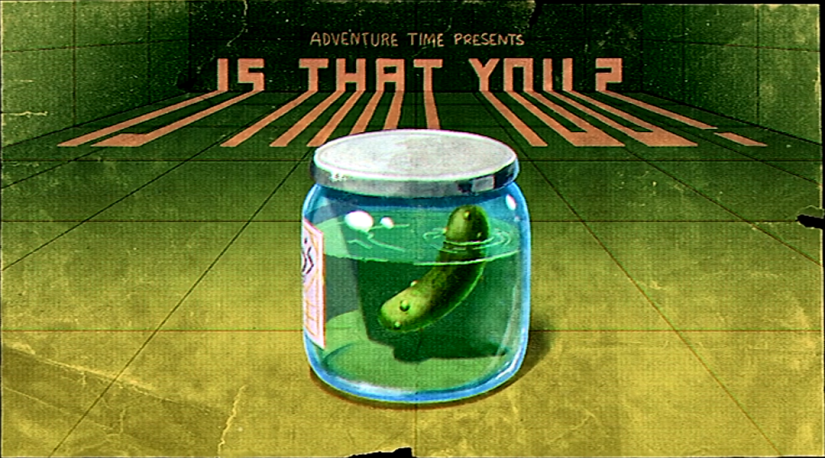
Looking at Is That You? from its premise alone, it easily could have tanked. A quasi-clip show episode that once again defies the status quo by returning Prismo to his former state and centered around a wildly convoluted and barely understandable story created by Jesse Moynihan? Yeah, this one just sounds like a dud on paper, but one that is actually quite awesome in execution. Really proves just how successfully Adventure Time is able to pull off any type of story, no matter how cliched or ridiculous it might sound.

ITY 2.png

As for Prismo’s revival itself, I’m not sure that it’s actually entirely necessary. I mean, Prismo appears about three more times in the series (one of which is a flashback), and Crossover is the only episode where he contributes to the actual story. Now, don’t get me wrong, I LOVE Prismo, but I wish his revival actually played a bigger part in the grand scheme of things. It seems more like a copout when characters in this series are brought back simply for the sake of being brought back, with the most prominent example being Root Beer Guy. Though, as I mentioned, there’s an episode like Crossover that absolutely cannot exist without his presence, so I guess I’m contradicting my own point. And, the way he’s actually revived in this episode seems completely in line with something that Prismo would do/plan. Get the feeling Jesse really understands and enjoys Prismo’s character.

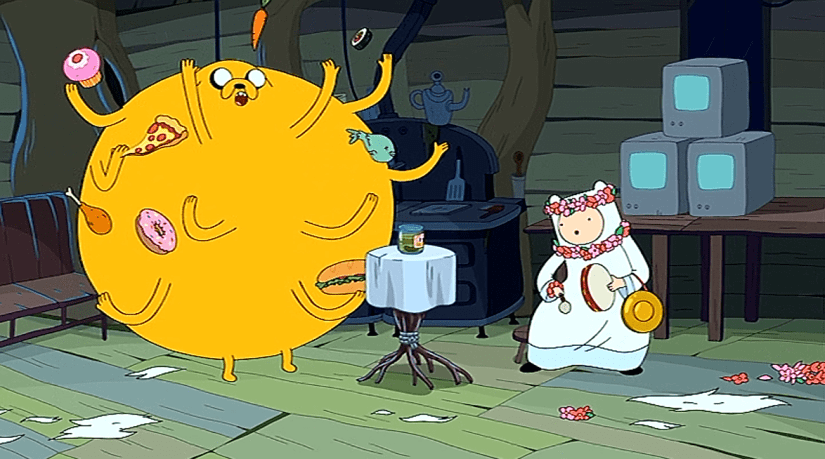
Prismo also finally gets a proper memorial service, and unlike how Billy’s death wasn’t acknowledged for an entire span of a season, this gap of time actually feels like it makes sense. Jake isn’t one who takes to death too lightly and would rather stay in denial than to actually deal with his close friend passing away. The service is certainly emotional for Jake, but it’s once again presented in such a goofy and hilarious way that it avoids being too lamentable. Adventure Time has this really great way of making light of darker situations, though it (usually) never feels tasteless or awkwardly placed. The way Finn and Jake send off Prismo is likely exactly how Prismo would want to be remembered.

ITY 3.png

I think it’s a given that any show that has at least 300 episodes would have a clip show or a recap episode at some point, and Adventure Time has done both, while cleverly subverting tropes and never actually hitting on cliches. Jake’s time-lapsed self recreates some of his all-time best moments, including everything burrito, Bacon Pancakes, and his techno-tuned dance moves from Power Animal. The best part is that the episode actually recycles the exact poses and animation from said episodes, which can really make for some hilarious night-and-day scenes. It’s also quite endearing; just look at that uncomfortably wonky shot of Jake saying “tough boysss!” from Crystals Have Power and compare it to Jesse’s mostly stellar work now. He’s really come a long way since the beginning. The moments themselves are a funny tribute to some of Jake’s greatest hits, and even funnier is that each sequence ends with Jake fucking exploding. It’s a gag that never truly gets old, and it’s even more enjoyable to watch Finn go from being absolutely terrified from such an occurrence to being totally numb to the whole situation.

Speaking of which, it’s nice to see Finn getting some action once again (though not in the Breezy sense)! He had major appearances in the past ten or so episodes, like Ocarina and Ghost Fly, but this feels like the first time in a while that we’re seeing things through his perspective once more. There’s that great shot as he wakes up from his nightmare and notices the now browned thorn on his hand, reminding us and himself that his physical and metaphorical scars still remain very much in tact. Though the episode doesn’t really focus too much on Finn’s own baggage, as he’s more preoccupied with the wellbeing of his brother.

ITY 4.png

And booooy, is Jake’s journey a doozie. It’s an Inception style trek through space and time that feels almost impossible to follow entirely. Essentially, the present version of Jake takes the place of Prismo’s resting spot, where he’s left to sleep before Finn wakes him up, assuring that the present Jake is kept alert while the past version of Jake once again takes his place in the bed, so current Finn can then approach the past Finn and stop him from waking past Jake up, assuring that the two will still be intact even after Prismo’s reincarnation. And if you had trouble following that, believe me, so did I. But the great part is that I don’t really care that I don’t fully understand what’s going on. Finn and Jake, and even Prismo, aren’t even sure they comprehend their surroundings, which is reassuring from an audience perspective and kind of just helps us to enjoy the journey regardless, which is a ton of fun.

The backgrounds in this one are LUSCIOUS. I could’ve sworn from the various staircase-style layers that Derek Ballard actually had some sort of part in designing the backgrounds for this one, but per usual, it’s Chris Tsirgiortis and Derek Hunter, who, also per usual, do a magnificent job. These backdrops aren’t especially complicated in nature, though their lush, painted color schemes and simple, boxed layout make them really aesthetically pleasing. I totally don’t agree with the notion that Adventure Time is the best show to watch while high, because I feel like that undermines its quality even during sobriety, but even then, this is the perfect episode in that category. It’s calming, cool, and bizarre in all the right ways, and really captures the more chill side of Jesse’s trippy writing style.

ITY 5.png

Speaking of which, Moynihan also squeezes in some decent philosophy. Jake is mostly used as an observer in this one, but in a way that’s quite enjoyable. I love all of his little observations, especially his acknowledgement of, “what if the world was just some goof’s dream? That would be dumb.” Dunno about everyone else, but I always thought that touched on the ongoing belief that Adventure Time would end up just being one big dream sequence, which, as this episode states, would be incredibly stupid. Glad the audience isn’t the only one to think so. I also believe Jake thinking out loud is cool because it provides for some rare introspective moments from his character. Though it feels a little too eloquently put for Jake to state, his monologue during the Lich sequence is just great.

“I remember feelin’ like someone had peeled a layer away from my brain, and my reality was no longer anchored to any point of reference, and I had to fight to keep from being crushed under the weight of an unforgiving new paradigm of ultimate reality.”

Never would have thought those words would come out of Jake’s mouth, but it really just shows how in tune to his surroundings that Jake is. Though he’s easily distracted and somewhat absent minded, Jake really does soak in everything he possibly can when he’s invested in particular situations. The Lich aspect of the clip show is also a great reminder that the Lich is still very much alive, even if he’s subdued. Adventure Time has these great little moments sprinkled throughout seasons 6, 7, and 8 to remind us of just how evil the Lich is, even if he isn’t actively cognitive.

ITY 6

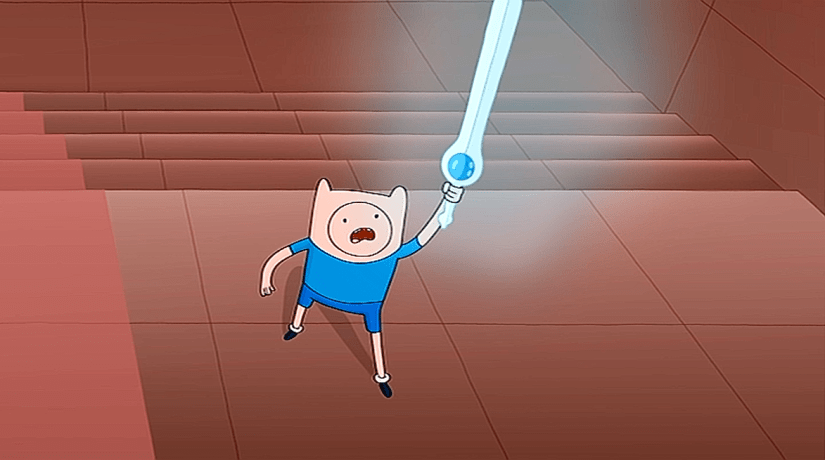
And of course, there’s also Prismo, who set up the entire plan. As always, Kumail Nanjiani does just a super job of portraying his character, and he may just be one of my favorite voice actors in the entire series! He captures the whimsy, charm, and detached nature of Prismo’s character all in one tone, and it always feels like he’s putting his all into Prismo even if he doesn’t have to emote much. The connection between Jake and Prismo is as strong as ever, and even Prismo and Finn form a more heartwarming connection. I love Finn acknowledging that he and Prismo aren’t truly close friends, though they just simply have a strong mutual respect for each other. I think we all know that type of person in real life, and Finn sums it up quite nicely. The icing on the cake is the ending, when Finn essentially kills himself to help to revive Prismo. In a long stance of stagnation in Finn’s life, I think this is just the kind of action that truly shows how heroic he remains. Even with his aforementioned scars, Finn is still willing to put others before himself, even if it means possibly sacrificing his own being. Granted, I think a lot of people could look into this in a much darker perspective, but I don’t think Finn willingly almost ending his life relates back to his own depressed feelings. He simply realizes that Prismo once took a bullet for him, and wants to repay that favor, and he’s rewarded in the best way possible: with a sick new sword. The Finn Sword may be my favorite sword in the entire series; it’s polished, clean, and wholesome, just like Finn himself! I think it’s the perfect visual representation of Finn as a character, and has possibly the biggest effect on the actual story out of all of Finn’s swords, aside from the grass blade. It’s a terrific welcoming back ceremony for the Pris-man.

This one’s just sheer awesome. It takes advantage of everything it has going for it, and though it has some aspects that could have easily come across as pretentious or even cliched, they’re presented in the absolute strongest and most unique ways possible. This is Jesse’s second solo-board in the series, and it fairs much, much better than Something Big. While complicated, Is That You? boasts a thoroughly cohesive story that brings back a very enjoyable character, and celebrates some of Jake the Dog’s greatest moments. And, in a bomb of episodes that goes out of its way to celebrate Jake’s character, this is quite the spectacular tribute.

Favorite line: “These picks were made by our friend to be mouth-loved!”

Adventure Time, Animation, Lifestyles

“Nemesis” Review

N 1.png
Another awesome title card by Derek Ballard, this being his last one in the series. This episode is also his final role as a storyboard artist.

Original Airdate: August 7, 2014

Written & Storyboarded by: Jesse Moynihan & Derek Ballard

Ever since The Suitor, I’ve wanted to see an entire story based off of Peppermint Butler’s interest in the dark arts and how it connects to his character. I think all of us, at one point or another, assumed that Pepbut would take on some sort of antagonistic role and turn full-on evil, but the way this episode presents his character is very telling and interesting. Though he certainly isn’t a hero by any means, his duty first and foremost is to serve Princess Bubblegum, regardless of his interests in the dark arts. I also like how this episode once again ties into Princess Bubblegum being viewed as suspicious throughout the Candy Kingdom, in what is likely the most explicit example of her misusing her power up until The Cooler.

N 2.png

First off, I really enjoy the Veritas Brigade (“veritas” is Latin for “truth”) and the collection of different people who gather for it. It really makes sense that Starchy would be the leader of this sort of thing, and the secretive nature of the group, along with how they practically speak in riddles, is really neat. The password itself to enter the organization, “to beelzebub with the brewer’s knave,” derives from the poem “The Romance Of Britomarte,” to which I have no clue what the connection is, so if you have any idea, let me know in the comments. The group slogan, “lux in tenebris,” translates to “light into darkness.” Love how much was put into establishing this society’s place in the Candy Kingdom, and the various interesting choices for members. Of course, Starchy is there because conspiracy theories are his one true passion in life, but what put people like Nurse Poundcake and Science in there? I like to think Starchy just brought Science there so it would appear as though he had more members. Also love the Banana Guard who wears a big plastic nose and fake mustache to avoid getting caught by PB. Though, that didn’t pan out too well, apparently.

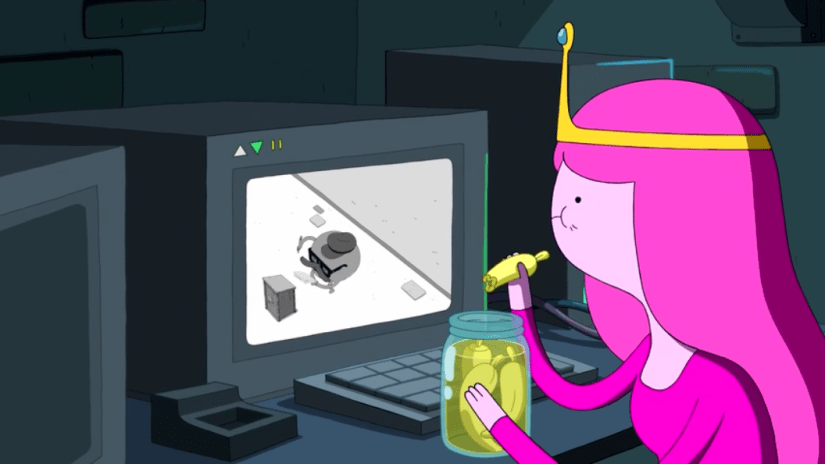
Princess Bubblegum is once again shown spying on her people because, let’s face it, this is her source of entertainment. In her ever-stressful life, it’s almost impossible for her to relax, and her one method of escaping from the stressors of everyday life is to do so in the most “responsible” way possible: watch over her city, or in actuality, spy on others. Of course, she isn’t malicious about it. She doesn’t plan on punishing the citizens who rebel against her, nor does she plan on stopping their meetings. She’s simply being invasive and not respecting the privacy of others, though this is likely a more justified reason than most others. A secret society that bases itself off of Bubblegum’s wrongdoings could potentially get unorthodox or violent, and it makes sense that she would want to observe for the possibility of such an occurrence, even if it’s unlikely. Though, the donut man named Kenneth has apparently built a device that disrupts parallel dimensions, and it actually works, too! I do wonder who the shadow-y figure that Nurse Poundcake mentioned is supposed to represent: Peppermint Butler or Rattleballs? Pretty cool if the main concern from the group in this episode revolves around the intrigue of Rattleballs’ existence. Even though we don’t see him much, it’s cool that he is established to be guarding over the Candy Kingdom at night, where he cannot be seen. Also interesting is that the information that causes the Candy People to question PB’s behavior is actually protecting them from impending dangers. Though it’s also likely this shadow is referring to Peppermint Butler’s strange activities after dark.

N 3.png

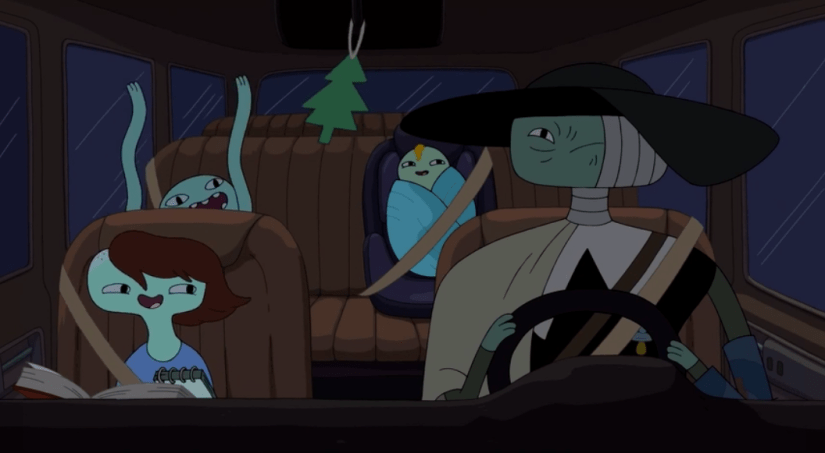
This is where Peace Master comes in: a delightfully hammy anti-hero who pretends to be a lot cooler in his head than he is in real life. He’s voiced by Rainn Wilson, which feels a bit distracting as it seems like including Rattleballs in this one was just an excuse not to find another voice actor for PM, though Wilson does a great job so I’m not complaining. Peace Master gives me major vibes of religious cult leaders who believe they are the savior over everything and that they are an all-powerful being, combined with elements of Batman. Though, PM isn’t the dark and tortured being he seems to portray. What makes Peace Master so interesting, however, is ironically the fact that he’s just a normal guy. Despite all of his abilities and his confidence in vanquishing all that is evil, he’s actually a father who is raising three kids. I love how much Nemesis builds this guy up, with his well-drawn dramatic faces and his menacing exterior, only for him to come off as a pretty lame dude when it comes down to it. Though I dunno, is it a little too mundane for anyone else that he just casually drives a minivan around? Who in the Candy Kingdom actually drives automotive vehicles? It seems too out of place for the setting, but I digress. I like how Peace Master even acknowledges to his children that he was pontificating, and just how much his children rebel against him. His children are essentially more down-to-earth than their father; Peacemaster dismisses the dark arts as nothing but monstrosities that deserve to be excluded from society, though someone like Peppermint Butler would prove that there is a balance between practicing such magic and also being a totally cool dude. Speaking of the peppermint man, his role in the episode is defined by PM’s defiance of such practices.

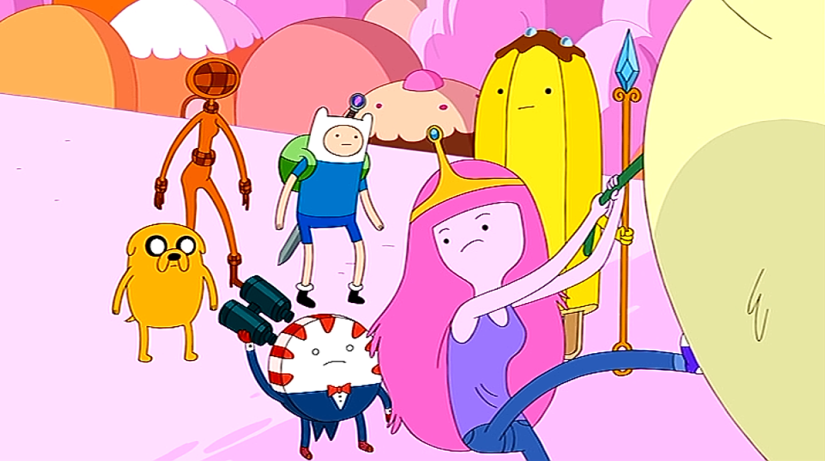
PB’s desire to shift the kingdom into full red alert mode is a lot of fun, namely the return of Colonel Candy Corn in a much more enjoyable appearance after his large role in Something Big. Something tells me that Jesse Moynihan just really likes this character for some reason. Regardless, his comments about his state of being and the nature of the Banana Guards were both hilarious, and it’s refreshing to see a member of the Candy Kingdom military who is actually relatively competent. Speaking of competence, PB calls upon the aforementioned Rattleballs after awkwardly avoiding the discussion revolving around him, in a pretty funny scene featuring an actual training session between Finn and himself! With Jake included, of course. The scene is pretty humorous in the fact that I have literally NO IDEA how such a skill is actually beneficial for Finn to use. It’s always fun to see Rattleballs, and it’s equally fun to see Finn and Jake by this point. I appreciate the direction that the show has taken to where they are able to focus on various different characters without the company of Finn and Jake, but their presence is still missed. It’s a lot different going back and watching these episodes now, where I can appreciate them more for what they are, rather than how they aired. Though I still enjoyed Nemesis upon airing, nearly a month of AT episodes had aired without Finn and Jake having a role, and I truly missed my boys by the time this one came along.

N 4.png

It’s funny how I’m only now realizing that the true meat of the episode, which is Peppermint Butler’s conflict with Peace Master, only comes into play about halfway through the episode. Yet, I think the beginning of the episode does a pretty solid job of creating a sense of urgency throughout the Candy Kingdom, which is just as important. The atmosphere which leads into Peppermint Butler’s experimenting is really what helps to create a justification for such behavior. And man, is Peppermint Butler’s transformation seminar just awesome! His spiritual avatar itself is nothing special, but the bit where the boxed walls are torn apart and transition into an A-HA inspired sketch sequence is just awesome! These past couple episodes (Ocarina, Crabapples, and Nemesis) have all incorporated unique animation and art sequences that derive from the show’s usual fare, and it’s awesome to see how ambitious the series is able to be with every single episode by this point. Really feels like season six as a whole has shown an effort to be completely different on all levels. The exchanges between Pepbut and Peace Master are pretty enticing, namely the camera angles and how each side has their own unique powers. That blade that Peppermint Butler pulls out of his shoe is especially gnarly, even if it is virtually ineffective. Though PM is liked by his acquaintances of Veritas Brigade, I enjoy how everyone virtually sides with Peppermint Butler for simply being a cool dude. It really goes to show how much Pepbut has masked his identity over the years; though a participant of the dark arts, Peppermint Butler is laidback, polite, and a total bro, which helps shape his identity where PB fails. Peppermint Butler is essentially just as shady as Bubblegum, though he has the people skills and the right demeanor to alleviate all suspicion from himself. The way Pepbut is saved through Kenneth’s machine is also a pretty awesome callback. I’d love to see more of this Kenneth fella.

After the two separate, PM and Pepbut meet back up at the always visually interesting Wizard Battle arena (complete with a beautiful sunrise) and the atmosphere is certainly tense. The way Peppermint Butler enters, as he’s carried by that awesomely bizarre brain creature, shows that he seems to have the upper hand. This is proven right when he goes as far as transforming Peace Master’s children into literal monsters. It’s certainly a disheartening experience, though I enjoy the way it’s presented. Peppermint Butler isn’t in the right, and the episode doesn’t go through any methods to prove as much. Peace Master is essentially the hero who wants nothing but to defeat all evil that faces him and to make the world safer for his children. What makes this “wrong” is that he’s threatening the state of the kingdom, and its main ambassadors, even though he isn’t inherently wrong in his mindset. What makes Peppermint Butler “right” is that he’s doing everything he can to protect the princess and the Candy Kingdom, even though he goes through extreme lengths to do so. It’s a really interesting scenario where the technical hero is presented as a villain and the technical villain is presented as a hero, and Nemesis presents this a hell of a lot better than the previous episode Princess Day attempted to. What stops it from becoming absolute tragedy, however, is that the children actually like their transformation, and Peace Master grows to accept dark magic and monstrosities because of it, making for a relatively touching close to his character. It’s still a completely unfortunate situation for himself, though it isn’t portrayed in the most horrific way possible. Also like how “eating dirt” is going too far for Peppermint Butler, but turning his children into monsters is not. Again, Nemesis does this much better than Princess Day.

N 5.png

But of course, after the entire situation fizzles out, Pepbut returns to his quarters, with little evidence that he was ever involved. Not even Princess Bubblegum knows the full extent of Peppermint Butler’s dark interests, though his demeanor once again proves just the opposite. Peppermint Butler is a complex soul who keeps himself presentable in the most appropriate of ways, yet will do what he must to protect what he stands for. Letting anyone know of his involvement in such sorcery would only confuse and put off most people, and Peppermint Butler knows this. He simply keeps to himself, but uses his powers for all the right things. At least, in his perspective.

The best way to describe this one is “cool.” It has some cool ideas, new characters, new developments from pre-existing characters, atmosphere, animation sequences, and more. It’s not necessarily the most amazing tertiary character spotlight episode, but it executes a lot of elements pretty well. It’s just the kind of Peppermint Butler episode I wanted, and aside from The Suitor, this is likely his best role to date.

N 6.png

Favorite line: “Sorry, I hate evil so much.”

Adventure Time, Animation, Lifestyles

“Something Big” Review

SB 1
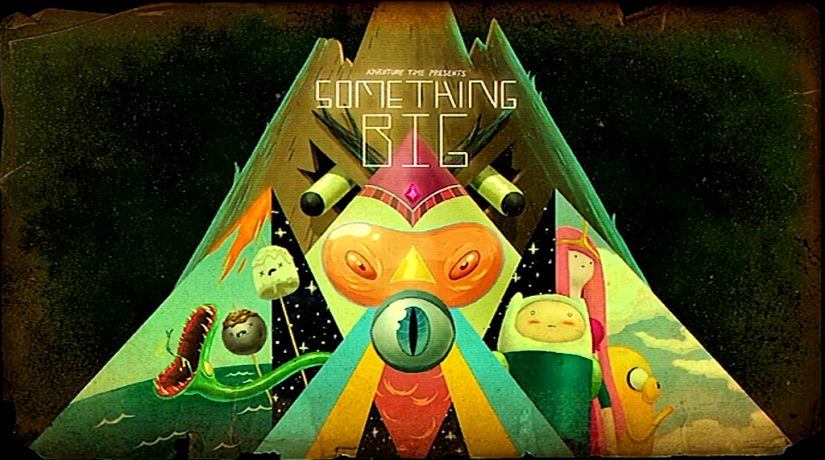
One of my absolute favorite title cards in the series. Designed by Michael DeForge and painted by Teri Shikasho.

Original Airdate: July 3, 2014

Written & Storyboarded by: Jesse Moynihan

As Jesse Moynihan stated, about half of Something Big derives from the scrapped 45 minute Adventure Time TV movie. A bit of background about this TV movie for anyone who isn’t in the know: the 45 minute special was created about midway through season five, but its parts were so dissonant from each other and it didn’t have a cohesive ending, so it was scrapped entirely. Jesse suggested that they try and cannibalize said parts into individual episodes, which is where Something Big came from. I’m really hoping that storyboarded segments of the scrapped special are posted online by the staff eventually, I’d love to see what it was like regardless of quality. But anyway, Something Big gives us a look at how colossally huge, and colossally messy this story could have been. Seriously, some of the set pieces in this episode are terrific, but it unfortunately feels like one big disjointed mess.

SB 3.png

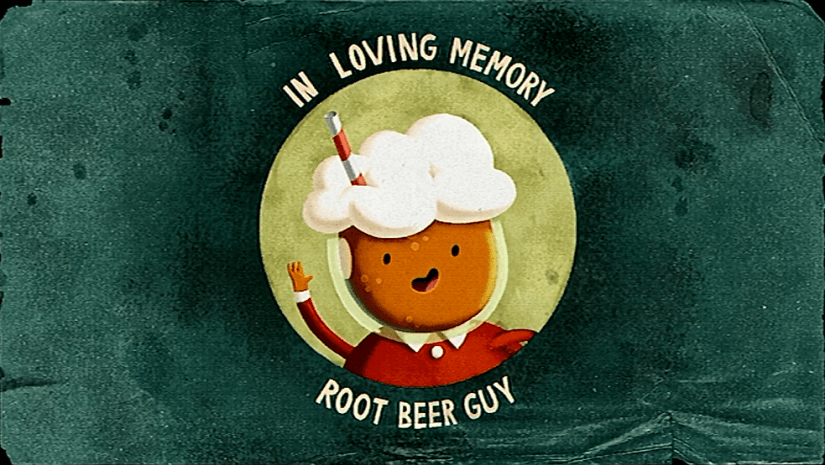
The episode begins with the Candy Kingdom in full-out war, a revolt led by none other than Maja the Sky Witch (who now has eye-whites for some strange visual reason). And, one of the first developments in the plot we get is that Captain Root Beer Guy sacrificed himself after setting up the force field to contain Maja and Darren, the Ancient Sleeper. Well, okaaay then. That’s one way to start off an episode! In all honesty, I think this was a pretty mediocre way to kill-off such a likable side character, but it’s not even really his death that bothers me. RBG had his star appearance in Root Beer Guy, and while I enjoyed that episode and his character thoroughly, I felt like I didn’t really need to see more of said character outside of his debut episode. Yet, the reason for his death is incredibly stupid to me. According to Jack Pendarvis, Root Beer Guy was killed off in an attempt to make the Banana Guards’ incompetency more believable. Just… what? Just because Root Beer Guy is an intelligent commander doesn’t mean that the Banana Guards have to be more educated as a result. It could’ve actually lead to more comedic opportunities if RBG tried to influence the Banana Guards, but to no avail. The reason Pendarvis gave just kind of comes off as a lazy excuse. Furthermore, the Banana Guard Academy comic series, which was written by Kent Osborne, tries to explain Root Beer Guy’s (nearly) permanent death, as PB states that “sometimes, Candy People are so special that you cannot bring them back.” I know it isn’t canon, but that reason is even more ridiculous! Only non-special Candy People are brought back? So PB cloned James 22 times simply because he was un-special enough to go through said treatment? How the fuck does Cherry Cream Soda feel that Bubblegum has all the technology in the world to bring her dead husband back to life, and still doesn’t? A load of bologna, I tell ya!

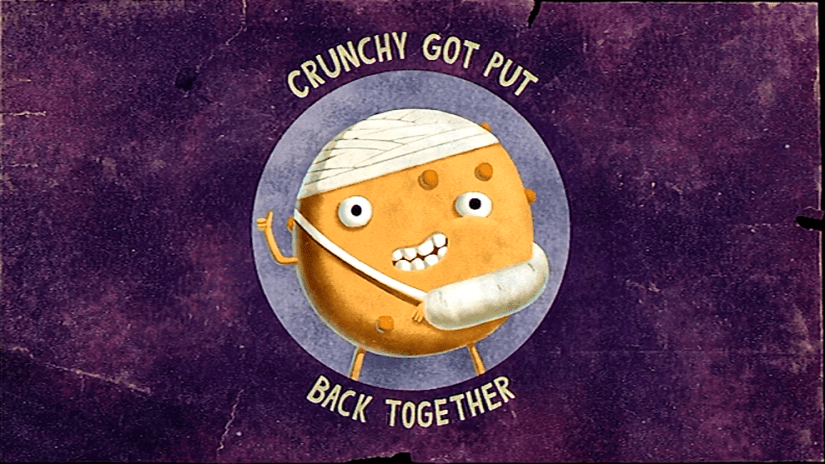
Enough about that, let’s get back to the actual episode. After Crunchy explodes from absolute fear (a nice callback to the rarely mentioned plot point from Slumber Party Panic), we’re treated to a flashback sequence where Maja summons Darren, and it’s pretty spectacular. Darren’s an awesome character; his design really reminds me of the similarly awesome beasts from The Suitor, and his lack of knowledge regarding the current state of the world is both humorous and kind of mythological. I like how Darren knows only life and death, and I really wonder if his existence dates back to before time even existed, where, as the Lich mentions in a later episode, there were nothing but monsters. It’s quite likely, and pretty cool to see that Darren is mostly an anti-hero rather than an absolute source of evil. He doesn’t have any motivation to want to destroy the Candy Kingdom, he simply goes off of instinct. And his instinct is to cause destruction and, likewise, success for himself. It’s pretty funny to see Darren and Maja work off of each other as well; Darren is dramatic and foreboding, while Maja is more playful and bratty. Maja doesn’t want to take over the world or travel across different dimensions. For whatever reason, she simply wants to conquer the Candy Kingdom, though Darren can’t seem to wrap his mind around such a simplistic and motive-driven act. Aside from a character and writing aspect, the scene is a visual treat. It’s lit terrifically, the angles are great, Darren’s size and scope are really felt through his absolutely massive structure, and there’s cool little details, such as how everything begins to move in slow motion when Maja summons Darren. Of course, I get immediate Gravity Falls vibes during said sequence, though I’m sure this was unintentional.

SB 2.png

The next few scenes focus strictly on the war aspect of the episode, as Darren calls upon these somewhat generic looking pink beasts that come out of a portal in eggsacks. Colonel Candy Corn also mourns over the death of his wife and how chicks his age aren’t into dating. It’s alriiight, but it also kind of slows down the overall intensity of the episode. I do enjoy PB’s distant attitude toward his sorrows, and how Peppermint Butler actually tries to help him out a bit. Pebut might be a dark dude, but he’s pretty nice guy when it comes to his fellow candy brethren.

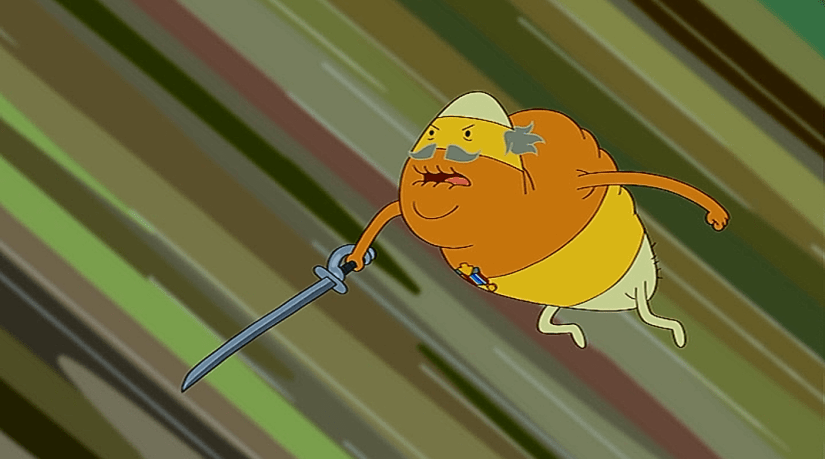
The purely action-based sequences are decent, with some moments really shining, and others that are just subpar. Of course, Adventure Time isn’t an action show, so I don’t really expect top-of-the-line fight sequences. The bits where Darren’s minions are blown up by candy material are nothing special, though, Colonel Candy Corn’s jump into action is pretty awesome. It features some good dynamic shots, some nice sword slicing, and the old veteran in probably his coolest appearance.

SB 4.png

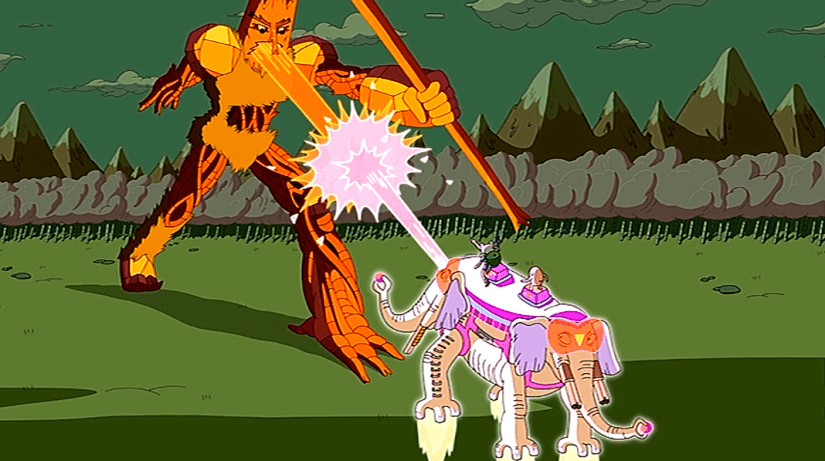
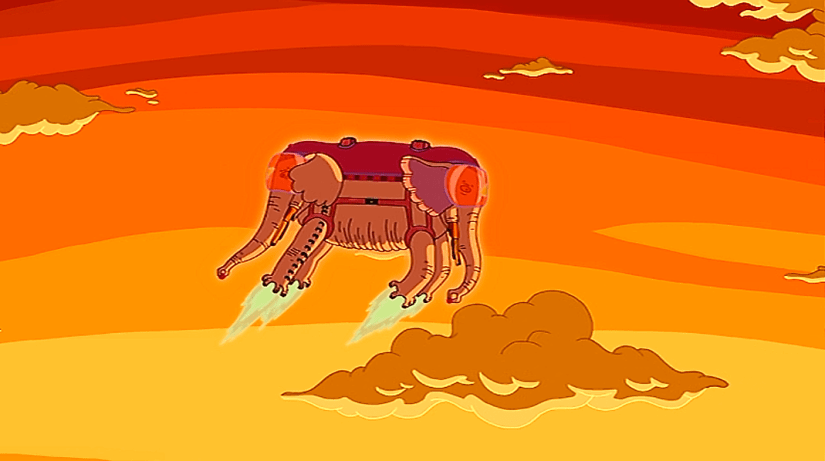
Of course, the Candy Kingdom can’t hold off Darren for long, as he nearly destroys PB, until Finn, Jake, and the Ancient Psychic Tandem War Elephant come to the rescue! It was cool to see Elie get a prominent appearance after his return in Furniture & Meat, and it makes sense that Finn and Jake would conjure up the idea to utilize him after only recently remembering his existence. I think it’s pretty cool that Darren and Elie know each other, and how they both can’t seem to grasp how the current state of the world actually works. Both are beasts from a different time period, and can’t wrap their heads around basic concepts such as feelings, purpose, and free will. As the two face off against each other, they prove to be equal opponents in power as well. It isn’t till Finn is launched into Darren’s brain stem (through another solidly animated and framed sequence) that he’s able to defeat the ancient beast. Darren quickly utters “thank you” before his ultimate demise. It’s a bit of a profound moment, showing that Darren would much rather cease to exist than to live in a world he doesn’t understand or comprehend. In a way, Darren is able to adapt to the current universe paradoxically; though he feels like he is not able to survive in a world where he cannot go off of his basic instincts, he expresses gratitude through experiencing death, showing that he is capable of feeling and showing emotion on some level.

So the day is saved, the Candy Kingdom is returned to its former state (with the exception of the deceased RBG) and everything is resolved. Buuuut, there’s nearly four more minutes left in the episode. At this point, the episode’s tone shifts almost entirely, and completely cuts out any war or action elements to focus on the inner struggles of the Ancient Psychic Tandem War Elephant. This is where Moynihan’s tweaking really shows… it almost feels like a transition into an entirely different episode. While the motif of purpose and meaning that Darren pondered is carried across into Elie’s struggles, I still feel like it’s a bit too disconnected in the way its executed to really work coherently. Darren’s issues were kept subtle and mostly humorous in the background of an all-out war, so this transition into Moynihan’s more poetic and philosophical just feels… odd.

SB 5.png

That being said, I think Elie’s story is generally interesting regardless. APTWE doesn’t even have the same pleasures that Darren has; Darren is able to base his decisions of destruction off of his own instincts, while APTWE isn’t able to bring himself to do just about anything without being ordered to do so. He doesn’t understand purpose or will on any level, he simply wants to be commanded to fight, as that is all he was created to do – or so he thinks. As he views the world around him, he observes the lives of an ant and birds, two creatures who also do not necessarily have free will, but still make decisions based off of their instinct and intrinsic purpose regardless. He then observes the sun, who drops this bit of enlightenment.

“I’m more ancient than you. Someday, I will engulf the solar system. What was and what will be are meaningless. Meanwhile, you should wonder: are you just a two-headed pile of meat on a crash course with the cosmic dump? Or do you contain the soul memory of a million dead stars? How do you light a candle without a match?”

Essentially, APTWE is wondering if he was simply born to die, or if he has greater purpose during his existence on Earth. Without said match, the candle has no purpose. APTWE wants to find a create meaning in his life, but does not understand what to do with this newfound purpose yet. This is where he recruits Maja, of whom he may team up with to destroy the Candy Kingdom, though he hasn’t decided yet. As APTWE mentions, he must be the match and the candle, meaning he has to decide what is best to do with the gift of life before he makes a hasty or wrongful decision. Maja’s less than enthusiastic, as the two fly off together and cause a sentient leaf to fall to the ground, where a caterpillar crawls over to eat him up, as a means of showing the caterpillar’s instinctive purpose in contrast to the leaf. The leaf didn’t plan for such a path in his life, though life often takes us in unexpected directions. APTWE, a creature who was originally designed for only one purpose, is able to discover a new sense of self-worth through his experiences and adapt to a new way of life. Shoutout to this story arc for only returning once in a brief throwaway joke! Seriously, I liked the angle they took on APTWE’s character in this story, but it just feels so incomplete without a proper payoff. Of course, there’s still a possibility that the two characters will return in the hour long finale, though I guess we’re just going to have to wait another three years to find out.

SB 6.png

This episode’s frenetic pacing makes it a bit difficult for me to praise it as a unit. You’ve got high-stakes battle scenes, mythological flashback sequences, some distracting lighter sequences like Colonel Candy Corn’s melodramatic life story, and the out-of-nowhere Elie subplot thrown in at the last minute. This one feels like what people criticized Betty for; where Betty was fast-paced and didn’t really have a chance to breathe, I still think it managed to tell its tale in the best way possible. Something Big feels like three or four different stories that are battling each other for attention. Yet, I still enjoyed most of this episode. I think it had its weaker moments, but it kept my attention throughout, and offered some genuinely insightful and unique elements along the way. I’d rather have a clusterfuck of an episode that’s enjoyable than an episode with one solid story that’s a complete snorefest. Something Big is frenetic and probably doesn’t work as a coherent story overall, but it has some pretty great bits, namely anything with Darren and Ancient Psychic Tandem War Elephant. And as miffed as I was when Root Beer Guy died, I’d be even more miffed when he was eventually revived one season later…

SB 7SB 8

Favorite line: “Yo, leave me out of it!”

Adventure Time, Animation, Lifestyles

“Breezy” Review

B 1.png

Original Airdate: June 4, 2014

Written & Storyboarded by: Jesse Moynihan & Derek Ballard

Breezy is the episode that completely broke Adventure Time’s audience, and the show’s fandom was never the same again. Many fans have viewed this episode as a turning point for its failure to break the status quo, its somewhat pretentious nature, and its implications of horrible circumstances happening on Finn’s behalf. It only makes sense that an episode stirring up this much controversy would be written and storyboarded by Jesse Moynihan himself (with assistance from Derek Ballard, who would later assist Jesse with Nemesis). On his own Twitter, Moynihan described Breezy as “a deeply personal episode, based on things that have happened to me in my life. I hope people find transcendence and beauty in it.” Given that he practically had a visible mental breakdown on his account following the criticism directed at this episode, it can be concluded that Moynihan dug deep and threw all of his emotional scars into this one. And, after years of rewatching this episode countless times, I can’t say I don’t understand why people don’t like Breezy. It is uncomfortable and at times, creepy. And the years of build up that surrounded Finn losing his arm, only for it to regenerate a couple episodes after he lost it, is admittedly a major bummer. Yet, this is a very special episode to me, and one of my all-time favorites at that. When it originally aired, I had been at a very fragile state of mind after suffering from depression for almost an entire year. I was at a point in my life where I didn’t really know where my life was headed or what was in store for me ahead. Then Breezy came along, and I resonated with it entirely. By its end, this episode left me with a beautiful and empowering message that effectively propelled my life forward. I don’t want to say something as ridiculous as “an eleven minute episode of a cartoon cured my depression,” because mental illnesses are much more complicated than that, yet Breezy at the very least showed me something so personal and so beautiful, and unlike anything that I had ever seen on television, that it really helped shaped my view on life as a whole and helped lead me to a much brighter path. Adventure Time in general was an absolute savior during this period of time in my life, and I attribute Breezy as being the breaking point of that period. Yet, I’m not gonna lie, putting this episode into context and talking about it is gonna get pretty fucking weird. Strap yourselves in for this, I ain’t holding back.

B 2

Where The Tower dealt mostly with Finn’s anger and aggression, Breezy focuses almost entirely on Finn’s sadness and lack of feeling. And while the previously couple episodes dealt with the trauma that followed Finn getting his arm torn off by his father, this one throws in the added bonus that he’s still not completely over his break-up with Flame Princess. Finn has lost a lot throughout the past few months, and it seems like he has finally come to a point where he can no longer cope with it. This is Finn’s absolute breaking point, and instead of being defined by a complete mental breakdown, it’s treated much, much sadder. Finn is simply numb to everything occurring around him. He no longer has the motivation and willpower to go about his day normally because he’s lost so many things that brought him joy, and is left only with sad truths about his present self. It seemed as though he was likely to reach this point from his break-up alone, though the dad and arm aspects only added to his pit of despair. A constant reminder of Finn’s sadness and deteriorating lifestyle is his wilting flower, yet Finn doesn’t even have the mental strength to keep it alive any longer. Finn has cared about so many things and people that have left him, so why should he care about this flower any longer? That’s his mindset, at least, and it doesn’t help that Dr. Princess offers nothing but nonsense in in return.

Instead of giving Finn legitimately helpful advice to cope with his unending sadness, she simply orders him to have fun, which shows how dangerous a message like that is. So often, people who suffer with depression will be told to “look on the bright side” or to “not be so serious,” yet these instructions only result in an increase of depressive feelings, as the sufferer is left only with false expectations and a feeling as if they can indeed control their feelings, and just simply are not trying hard enough.

B 3.png

This transitions into a sad, yet simultaneously humorous music sequence where Finn sluggishly drags his body across a forest. “Lost in the Darkness” is one of my favorite songs in the series; it’s a melody quite beautifully carried across by Jeremy Shada’s vocalization, and that of Ashly Burch, who voices Breezy. Breezy is one of my favorite one-off characters; being an adorable creep, Breezy is given life through Burch’s terrific voice acting. Ashly Burch herself joined the story writing team of Adventure Time during the show’s seventh season, and this was a terrific introduction to her presence in the series. Anywho, Breezy’s attraction to Finn’s flower comes across as often obsessive and somewhat disturbed, though I think it can easily be connected to Finn’s previous infatuation for Princess Bubblegum, which also had its darker elements involved. Breezy’s hypersexual behavior comes from her ultimate desires as, well, a bee, though with any desires that a being may possess, there’s often attachment that comes along with it, and Breezy experiences first hand what that means.

As a result of his former break-up, Finn does not want to deal with the emotional weight of a relationship in the slightest, and simply wants to makeout with princesses (a kidified version of having sex with multiple women) and wants nothing to do with them afterward. As Finn acknowledges that he didn’t feel much from making out with Crab Princess, he then concludes that making out with many different princesses must be the solution to his lack of emotion. This is where Breezy assists in Finn’s pursuits: as a wingman (or woman) who helps to set up these makeouts. The connection between Finn and Breezy is certainly dysfunctional. Breezy does not know Finn’s current state of mind, nor does she understand his emotional fragility, so she simply helps him as best as she can to try and get closer to the thing she desires most, to deflower him of sorts. And though her motivations are undeniably manipulative, she is helping Finn in his endeavors, in a misconception that if she helps Finn, he in return will meet her needs. Breezy feels entitled to Finn, or at least his flower, and puts herself in a self-destructive position because of it. Where Breezy’s affection for Finn generally grows throughout the episode’s run, Finn remains entirely centered on fixing his own issues at hand. As he should, as he really isn’t obligated to respond to Breezy’s feelings that he probably isn’t even fully aware of. Finn continuously attempts to fulfill his own needs by kissing other princesses, including Lizard Princess, Muscle Princess, and eventually Frozen Yogurt Princess.

B 4.png

Though, Finn’s efforts are a failure. He masks his feelings of overarching sadness by using random one night stands (I’m just gonna go all out with the sexual metaphors here; we all know what Jesse and Derek’s intentions were) as a means of getting over his old love interests, but this backfires when FYP comes into the mix, and Jake notes that her appearance is reminiscent of Flame Princess and Princess Bubblegum. Though Finn’s hang-up on FP is obviously, I think it’s really interesting that they still went the extra mile to display that Finn isn’t over his original crush either. Infatuation for someone rarely ever goes away completely, especially someone you’re in regular contact with everyday. Finn’s love for Flame Princess was enough to alleviate his feelings for Princess Bubblegum during his relationship, but once that relationship ended, his former feelings began resurfacing. It’s likely that Jake still doesn’t know the full extent to Finn’s pain. Finn is able to talk about his issues to Jake, but likely knows that he won’t fully understand his depression, or even is afraid to tell Jake that he’s experiencing such feelings. Thus, Finn blows up at Jake for bringing up his own insecurities, a rarity in terms of Finn’s behavior. It’s nice that the show was able to squeeze some “teen angst” in down the line, and even nicer that it’s only a smaller moment in the grand scheme of things.

Still in denial about his feelings, Finn looks for validation and advice from Breezy. As the two bond, Finn contemplates letting his flower die after his prior failures. Finn declares that he’s only trying to have fun, probably implying that he sees relationships only as more opportunities for drama and heartache, and that casual, meaningless sexual relationships are the only means to a prosperous life. Breezy combats this by mentioning her status as a virgin queen bee (I still can’t believe Cartoon Network allowed this without some form of alternative) and that once she drinks of her royal jelly to become a queen bee, she will essentially “lose her virginity” and her life as a free spirit will finally be over. Finn views this as a “bummer,” and that Breezy should stay as she is so she can be with as many different people she wants instead of settling for the responsibility of adulthood and maturity. Take the royal jelly metaphor for what you want, but I’m pretty positive that drinking it just translates to finding a mate in bee logic (which is why this behavior is frowned upon later on). Breezy’s one fatal flaw is that, in her casual behavior in simply trying to acquire her desires through Finn’s flower, she in turn begins to have feelings for Finn. The strength of these feelings is questionable; I’m not entirely sure that Breezy actually loves Finn, though she’s certainly convinced herself of it. Often times sexual feelings can be confused with emotional connections, and it could be concluded that, during Breezy’s time with Finn, this confliction became stronger and less decipherable.

B 6

The budding friendship between Breezy and Finn comes to a halt when a gang of hillbilly bumblebees discover the two and describe their relationship as “disgusting.” Once again, I believe that Finn is mistaken to be Breezy’s mate, which is a nice bigoted viewpoint to throw into this episode that’s already full of misconstrued views on relationships. During Finn’s pummeling, Breezy drinks a bottle of royal jelly, committing to the idea that Finn (or at least, his flower) is the one that she wants to mate with for the rest of her lifespan. Breezy was lost in her desires and came to a conclusion without even ever speaking to the other party about it. Breezy simply bases her decisions off of her emotions and feelings, which is another red flag within the budding of sexuality that can often be lost in translation. During a terrific Sailor Moon-esque transformation, Breezy officially becomes a queen bee, and offers a life of commitment and love to Finn. Finn, however, is understandably taken back by the offer. Finn was not looking for love, he was looking for gratification of his own needs, which he believed to be Breezy’s thought process as well. While Breezy thought she was looking for that same gratification, she found infatuation in the process, and ultimately squandered her own potential in doing so. As she sadly remarks, “but I royal jellied for you…” it’s easy to conclude that Breezy essentially gave up her virginity for Finn, and was expecting more in return, where Finn saw this as a casual relationship in contrast. This moment cleverly avoids making Finn look like an absolute asshole, because he technically didn’t do anything to Breezy to blow her off. Breezy simply gave herself up to Finn, even without his input or approval. Regardless, Breezy leaves heartbroken, knowing that she gave up everything for someone who doesn’t even feel any love for her. As she flies off, Finn quietly remarks, “I’m lost in the darkness, Breezy,” mirroring his tune earlier, and showing the extent to which Finn’s sadness is affecting him. Finn wants to feel love and affection as he believes that Breezy felt for him, but is simply unable to do so because of everything he’s been through. He doesn’t want to go around casually having sexual experiences, but feels as though he has no other choice as a result of his circumstances. Breezy leaving was only another blow to Finn’s confidence and enthusiasm: yet another person left him, and he once again feels as though it was his undeniable fault. Finn feels as though he has very little left at this point.

And, in his ultimate lowest point of existence, Finn travels into the woods to spend the night with Lumpy Space Princess. Given how heavily this topic of conversation has been elaborated on, I’m going to try and be as respectful and diligent in talking about it, since I disagree almost entirely with what was implied. After a brief makeout session, Finn is ready to back out, yet LSP pulls him in, claiming that she didn’t involve herself in such an activity to simply kiss and leave, and leans back in before a quick fade-to-black. Many, many people have called this moment out as being an implication that Lumpy Space Princess raped Finn, and while I can totally see that and sympathize with anyone who was negatively affected or triggered by the scene itself, I really don’t think that’s what they wanted people to get out of this moment. To me, it was, again, supposed to show Finn at his absolute lowest. The scene that follows shows that Finn’s flower wilts a bit more (another allegory that people have compared to Finn being “deflowered”, which I can somewhat buy, though kissing is already an allegory for sex as it is, so that theory doesn’t really hold up for myself) as he immediately places the thought in his vault. I don’t think that Finn felt as though he was violated or attacked by the scenario. Granted, he isn’t in the greatest state of mind as it is, but I think if the pressure was actually there, he would deny such favors from LSP. But, given his situation, he’s willing to go through with it in an attempt to make himself feel better. Only, it fails. Did LSP pressure him into doing something he didn’t want to do? Possibly, it’s up for debate. I totally get the mindset behind this, and understand why people are upset, but I really just don’t think such a dark implication is something Jesse and the staff wanted to get across. It was just as a means of showing Finn’s debilitating mental health, not to antagonize LSP more than she already has been throughout the past six seasons.

B 7.png

The climax of this episode is really where we find the most audience criticisms. Lumpy Space Princess’s naughty deed is the first one, though the next scene is certainly the one that takes the controversial cake. In a sequence I’d describe as absolutely stunning, Breezy shows up in the forest and she declares her loves to Finn and his flower through song, as Finn begins to imagine her as Princess Bubblegum in his sleepy state. Breezy’s connection to Finn has reminded himself of his past love for Princess Bubblegum. Finn recalls what it feels like to be absolutely head over heels for someone and to literally feel high in a lover’s presence. Through Finn understanding Breezy’s feelings for him, he identifies that his feelings for Bubblegum, and presumably Flame Princess in a sense, saw him at his absolute happiest. This is where dream Bubblegum’s line comes in, as she holds the never-before-seen Finn sword in her hands: “My hero arise, let love be your guide.” Finn now recalls what it is to love, and realizes that casual hooking up does not involve any of those feelings. Finn has been cheating himself by cutting off his strongest emotion: his ability to love and to care for others. Finn thought that shutting off his feelings of love would only lead to more beneficial results in the long run, though he now realizes that he’s only forbidding himself to be, well, himself. And Finn acknowledges that loving and caring for others, as well as himself, helps him gain a part of himself that he lost after being betrayed by his dad in the Citadel. That part of himself that Finn gains back is represented by his arm. Cue the fandom of Adventure Time going into flames.

While I never found myself absolutely “mad” at this scene, I cannot lie, I understand completely why people can see this as a turning point for the series, but I look at it in a way that most people probably do not. I see Finn gaining his arm back in this episode as a flaw with the series as a whole, and not as a flaw of the episode. Because, the way it is presented in the episode works entirely for the metaphorical and allegorical purposes it set out to achieve. The entire arm arc itself was supposed to represent Finn’s feelings and emotions, not just as a means to give him a cool robotic arm. It’s supposed to represent Finn’s journey as a hero and his experience as a human being, and all throughout this season, we continue to get allusions to said journey through the state of his arm and its upholding.

B 8.png

Yet, from a series perspective, it was absolutely a mistake to promise something so dire through years of foreshadowing, only to return to the status quo episodes later. Whether this was a network decision, a crew decision, or merely a decision on Jesse Moynihan’s part is still unknown to this day, even though many feel as though they know the exact answer. Regardless, it really shows how uncommitted Adventure Time can be in carrying out its most promising plot points. I’m glad the staff realized the errors of their ways and committed to actually having Finn lose the arm entirely, and whether or not this was all planned down the line, it still does not change the levels of disappointment felt by everyone and the lack of excitement when he lost it a second time. I’m still happy with everything that happened following Finn’s re-limbing process; the grass arm arc that eventually leads to the creation of an entirely new character and Finn finally getting that coveted robot arm are both terrific directions that the show took that almost justify the arm returning. However, I, like everyone else, acknowledge that the arm growing back was ultimately a disappointing moment for the show as a whole, as it felt as though the show would never be able to leave its cherished comfort zone. I’m so glad all of us were wrong, but the bad taste still remains a bit to this day.

Back to the actual episode, the arm sequence itself is beautiful. With a large, lengthy tree growing out of Finn’s arm that bursts into a gooey, honey-ish substance. Yeah, yeah, you can make all the honey-jaculation jokes you want, but I still think this is a gorgeously executed scene in its visuals, music, and lush night-time colors. As we actually see the arm, there is a small thorn sticking out of it, reminding Finn that, while he gained a part of himself back, he still has a scar to remind him of all that he’s been through. Regardless, Finn happily celebrates this moment, and stands before Breezy in awe that through all of her help, whether it was intentional or not, she showed him the light. These last few moments are remarkable, as Finn utters “Breezy…” and watches his former flower float onto Breezy’s head. Breezy kisses the flower, and it’s a lasting humorous moment that further shows Breezy’s misconceptions. Once Breezy receives Finn’s flower, she’s able to realize that it’s all she’s ever wanted. She certainly cares about Finn and likes him, but once she is able to separate the flower from Finn (separating sex from the person) she’s able to have a more rounded perspective and realize that she didn’t lose her one, true mate. Now she’s able to take on her responsibilities, gratified with her desires that are met. And she can be thankful for the lasting impressions that she left Finn with, as he once again can return to living life a little bit happier.

B 9.png

Woof. There’s a ton to take in with this one, you guys. And I totally get why people are left so angered, or even just confused by the episode’s end. But really, this is one of Adventure Time’s most unique and personal endeavors. I love how unapologetic it is with showing some of the harsher and darker sides of sexuality, and some of the darker sides of humanity as a whole. Breezy and Finn are two flawed beings trying to get their needs met in one way or another, and fall into the common circumstances that so many others experience when trying to meet these same needs. It also shows the dangers of choosing certain paths in life as means of finding happiness, and how trying to protect one’s self from getting hurt is essentially a paradox. I know this one is certainly one that feels more aimed at adults, but I think there’s a good amount of decent lessons that the kiddies can follow along with this one too. I know they probably won’t follow each allegory completely through till the end, but they’ll at least acknowledge that Finn was trying to get with multiple girls to fix his sadness, which ultimately did not work. And of course, through its dark nature, this episode manages to give off a convincing beautiful message about the importance of love and affection. Again, it’s not enough to just force one’s self to love in order to effectively “cure” depression, but I think it’s pretty clear that the implication isn’t that love cures sadness, but that love is the way to finding one’s self. Through loving yourself and loving others, you’ll be able to make the most rational and beneficial decisions, and be able to find yourself in a much happier and rewarding place in the end, rather than trying to make it on your own and resist falling into a genuinely helpful emotion. Breezy may not have the greatest reception overall, but it’s one that I always find quite enlightening on a personal note, and I think that’s just the way that most AT episodes go. Of course, there’s the episodes created that everyone is capable of enjoying equally, but the more personal episodes will chime with some and won’t for others. And that’s the real beauty of this show: having it see you through in some of life’s toughest dilemmas. You didn’t know you wanted it, you didn’t know your were looking for it, but God damn, Adventure Time will always be there to drop the shit that you absolutely need. I love this weird, manic series.

Favorite line: “But I’ve been pounding pickle juice like I was preggos!”

Adventure Time, Animation, Lifestyles

“Billy’s Bucket List” Review

BBL 1.png

Original Airdate: March 17, 2014

Written & Storyboarded by: Ako Castuera & Jesse Moynihan

We’ve seen Finn at his absolute lowest during this particular half-season, and the little guy has certainly been through a lot. He not only lost his girlfriend of whom he deeply cared for, but also battled quite heavily with his own identity, to the point where he begins to lose himself in his own insecurities a bit, as shown in episodes like Rattleballs and The Red Throne. It’s clear that Finn has regained a bit of his happiness and self-confidence in Billy’s Bucket List, however. He’s rapping away with his admirable rival Rap Bear, and has the support of his friends and his acquaintances behind him. The ending of this episode, however, opens up an entirely new wound that would send Finn into an new state of depression and existentialism when he’s faced with the one person he likely never expected to meet: his human father.

BBL 2.png


I enjoy the silliness of this episode’s introduction; I’m never really a huge fan of when AT incorporates rap into their melodies, because it often comes off slightly awkward and never actually catchy (Regular Show was able to do rap episodes much better), but this instance is goofy enough to be enjoyable. And again, it’s nice to see Finn back being proactive and entertaining. Steve Wolfhard once mentioned that the previous episode, Lemonhope, saw Finn at his absolute dumbest (spurting loud noises and referring to cupcakes as “cup cups”) and while I don’t think it was to that episode’s detriment, it is nice to see the more competent and standard version of Finn that we haven’t seen much of throughout the past handful of episodes.

Finn’s happiness is slowly brought to a halt when Party Pat somewhat uncomfortably brings up Billy, who last was revealed to be dead in the episode Finn the Human. It was nice to bring Billy and the Lich back into the mix of things after an entire season of barely even mentioning the two. It’s also nice to get a bit of a flashback sequence that shows Billy and Finn hanging out with each other, partaking in adventurous activities. Though it was implied that they had hung out following the episode His Hero, it is at least nice to see some visual evidence that they did set aside time for cool quest shit before Billy’s inevitable death in The Lich. Makes the weight of his death feel much more impactful from Finn’s perspective.

BBL 3.png

It’s a surprising and somewhat surreal experience to hear these characters talk about Billy’s death so earnestly. Adventure Time characters who die very rarely stay dead; up to this point in the series, the only characters who died and actually stay dead are Billy and the King of Mars, and to my knowledge, only one other character’s death is solidified following this episode. Everyone else who perishes in the AT universe is either revived or reincarnated, so it is somewhat refreshing to have these characters so solemnly discuss the death of a loved one. It all feels very honest and in good taste, which really helps this episode soar beyond its main premise. Even Jake himself is dealing with a bad case of being in denial about the whole thing.

One character that helps really add mood and substance to the episode is Billy’s ex-girlfriend, Canyon. Canyon is a side character I quite enjoy, again, mostly relating to her earnesty in her past relationship with Billy. She doesn’t have a huge presence on her own, but I think her relationship with Billy and wistfully zen behavior are enough. I enjoy how her connection to Billy is kept really mature and realistic; there was no ultimate drama or intensity that led to their break-up, Canyon simply felt stagnant in her path and decided to let Billy go because of it, though you can tell there was still a heavy feeling of love that stuck with them even following their break-up.

BBL 4.png

In addition to that connection, I really love the way Canyon and Finn work off of each other. It’s a simple mutual connection that really goes a long way in regard to how much respect the two show for each other. It really just feels like two mature people naturally relating to each other, and honestly, I think the episode is really underrated on that aspect. The atmosphere with which the premise is carried out is truly terrific, and even though only half of the episode is dedicated to mourning Billy’s loss, it’s still treated better than I could’ve expected. Canyon’s identity is also formed through some strong voicework by Ako Castuera, and it’s even more fitting that this was initially her last episode as a storyboard artist for Adventure Time. Ako and Jesse certainly put their all into this one, and while I enjoy the direction Jesse’s writing style takes in the following season, the two certainly made for one of the best boarding teams in the duration of the series. Ako’s presence will be missed.

And as mentioned before, Finn’s portrayal in this episode is much needed and refreshing. I enjoy the degree to which he understands Billy’s flaws and issues as Canyon lists them off, to which Finn responds “even heroes have slumps, bro.” After an entire season of making countless mistakes, Finn realizes that heroes, like anyone else, are still “human”. Despite the fact that Finn and Billy are regarded as two of the most legendary heroes within Ooo, they are still flawed and imperfect beings, and Finn is beginning to understand that he can be hero, but still fuck up from time to time.

BBL 5.png

Following Finn’s desire to finish Billy’s bucket list, he discovers that the final unmarked option (aside from telling Finn “that thing”) is to lay on his back in the ocean. It’s also a sign of Finn’s growth, that instead of automatically deciding that he can’t face his fear, he at least wants to attempt to do so. Finn has experienced fears and traumas during his entrance in adolescence whether he likes them or not, and he’s now more willing to put himself into uncomfortable situations because, hey, he made it out alright the first time, right? Though he isn’t without adversity, as the Fear Feaster returns once more to extract torture onto his host body. It’s nice to hear Mark Hamill’s voice again after being gone so long from the show, and his inflections continue to hit on both menacing and humorous notions.

While he’s unconscious in the ocean (or is he?) we’re treated to a delightfully trippy sequence in which Finn’s hat is taken from his head and sizes up to giant levels, while shades of bright purples, yellows, and pinks make up the sea floor. I’ve seen a lot of interpretations of this scene, mainly that the loss of Finn’s hat symbolizes the loss of his youth, though I’m much more inclined to believe that it’s just an entertaining visual experience. I’m not opposed to the idea that it has some sort of deeper meaning, but I’m perfectly fine with it being surface level enjoyment as well. The colors, the backgrounds, and the music are all wonderfully executed, making it for equally entertaining experimental experience (pulled that alliteration out of my ass) after coming off the heels of Lemonhope.

BBL 6.png

When awakening and resurfacing, Finn is still afraid while being confronted with the Fear Feaster. Though, his instinctual terrors and anxieties in relation to his eternal grass sword curse take over, and Finn’s grass sword effectively disperses of his fears and adversaries, which is attempt to make the grass sword’s owner content and safe in his own experience. This is a nice set up to the long running saga of the grass sword having a brain of its own, and it’s nice to see Finn’s confusion and lack of understanding when it comes to the grass sword’s power over his own body, and his own actions.

Though, the grass sword ultimately worked in Finn’s best interests, as he finally is able to experience the ocean without a care in the world. It’s here that Billy presents himself to Finn within the stars, and suggests that Finn go to the Citadel, where he will meet his human father. It’s a huge moment in Finn’s developmental path, and one can only wonder what is going through Finn’s head as he repeatedly hears Billy’s voice over and over again. Finn likely didn’t question the existence of his human parents much before, as I’m sure it was something he locked away within his vault because he simply didn’t want to deal with the emotional weight of the issue. Now he’s confronted with the existence of his biological father whether he likes it or not. Does Finn even want to meet his father? Why did Finn’s father abandon him as a baby? Why is he in the Citadel to begin with? These are all questions that are likely running through Finn’s head nonstop, and questions that we as viewers are inclined the wonder ourselves.

BBL 7.png

Though the biggest question remains: knowing what we know now in the series, why would Billy want Finn to meet his father in the first place? Some have speculated that it was actually the Lich projecting himself as Billy, though I don’t really buy into this one at all. I simply think that Billy knew it was an important part of Finn’s journey that he did meet his father at some point. It would lead to much suffering for Finn, though it would overall lead to the growth of Finn’s character and his developmental as a smart, young man. Regardless of whether Billy telling Finn was a good choice or not, Finn will have a ton to chew on in the future, as he experiences one of the toughest hardships in his life.

This episode is definitely one that gets overlooked a lot, and I think it deserves more attention. The atmosphere is terrific, the characters featured are just swell, and it’s nice to have a crucial solo journey for Finn that really shows us as an audience that he hasn’t transformed into a complete idiot manchild. And all with a big, dramatic cliffhanger to boot the longest season to date.

And that’s it for season five! Again, thank you to everyone who has kept up with the blog to this point, I honestly can’t believe I’ve made it this far in such short time. The season five review will be out later this week, followed by the secret bonus review, and some updates about how season six will be covered are soon to come. Big stuff is on the way folks, and I look forward to everything that’s ahead!

BBL 8.png

Favorite line: “Well, that’s gonna bother me forever.”

Adventure Time, Animation, Lifestyles

“Betty” Review

B 1
This title card was designed by Derek Ballard, who has created some of the trippiest and most artistically interestingly title cards throughout the fifth and sixth season.

Original Airdate: February 24, 2014

Written & Storyboarded by: Jesse Moynihan & Ako Castuera

Betty was originally intended to be a full 22 minute episode, but switched to the standard 11 minutes in favor of the Lemonhope two-parter. As a result, Betty has an absolute ton going on within its brief runtime that would almost seem impossible to pull off in a satisfying way. Yet, this is Adventure Time we’re talking about, and while this episode certainly isn’t without its problems, it somehow manages to execute this story in an enticing and somewhat powerful way.

B 2.png

The decision to include and also effectively resolve the story arc involving the secretive Wizard Society in this one is certainly an interesting choice, and one that I think works relatively well. I always expected this to be some big plot point that result in some sort of Wizard war with Ooo, so I was quite surprised how little the Bella Noche plan came into effect following this episode. Yet, I’m perfectly fine with it, because it did lead to some big effective changes within the story that I can appreciate. And hey, that beginning scene is a lot of fun. It’s always nice to see this group of wizards, and I think they work off of their general disdain for Ice King pretty well.  One of my favorite funny/”oh shit” lines in this episode is when Laser Wizard declares “your life is my problem.” I’d love to see more of Laser Wizard; despite the fact that Tom Kenny voices about a zillion characters on this show as it is, he still gives Laser Wizard a convincingly devious tone in voice that is menacingly cool. And of course, there’s the other classics as well; it’s nice to have Maurice LaMarche back in his final role as the Grand Master Prix (still have no idea if he actually did voice GMP in Wizards Only, Fools, but his inflections in this one have reverted back to how he sounded in Wizard Battle). Forest Wizard also has his fair share of funny moments, namely in his passions that cause him restless leg syndrome. Bella Noche isn’t an especially memorable foe, but the episode never really makes him/her a main focus. It’s more about the effect he/she has on the Ice King when it comes to Bella Noche’s pure essence of anti-magic. Interestingly, Bella Noche means “beautiful night” in Spanish, and is based off of a barista who Jesse Moynihan used to frequently see at his local coffee shop.

What this episode does best, however, is really giving Simon a defined chance to shine. We only got to see a mere glimpse into his history in Holly Jolly Secrets, and Simon & Marcy fluctuated between his normal state and some odd quirkiness that I’m not really sure if it was supposed to be him or his transformed self. Here, Simon isn’t portrayed as this super interesting or unique dude, but he’s… normal, as he states himself. And from the lack of humans we actually get to see from the series, it is nice to see him as an utter straight-man, with some likable qualities, as well as flaws. On the likable side, you can really tell how kind, genuine, and intelligent he is and was. When looking towards his flaws, you can kind of tell there is a bit of a pretentious side to Simon. And I don’t necessarily mean that in a critical way, as it is interesting to look at his from a different perspective than just “that amazing guy that Marceline loved.” It seems like he has a bit of an ego, whether it be his lame poetry to Betty, “what am I? What am us?” or the fact that he kind of dickishly sent off Betty while talking to her through the time portal. His line “I forgive you for leaving me,” shows that he even blames Betty to a degree for him losing his sanity to the crown. I’m not saying that it’s necessarily his fault either, but it seems like he’s more sorry for himself than the fact that Betty lost her fiance to the crown. Again, I don’t think any of these aspects make Simon seem like an actual dick, but help to make him appear more human. He’s still a super compassionate guy, as shown in his interactions with Marceline, which received possibly the most criticism within this episode.

B 3.png

Marceline’s interactions with Simon are… brief, to say the least, but I wouldn’t necessarily say it dampens the moment. While it definitely sucks that Marceline and Simon aren’t allowed more time to interact and catch up with each other, I will say: as a viewer, this is exactly what I wanted to see. Simon and Marceline lovingly reunite, they briefly have some humorous back-and-forths, before realizing that Simon is dying and he won’t be able to go on without the power of the crown, which means that the focus has to change for the episode to progress. I guess I’m kind of wondering what exactly people wanted from this; I think the main complaint that I can kind of see is that Marceline just seems passive to everything that’s going on, leading up to the point where she gives up Hambo to Simon with little hesitation. Again, I disagree with the criticism in the sense that the episode isn’t trying to make Marceline seem selfish and overly emotional. Obviously she’s going to want to do anything she can possibly do to help Simon, he’s the main reason she even survived during the aftermath of the Great Mushroom War, and it seems silly that one would expect her to be anything more than exceptionally giving to her old friend. Most would think it contradicts her behavior shown back in Sky Witch, where she literally stops at nothing to get back her beloved teddy bear. But it really isn’t Hambo that she longs for, it’s the emotional connection she has to Hambo that was brought to her through Simon. Love calls for sacrifice, and it’s hard to imagine that Marceline’s love for an inanimate is more for her all-time closest friend. There’s even a brief moment of quietness as Marceline looks at Hambo, kisses it, and sadly obliges. It’s clear she doesn’t want to give Hambo up, but what the fuck is she going to do otherwise? Marceline’s exterior is hard, but she also isn’t entirely selfish.

And this is where we’re finally introduced to an on-screen appearance of the aforementioned fiance. Betty also works in the same way the Simon operates; she’s slightly more quirky, but much more in-tune with the human side of herself. She’d later join in on the insanity as her character becomes more and more tormented from this point on, but we’ll get to that later. In a sense, however, I actually enjoy how one-note they make her character in this episode and from this point on. If you think about it, how much do we actually know about Betty besides her undying drive to cure and help Simon? Yet, it’s that same drive that makes her continuously more interesting and tragic. I never felt like I needed to know who Betty was as a person, it seems very clear. She’s much like Simon: intelligent, slightly quirky, and loving. Yet, it’s these qualities that make it all the more somber when she does get consumed by her loss and is unable to function or focus on anything that isn’t curing the love of her life. It’s all quite well done. Betty is voiced by Lena Dunham, and while I most commonly associate Betty with the Dunham voice more than anything, it’s kind of disappointing because I feel as though Dunham is kind of phoning in the lines in all of her appearances. It’s not necessarily an awful performance, but I always feel like Dunham is never completely engulfed or even understands what is going on in the story. And as much as I absolutely and dearly love the staff of this show, it was an absolutely awful decision to cast a celebrity as busy as Dunham to voice a new potential recurring character. This would later backfire, as Dunham was replaced with a different voice actor (whether based on availability or Dunham’s… questionable behavior… I still don’t know) and I’m glad they were able to get someone who seemed more committed to the show and the character as a whole.

B 4.png

But that little detour aside, I do like the interesting ways that Betty is incorporated into the story. Mainly the fact that her entrance through the time portal is what caused her to completely disappear from her old life with Simon. It’s a paradoxical event that makes me wonder… if Betty had stayed, would she be able to fix the crown and save her fiance? I guess it’s impossible to say now, but I’m sure that, no matter what the scenario was, it possibly could have been better for Betty and Simon individually if she had just stayed within her timeline. Even if she couldn’t save him in the past, the future has only led to pain and suffering for the both of them… for now, at least. Once Betty enters the current timeline, the episode seems to be running on speed from this point on, and again, drew a lot of criticism for the portrayal of Betty and some arguable pacing issues: why is Betty so laidback about the post-apocalyptic world she entered into? How is she so easily able to operate a magic carpet when she came from a world where magic was virtually rare? How is she so easily able to take down Bella Noche without even struggling to do so? Well, for the first two, I’ll at least say that the episode is so fast-paced, hectic, and dire, that it really doesn’t give me any time to question if anything that is going on makes sense. And that’s the best way to describe this episode as a whole: tense and dire. It doesn’t always work off of logic or reasoning behind its choices or the way the plot progresses, but I’ll be damned if isn’t a compelling, stressful adventure. It very much works like the future episode Reboot in a sense; it isn’t exactly the most terrific episode when it comes to writing or story, but it certainly makes up for it by how well it captures you in the moment.

And Simon’s deteriorating state feels legitimately crucial. Regardless of the fact that we know that Ice King isn’t simply going to die, it is still difficult to see Simon in what is possibly his lowest state of being, and in a legitimately suicidal state of mind. Simon would much rather perish than to have to live one more day being the Ice King again, which also contributes to his vague memories during his periods of insanity. Simon doesn’t know much about what it is to be the Ice King, but he knows that it’s a person that does not embody who he is or who he wants to be. Death even appears in this one to emphasize how close to dying the Ice King really is. And, during the instance where Ice King gains his powers back, he solemnly states “you lose.” Living is not the prize for Simon, dying is. Whether he believes there is a cure for himself or not, he regrets every waking second that he has to go on as the Ice King. And as long as the crown has power over him, it’s tough to say how he’ll be able to regain his past identity.

B 5.png

As for Betty’s takedown of Bella Noche, I actually do enjoy how it took a non-magic user to simply and effectively take the being of anti-magic down. It seems pretty obvious that all of these skilled wizards wouldn’t be able to beat Bella Noche because, duh, magic, so it is fitting that Betty would effectively have no trouble kicking the shit out of this being without any hesitation. And it’s a triumphant victory as she restores magic to all Wizards in Wizard City… that is, except for the one person she was not able to save: Simon. One of the most poignant pieces of the episode is the ending, as Betty sadly watches her loved one get beaten to death by a princess that he kidnapped, as he can hardly even remember who she is. Betty sadly flies off in hopes for a cure for her fiance, but things have arguably never felt more grim and hopeless for her and the future.

The music in this one is particularly great. Tim Kiefer composes a lot of tunes similar to the ones heard in Holly Jolly Secrets during Ice King’s secret tapes, and it gives the episode a bit of an off-putting, yet whimsical feel.

B 6.png

So yeah, I think this one is pretty solid. I’m not going to say that people are necessarily wrong when they address how much is going on with this one, it’s A LOT. But a lot isn’t always a bad thing, and I think this episode still effectively blends everything it wants to do in an enticing, jam-packed 11 minutes. I much prefer an episode like this, that is really intoxicating and potentially crazy, than an episode like Simon & Marcy which was much slower and didn’t really give me any new information that was worth swallowing. Betty leaves me with a ton of impressions, some good and some bad, but overall always makes me excited for that really energetic, nonstop journey. It’s one that I totally understand why people don’t like it, though personally, I think everything was executed the absolute best way it possibly could have been in the course of 11 minutes. Would it have been even better as a 22 minute episode? Maybe, it’s impossible to say. But Jesse and Ako still put all that they could’ve put into 11 minutes, and I commend them for making this totally insane story actually pay off quite successfully.

Favorite line: “I don’t want to be the Ice King again. It’s like living with eternal diaper butt.”

Adventure Time, Animation, Lifestyles

“The Pit” Review

TP 1.png

Original Airdate: November 18, 2013

Written & Storyboarded by: Jesse Moynihan & Ako Castuera

The Pit certainly provides more entertainment value than Play Date did. It isn’t really as epic or dark as the ending of Play Date seemed to imply it would be, but it’s a thoroughly fun adventure that highlights some terrific character interactions and gags.

TP 2.png

First off, I LOVE the broken dimension that Kee-Oth brings Jake to. It makes the entire episode feel like a trippy, visual treat. The interactions between Kee-Oth and Jake in general are a lot of fun. Per usual, I love Jake’s absolute laid back attitude when it comes to stressful situations. Instead of freaking out, he just kicks back, knowing that Finn will probably end up saving him anyway. And can you blame him? He did end up coming by the end.

Kee-Oth is pretty fun antagonist. He didn’t really have much going for him in his first two appearances, but I think he’s given some stellar lines to work with (“You’re causing tension in my neck and shoulders. I’m gonna go stretch it out. You stay here and suffer.”) and his voice actor, Noah Nelson, provides for some funny deliveries.

TP 3.png

There’s plenty of other enjoyable moments within Kee-Oth dimension. The “little buddy” that arises after 12 years of sleep and then immediately dies is a terrific addition to AT’s line of exceptionally dark jokes. I also enjoy the character of Samantha. She doesn’t have many defining character traits, as her story is mostly surrounded by a group of enigmas, but her voice work by Marina Sirtis gives Samantha more of a standout performance. Also, Jake nearly reveals himself as J.T. Doggzone. And that is the last time J.T. is ever mentioned in the series.

On the other side of things, Finn and Lady work together to rescue Jake from Kee-Oth’s dimension. It’s pretty clear that Finn and Lady haven’t hung out much since My Two Favorite People, as Finn comically doesn’t even know what Lady’s relationship with Jake is. I also like how this becomes a running gag for Finn, and even somewhat reflects the audience’s perspective. By the time it’s brought up again in Bonnie & Neddy, I actually said to myself, “oh shit, Lady and Jake still aren’t married!” Their time together is met with comedic results, mainly centering around the contents of the videos they watch. I enjoy the steps Finn takes after Jake is captured as well; he calls the second most important person in Jake’s life and then meditates till she arrives. It’s a calm and effective moment, showing one way that Finn has taught himself to deal with stressors and anxiety in his life.

TP 4.png

I always enjoy getting new scenes focusing on Joshua, just because we continue to get a better understanding of how much of an asshole he actually was when it comes to demon hunting. It seems like Kee-Oth didn’t actually do anything wrong, and Joshua chained him up specifically to fuck with him. His “protection” of drinking holy water is equally hilarious; Joshua really fits the stereotype of “1950’s father” quite perfectly.

The interludes between each video are also a lot of fun. I think it’s pretty obvious by this point that Lady and Jake are hella freaky when it comes to sexual deeds, and it’s even weirder that Jake taped over his father’s videos specifically to film a sex tape for Lady. My guess is that he just grabbed the first tape he could find without actually questioning what was on it. And the filming of Heat Signature 2 was a thing of brilliance. It’s always nice to see Shelby, and even better that he’s apparently an actual ordained minister. Check please!

TP 5.png

I enjoy the clever way the climax is tied together, as the blessed Demon Grape Sword is too much for Kee-Oth to handle. Upon returning, I enjoy the casual banter between Lady and Jake over whether Jake actually fell in love with Samantha or not. Jake and Lady are far too comfortable with each other to ever get involved in any real drama, so it’s reassuring that an actual “fight” between them is kept light and enjoyable. They’re much too adorable for any of that nonsense. Also a bit of a melancholic inclusion, Finn is still in love with Flame Princess. It’s good to see that there’s no clear episode or plot thread that is going to wrap this up completely; Finn may have used the dungeon train to help cope with his issues, but that didn’t alleviate the problem entirely. Finn is still in love with Flame Princess, and it will take much, much time before he’s able to work out this burning sensation.

Overall, this one is fun. There’s not really a ton I can say about it, as it’s mostly surface level enjoyment, but there isn’t anything necessarily wrong with that. It’s full of fun and enjoyable gags, some nice character interactions, and the inclusion of enjoyable minor characters, such as Joshua and Shelby. Definitely isn’t a strong point of season five, but one I enjoy rewatching regardless.

As an added bonus, here are some title card concepts of The Pit illustrated by Michael DeForge.

TP 6.png

Favorite line: “Yeah, your hubby – your boyfriend or whatever.”