

Original Airdate: December 18, 2025
Written & Storyboarded by: Anna Syvertsson, Maya Petersen, Rebecca Sugar & Charmaine Verhagen
Annnnd we’re finally winding down! Or revving up, in this case. Some housekeeping notes before we start, feel free to skip to the next paragraph if you want the meat: I’ll be reviewing the season finale on the day it comes out, take a loooong break from there, and then come back and review season two as a whole. For a couple of reasons – one, because my reviews this season have been about as messy as the season itself. I don’t think there’s really a concise throughline to most of them and they work more as a stream of consciousness. Not to say this format hasn’t worked for me. Honestly, if I wasn’t for the immediate momentum to get my thoughts out following each episode, I don’t know if I’d have a ton of motivation to revisit and review most of these in the future. But I’d like to have something meaningful to say about the season as a whole, and I think I’ll need a good amount of time to collect my thoughts and emotions and see where I ultimately land. Second, because this season has been kind of exhausting! There isn’t a ton of goodwill to be had at this point, even with people who ultimately like this season. I’ve seen plenty of people who like this season act with disdain towards anyone who does not and vice versa. And then there’s the whole subset of weird MAGA inspired discourse around the dynamics of the show that I don’t even wanna touch. It’s just a bummer to be around, so I think a good long break is warranted. I have no idea when Side Quests is coming out next year, but I’ll try to plan to have the season two review done before its release. As for Side Quests, I haven’t fully decided whether I’ll be doing episode-by-episode coverage, but given the nature of the series as a whole, it will probably be one review covering everything. But, for now, let’s get to the episode review.

After dealing with what was possibly the most frustrating episode of this entire spin-off series last week, it’s good to see the season redeem itself again with an episode that is pretty great. Honestly, I think this season has really benefited from the episodes that just have one solid setting throughout, intertwining each segment and character involved. This really worked for me in The Bird in the Clock, and also greatly benefits The Worm and the Orchard. Of course, these are two episodes that additionally really limit themselves on the inner workings of Fionna-World, so I think my biases are also clear. But is it any surprise to anyone that when this series focuses on fantastical elements, people are likely to be more engaged? Just a thought!
This one picks up where the last episode left off, with Huntress finally connecting to the Heart of the Forest through her own “inner mope.” HW’s been looking for answers outside of herself in order to return home when this episode makes it clear that the answers were within her the whole time. It’s cheesy, but also very Ozian, once again tying back into the fairytale woohoo of the season. And the episode doesn’t really hold on this fact too long for it to feel like some massive revelation, it’s quickly acknowledged and expanded upon further when Huntress ends up in the Undergrowth. Along with Fionna, who has fully entered sulk territory. Her absolute apathy towards everything is very funny and connects more to elements of her character that I actually enjoy. I like the Fionna that is just so consumed with her own self-worth that she drowns whenever she’s confronted with her own actions. I think you can’t really get there without having the events of last episode, which I still think were kind of ridiculously executed upon, but I’m a lot more positive about this portrayal than the previous. I don’t think Fionna’s actions ever really nuked her as a character in my eyes, it was more so just exceptionally frustrating to sit through in that singular instance.

Going deeper into the Undergrowth, Fionna is rescued by a mysterious stranger that turns out to be none other than Fern! It’s really neat to see how much the series has kept him in as a valuable player even after his passing in Come Along With Me. I get the feeling that the staff really likes this character, and I get it, I love Fern! I almost didn’t recognize Hayden Ezzy’s voice at first, who has clearly matured greatly since the series finale of Adventure Time. It’s really neat to see him work as a spirit guide to Fionna, seeing as how they’re both kind of cut from the same cloth. Both have had the experience of living in Finn’s shadow, trying desperately to be a beloved hero, but not knowing exactly how to get there and falling into their own sense of self-destructiveness. It was additionally cool to see the exploration of some of Finn’s repressed thoughts, including one that we’ve seen before in Escape From the Citadel, along with some new pain, like getting fully rejected by Huntress Wizard after asking her to move in with him. Ooof! I’m not gonna lie, I did tear up a bit when Fionna touches the massive pain ball that is presumably in reference to Jake’s death. I guess this confirms that Jake died on some kind of expedition and that it wasn’t due to old age. Additionally, it’s so utterly macabre that Finn is referred to as a “sad fruit medley” and that he has tons of repressed memories that he hasn’t yet dealt with. Of course, we know that this has always been apart of Finn’s conscious decision to “vault” thoughts that are just too painful or weird for him to fully acknowledge. It’s clear it’s only gotten worse with time, and I would once again love to see a future iteration of this franchise that has Finn start to deal with these painful experiences that he’s pushed down so far, eventually leading up to him acknowledging Jake’s death on a conscious level.
We get to finally see the Karmic Worm, who was introduced by voice in The Crocodile Who Bit a Log, and who we saw briefly as a background cameo in The Bird in the Clock, as we get to see what he was banished to do after breaking off from his brother. I really like the character, once again portrayed by Sean Rohani, who is just so sweet and likable. They give him a real weight in that he’s spent 1,000’s of years coming to terms with his previous failings and the grief that he’s brought his brother. The way this episode deals with karma as a concept is rather fascinating, having the Worm consume repressed trauma, process it, and then letting that trauma ripen until its ready to be processed on a conscious level. As the Worm indicates, those bits of trauma may cycle back into the Undergrowth time and time again, showing that the cycle of suffering throughout the multiverse is unlimited in its infinite approach to dealing with karmic truths time and time again. I’ve been super into the Buddhist perspective for a few years now, so having the series sort of play around with the concept of saṃsāra is really neat. As the Karmic Worm states:
Thoughts come here to transform. It’s amazing. And not just because of what changes; the changes reveal what stays the same… The truth. It might cycle through here a hundred times, take a hundred forms, but every one is another chance to know it, like you, and the forms you take.
It’s quite a beautiful sentiment that I don’t think has any real concrete answer. The concept of “truth” is so complex that I don’t think it’s exceptionally easy to come to conclusion of what one’s truth is. Obviously, Fionna has majorly struggled with finding this answer in herself after dealing with the often misleading sentiment of “following your heart.” I think the idea here is that, beyond just thoughts themselves, there is an inherent “youness” that always exists beyond thoughts, actions, and states of beings, and that every experience is just another way to find out what works for you and to connect it back to something that expands your worldview beyond making logical deductions. The song is additionally lovely, and had me shedding another tear. It’s another Rebecca Sugar song (more about her shortly) and I think it’s quite incredible how she can whip up these really meaningful songs that are simple, yet so incredibly complex. Like, it’s for sure super sappy, but at the same time I can’t help but watch my cynical heart melt when you have these lyrics that feel like life’s greatest truths are unraveling – the acknowledgement of the darkness and the light, the stagnant, yet always evolving nature of life, and the ability to accept and appreciate the beauty of it all. I really fell in love with this whole section.

Also, yeah, Rebecca Sugar is back on the storyboarding front! The relationship between Adventure Time, Rebecca Sugar, and her series Steven Universe is something that always fascinates me. So much so that I’m going to long ass detour in the middle of this episode review to talk about it. Adventure Time paved the way for the animation industry throughout the course of the 2010s in more ways than one, with Sugar playing a key part in what so many other animated shows have since tried to replicate. The exploration of emotions, intricate character dynamics, somewhat explicit LGBTQIA+ representation, and catchy songs to boot. Granted, Sugar can’t be credited solely for these contributions, but the episodes she’s worked on are so distinctively recognizable in both art and tone that her individual presence is irrefutable. Her own series, Steven Universe, very much followed in the footsteps of Adventure Time, starting out as a goofy, episodic cartoon that eventually evolved into a surprisingly intricate examination into a complex world and its characters. In a lot of ways, Adventure Time walked so Steven Universe could run. SU had all of the hallmarks that made people love AT in the first place, and exceeded upon them in many respects. While AT ended up being somewhat of a prisoner to the status quo in its middle seasons, SU was able to evolve its characters and story beats in a much more progressive way. Steven Universe quickly became more of the flagship show in the animation industry, both in art direction and focus. So heavily that it’s almost hard to ignore how Adventure Time was also influenced by it.
Adventure Time as a franchise has largely revolved around dedicated character arcs with a heavy emphasis on emotion in recent years. Because of the fluctuating nature of the original series, nobody really had a defined character arc outside of individual episodes or long running character themes, and emotion often took the backburner. Not to say that Adventure Time was devoid of emotional moments, but because of how bonkers the world is, the characters, in unison with ourselves, didn’t really know how to react to certain outcomes. You have an episode like BMO Noire where we explore BMO’s psyche, and you’re not really sure if what you’re watching is deeply evocative or entirely silly. You have You Forgot Your Floaties, which is less about the grief Magic Man feels for his lost wife and more about magic and its connection to madness. Even episodes that do inevitably expand upon the emotions of characters, like The Tower, are more of an exploration of how confusing it can be to try and rationalize what you feel in a meaningful way. This isn’t a diss at Steven Universe, by the way. I think it’s a pretty fantastic show that kind of paints an idealistic world where everyone does acknowledge their shortcomings and value truth and love above all. But the sensibilities of these franchises and how they deal with characters and emotions are often day-and-night: Adventure Time‘s characters are almost entirely repressed for a good amount of its run while Steven Universe‘s characters erupt with emotional introspection.
As much as I like ambiguity of how characters feel throughout most of the series, it was kind of cathartic to have something like Islands come around, where Finn finally deals with his curiosity about his heritage, or Elements, when Jake lets out his bottled up stress that comes with being a caregiver. That trend of having characters be more expressive regarding their baggage continued into the spin-off projects, with Distant Lands and Fionna and Cake mostly revolving around characters working through their emotions to the point where I’d argue there is very little ambiguity when it comes to how characters are feeling or what they’re experiencing at any given moment. Even stuff that I think is kind of nuanced in its approach, like Simon’s relationship with Betty, is basically all worked out via a therapeutic monologue he has with himself in GOLB’s realm. I say all of this not to deem one method of writing good or bad, but it is thoroughly interesting to me how much Rebecca’s presence and the impact of Steven Universe seem to have paved Adventure Time‘s future almost as much as its own past has. So it’s fitting that she returns here, to not only once again grace our ears with another banger song, but also to bring Cake’s ongoing internal struggles to a resolution. As much as I kind of dislike how this episode is solely going to be credited as a work of Sugar’s, since many talented artists worked on it and have not been recognized all season, I admit that I’m also kind of a hypocrite! I just spent the last three paragraphs talking about how much of an impact she’s had on this series, and really, it’s hard to ignore what a magical presence she brings to the table. I almost rolled my eyes at the idea of another Sugar song popping up about the beauty of all things – it’s just something that feels like it should be so hackneyed by now. But when it actually plays in the episode, I’m like putty in Rebecca’s hands. It’s hard to ignore what a visionary she is and how much she influenced, and is still influencing the series as a whole.

We also get a ton of Huntress Wizard on the side, which mostly accumulates into a battle sequence between her and Witch Wizard. I don’t know if I really like that Witch Wizard ended up being the big bad of this season, even though I don’t think it really comes out of nowhere, given her role in The Crocodile Who Bit a Log. I think I just did admire the season up to this point for not having any kind of direct antagonist, with time and internal struggles playing the forefront. I don’t think it’s really a huge detractor, and I do like the way their back-and-forth bleeds back into the episode. Witch Wizard struggles to actually transform in a meaningful way (literally) because of how much she’s taken, and her own karma will not allow her evolve as a result. Huntress Wizard is able to reform because she’s connected with her own truth, in a way that I additionally don’t think has been particularly explicit throughout the season’s run. I was bitchy last episode about how little HW has been at the forefront of this season, and I think that stills stands, but I wanna go back to what I said in The Wolves Who Wandered and commend this team for not going the obvious route with exploring Huntress Wizard’s character. I think from the first episode we sort of know what she has to learn already – that she’s mostly closed off and she needs to find a way to connect more with the world around her. The season has mostly steered away from reinstating this, outside of it being a bit overtly alluded to in The Bird in the Clock. I think this episode kind of solidifies the idea that Huntress herself is not necessarily someone that needs to be fixed, nor is Fionna, for that matter. She’s had the opportunity to look over her circumstances over the course of the season and realize that her own form is malleable, and that her role in this world doesn’t have to be so static. Granted, change is only ever so slight. She’s not necessarily a different person from what we see in this episode. She helps the little plant boy recover and then promptly shoos him off before he gets attached. I think a lesser version of this episode would’ve expanded upon the relationship between these two as a clear point of Huntress’s growth, but I think it’s a cool addition into the “everything stays, but it still changes” motif that AT has carried out since the very beginning. Huntress Wizard isn’t some radically different being who is now open to everything life has to offer, but she’s seen the truth of herself and is able to adjust accordingly, for the good of her and everyone in her life. This revelation is additionally referenced in her response to Witch Wizard later in the episode: “You’ll learn to be somebody again.” Even in nothingness, there’s an opening to pave your way into somethingness.
Talked about it more in relation to the Worm, but Cake also has her season long arc wrap up with this episode. It’s once again a nice little revelation for her to recognize that she was essentially transforming for the purpose of others accepting her, and not moving in the direction towards self-acceptance. It’s sweet that she inevitably chooses to stay in a world where she feels welcomed and celebrated, just for a bit to figure things out. It reminds me a lot of Dungeon Train, where Finn learns a lesson, but isn’t exactly ready to give up the comfort he feels in his surroundings. I think it is a lot more understandable here that Cake would want to live here long-term, as it treats her less like a circus attraction and more like her own, special being, but I also think there is a purpose for her in Fionna-World as well. Now that it’s integrated with magical beings, Cake can be a voice for those that are treated differently by society, but it’s nice that she has her own moment of reprieve where she’s allowed to explore what being magical means for her within a mystical landscape.
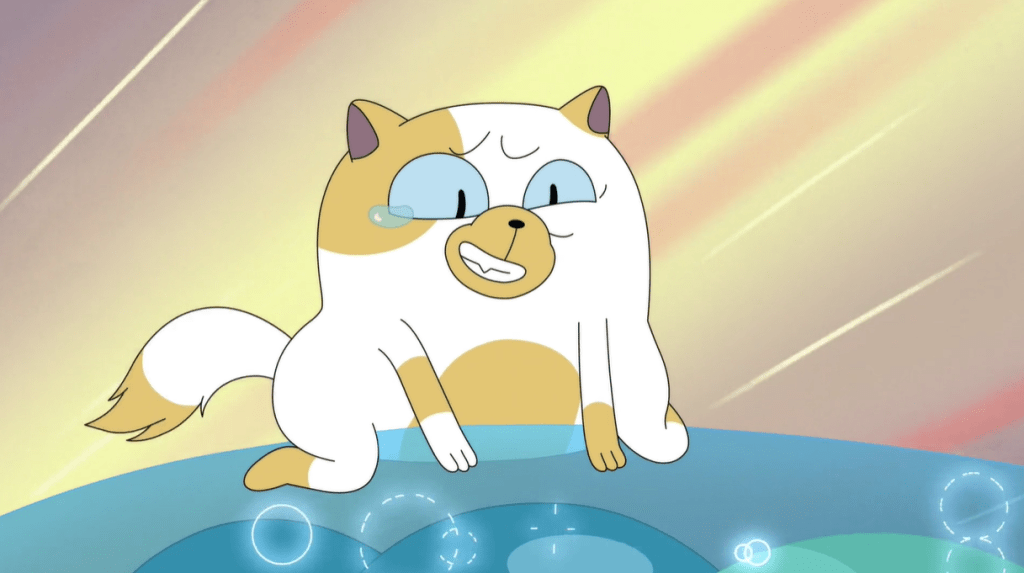
Fionna’s arc moves forward as well, in a way where it’s hard to necessarily make a judgment on what she needs to do from here. I personally think after the last episode it would kind of be interesting to see her friends not forgiving her and her being left with a way to find her own self-worth that doesn’t depend on the validation of those around her, but I’m open to multiple ways of exploring this. I do still like Fionna, and I think she’s still likable despite all of the baggage this season has churned out for her. I’m not really sure how exactly this team is gonna pull it off, so I am intrigued to see if this heads in the direction of redemption or possibly doubles down on the difficulties of change that this season inherited. We get limited exposure to the citizens of Fionna-World, but it did get a bit of a snide laugh out of me how Gary’s repressed memory revolves around him struggling to be responsible with his family when we just saw Finn watch his brother fucking die. Again, being smug, I don’t think suffering necessarily should be weighed against each other, I just couldn’t help but laugh at it. I really like Hunter’s scene, primarily because I don’t think this world has had dialogue all season that ever felt like it emulated a real human conversation. But Hunter very bluntly stating that Fionna needs to “get her shit together” did ultimately hit me in a very real way. Especially with Fionna’s heavy realization that she’s caused Hunter pain in a way that she didn’t even know could be expressed by them. We also get maybe the most explicit revelation of Fionna’s abandonment as a child, which is about as much as I needed to see. With how much this season has gone to great lengths to just reprise character moments that we’ve already seen examined in the original series, this is a nice, small moment that hits because of everything Fionna’s gone through. It’s not just simply connecting it back to her counterpart, it’s using her counterpart’s experience to accurately build into everything she’s feared and grasped onto for so much of this season. Had this been done earlier in the series or even expanded upon in great lengths, I don’t necessarily think it would work with the same emotional weight that its tackled with here. Ellis’s dream also finally plays out, where we get to hear the Venusian citizen’s words: “go beyond the end of the peach.” One idea about what this could mean – Finn’s referred to as a “sad fruit medley,” with the thoughts themselves growing and ripening like fruits. I think the idea here is to go beyond the fruits, or thoughts, themselves to discover the truth. I think Fionna herself has gotten so wrapped up in what she thinks is her intuition, but it’s just her latching onto thoughts that she’s mistaken as wisdom. Thoughts themselves are meaningless unless given meaning, so simply watching them play out as is and doing your best to use your better judgment is ultimately what leads to that truth. We’ll see if this has further implications in the following episode.
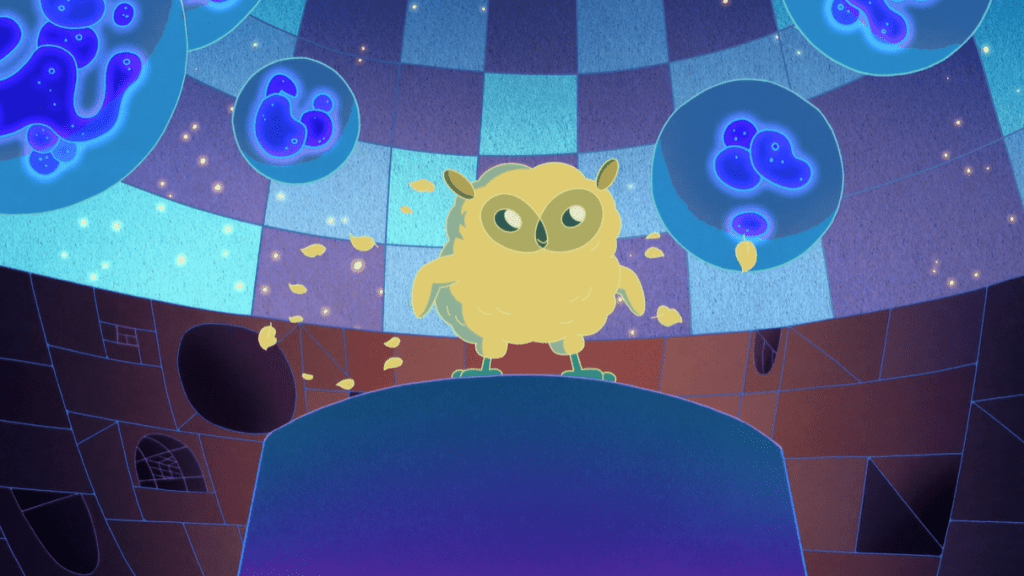
We also get to see the revival of the Cosmic Owl, leading to yet another AT character that beat death. I think many will complain about how short-lived this development was, and how the franchise as a whole seemingly fails to stick to killing off its characters, but I kind of love how finite death as a concept is in the AT world. As the Karmic Worm says, “our kind are like ideas, hard to kill outright.” It’s really neat lore that deities essentially exist based on the belief and thoughts of others, very much in a way that connects to our real world views of gods. And in this sense, we see the thought of Cosmic Owl evolving in real time – he’s gone beyond his role and having had the experience of reconciliation with his brother, he’s ready to move beyond his designated place in the world and become something greater. It’s a really nice way to progress his character in ways that tie back to the episode itself.
We get a brief tangent from Ooo, which made me laugh out loud when the shotgun cocking sound effect plays as PB turns to her last option: calling Minerva. This kinda bothered me at first, because I thought, “oh, NOW you’re calling his mom?” But of course, someone brought up the idea that this is obviously because Minerva will probably advocate for uploading her sons consciousness to the mainframe, which I imagine is something that Finn’s posse, especially PB, are largely against. I’ll be interested to see how much this debate is explored in the following episode, because I think there’s so much you can do with it. With the ever-prevalent concept of AI slowly creeping in to take over the world as we know it, I think there’s a lot you can tackle with this concept that ties back into how we experience this in the real world. Not really sure if they have time to even deal with that, but I’m eager to see it nonetheless.
I really love this one. I feel like there’s so much magic to be had, and aside from The Bird in the Clock, it’s really the first episode all season that made me feel like a kid again. And one of the few that really made me feel anything! Again, it’s not my intention to diminish any contributions of the talented artists that have no doubt worked tirelessly on the rest of this season. Some of which I haven’t even mentioned – the backgrounds in this episode look beautiful, working off of what clearly look like Jesse Balmer’s visual development. I haven’t even properly credited the directors for each episode, this one being Ryan Shannon, which I’m possibly planning to adjust moving forward. But yeah, I can’t deny the chops that Sugar brings to this one. She can’t be solely held responsible, but her segments (lasting from about the 15:10 mark to the 20:50 mark, and I think 7:30 through 8:34?) really reminded me about just how endearing and special this world is. Coupled with a great song, good action, lush landscapes, surprising character cameos, and thematic elements that are just so irresistibly beautiful, this may just be the best episode of this season.
Please, please, please everyone check out The Elephant tomorrow night on adult swim, or next day on HBO Max! It’s an anthology special with Pendleton Ward, Rebecca Sugar, Ian Jones-Quartey, and Pat McHale at the helm, each working on a unique section that none of the others have seen. It’s such a unique experiment and the creative process is so fascinating. You can read more about it here, where McHale is interviewed in length about his experience.
 Adventure Time Reviewed
Are you still planning on reviewing the finale?
LikeLike
Yep! Feeling a bit burnt out from the series, so I’m gonna wait until the energy returns to be interested to talk about it once more. Eventually I’ll return and review the finale, as well as the season as a whole. But for now, I wanna prioritize other projects in the meantime.
LikeLike
Ok great! Thanks for the response.
LikeLike